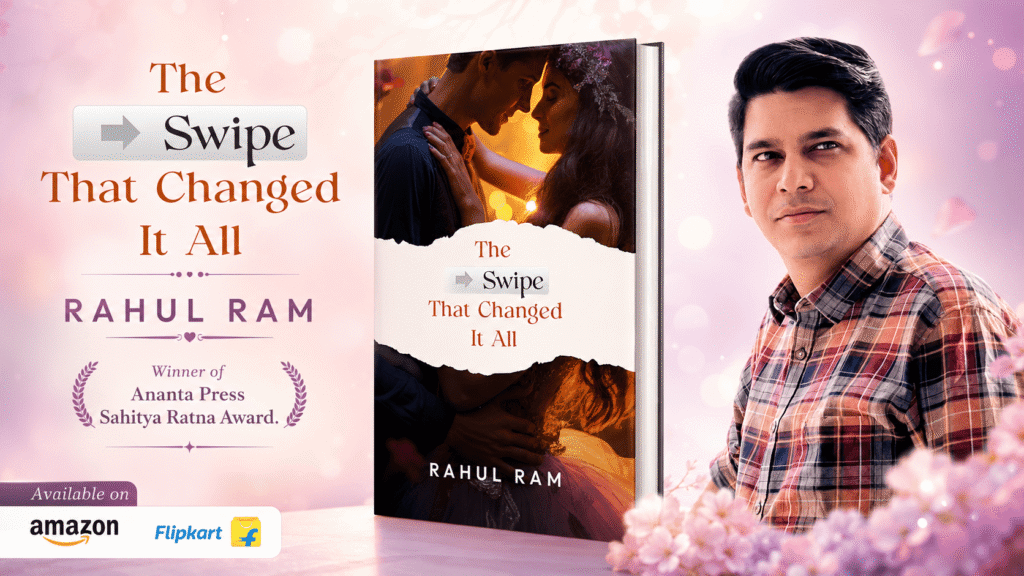
The Swipe That Changed It All by Rahul Ram
Rahul Ram’s The Swipe That Changed It All enters contemporary Indian fiction with an idea that immediately separates it from familiar relationship narratives. The novel combines a love story with a speculative technological invention, placing emotional pain at the centre of both. Vivaan, an inventive genius burdened by the loss of loved ones, designs a machine to remove the sensation of pain. Yet his attempt to escape suffering costs him Aanya, the passionate love who once gave his life meaning. From this premise emerges a story about grief, second chances, emotional responsibility, and the limits of innovation.
One reason the book stands out is that its concept grows naturally from the author’s own world. Rahul Ram was born in Pollachi, lives in Coimbatore, holds an M.Sc. in Software Engineering, and has more than twelve years of experience in digital marketing. His professional life has been shaped by technology, systems, platforms, user behaviour, and rapid change. His creative life has been shaped by books, cinema, and an interest in stories of love, mystery, action, loss, and resilience. The novel brings these two identities together.
This connection matters because technology in the story does not feel like a fashionable addition placed on top of a romance. It is the language through which the protagonist understands his suffering. Vivaan is an inventor, so he approaches grief as a problem that should have a solution. His response is consistent with his identity. He does not merely wish to forget. He builds a mechanism intended to change the experience of pain itself.
The strength of this idea lies in its emotional logic. Grief often creates a desire for control because loss is a reminder of how little control human beings possess. Vivaan’s invention can be understood as an attempt to recover power. If he cannot reverse death or erase memory, perhaps he can control sensation. The novel therefore uses science and technology to express a psychological response to helplessness.
Contemporary Indian fiction has a strong tradition of accessible stories about relationships, heartbreak, ambition, and personal growth. Rahul Ram acknowledges inspiration from writers such as Chetan Bhagat, Sudeep Nagarkar, and Ravinder Singh, whose works brought modern relationships and recognisable emotional struggles to a wide readership. He has also read authors with very different narrative interests, including Amish Tripathi and Agatha Christie. These influences help explain his desire to create a story that is emotionally relatable while also driven by a distinctive central concept.
The Swipe That Changed It All fits within popular relationship fiction, but it also stretches that category. It contains the emotional immediacy of a love story, the moral questions of speculative fiction, and the personal transformation expected from a healing narrative. This combination allows the book to reach different kinds of readers. Someone may begin reading for the romance and become interested in the ethical implications of the machine. Another reader may be attracted by the technological premise and discover that the real story concerns grief and vulnerability.
The title is particularly effective for a novel shaped by modern digital experience. “Swipe” is one of the most familiar actions of the smartphone age. It suggests speed, choice, rejection, acceptance, and transition. It can begin a conversation or end one. It can reveal a new possibility or remove the current one from view. In the novel’s context, the word becomes symbolic of how quickly a decision can alter a life. The gesture is simple, but the consequences are emotional and lasting.
The book’s literary value comes less from technical complexity than from the clarity of its central metaphor. Vivaan’s machine represents the wish to become numb. Many readers will recognise that wish even if they express it differently. People may use work, entertainment, social media, emotional distance, or constant movement to avoid grief. The novel turns that tendency into an invention, making the internal struggle visible and dramatic.
Aanya gives the metaphor its human cost. Without her, the story might become a theoretical discussion about technology. Through her, the reader sees what Vivaan risks losing. He is not only modifying his own relationship with pain. He is changing his capacity for intimacy. The more he treats emotion as a threat, the more difficult it becomes to remain connected to someone who asks for honesty and presence.
This is an important contribution to the book’s message. Technology often promises efficiency, but love is not efficient. Relationships require time, repetition, conversation, patience, and the willingness to remain during discomfort. Vivaan’s project seeks a clean solution to a messy experience. Aanya’s presence reminds him that life cannot always be reduced to a problem with a single correct answer.
The healing theme also gives the novel hopeful appeal. The story is not merely about the destructive potential of obsession. It is about the possibility of understanding what has been damaged and choosing differently. Second chances play a central role, but the concept is treated with seriousness. A second chance is valuable because it is not guaranteed. It requires the characters to face what went wrong rather than hiding behind the intensity of love.
For a debut novelist, Rahul Ram chooses an ambitious emotional subject. Grief can easily become melodramatic if handled only as a source of sadness, while technology can become superficial if used only to make a story appear modern. The premise of The Swipe That Changed It All avoids this separation by making each element necessary to the other. Vivaan invents because he grieves. His invention threatens love because it is built from avoidance. Love becomes the measure by which the success or failure of the invention must be judged.
The novel is also relevant to current discussions about artificial intelligence, digital dependency, emotional technology, and the increasing role of devices in personal life. Rahul Ram has separately written a professional eBook about using AI for digital visibility, showing that he engages with technology in practical as well as imaginative ways. In his fiction, however, he turns from the benefits of technology to its psychological limits. The question is not whether innovation is useful. The question is whether innovation can replace emotional understanding.
This distinction gives the novel a responsible and balanced perspective. It does not need to reject technology in order to defend humanity. Vivaan’s abilities are not presented as meaningless. His intelligence is valuable, but it becomes dangerous when separated from self-awareness. The problem is not invention itself. It is invention without acceptance, ethics, and emotional maturity.
The book may be especially attractive to younger and middle-generation readers who live daily through digital platforms but continue to seek sincere emotional connection. It recognises the vocabulary of the digital world while refusing to believe that human relationships can be managed like interfaces. A swipe can initiate contact, but it cannot create trust. A machine can alter sensation, but it cannot automatically create peace. Data can describe behaviour, but it cannot fully explain love.
Rahul Ram’s journey from a reader and movie enthusiast to a published author also adds an inspiring dimension to the book. He did not begin his professional life as a full-time writer. He built a career in digital marketing, continued reading, carried the ambition to publish, and eventually transformed an idea into a novel. This background may encourage aspiring writers who believe that creative work must begin through a conventional literary path. His example suggests that professional experience can become a source of originality rather than an obstacle.
The Swipe That Changed It All deserves attention as a debut because it is conceptually clear, emotionally relevant, and rooted in the realities of modern life. Its central question is memorable: can love survive the damage caused by a technology designed to protect a person from pain? That question contains the entire emotional paradox of the story. Vivaan wants to stop suffering, yet his method threatens to destroy what could make life meaningful again.
For readers of general fiction, the novel offers an accessible emotional journey. For romance readers, it provides a relationship tested by more than misunderstanding. For readers interested in technology, it creates an ethical thought experiment. For those who have lived through loss, it recognises the temptation to become numb while still arguing for the value of feeling.
Rahul Ram’s first novel marks the beginning of a promising literary journey. It shows an author willing to write from the intersection of his professional knowledge and emotional curiosity. The Swipe That Changed It All is unique because it does not ask readers to choose between a technological story and a human story. It demonstrates that in the modern world, the two are already connected. The real challenge is ensuring that innovation serves life without reducing the complexity that makes life worth living.
Buy the Book on Amazon: https://www.amazon.in/Swipe-That-Changed-All/dp/B0DWXFBFZJ/