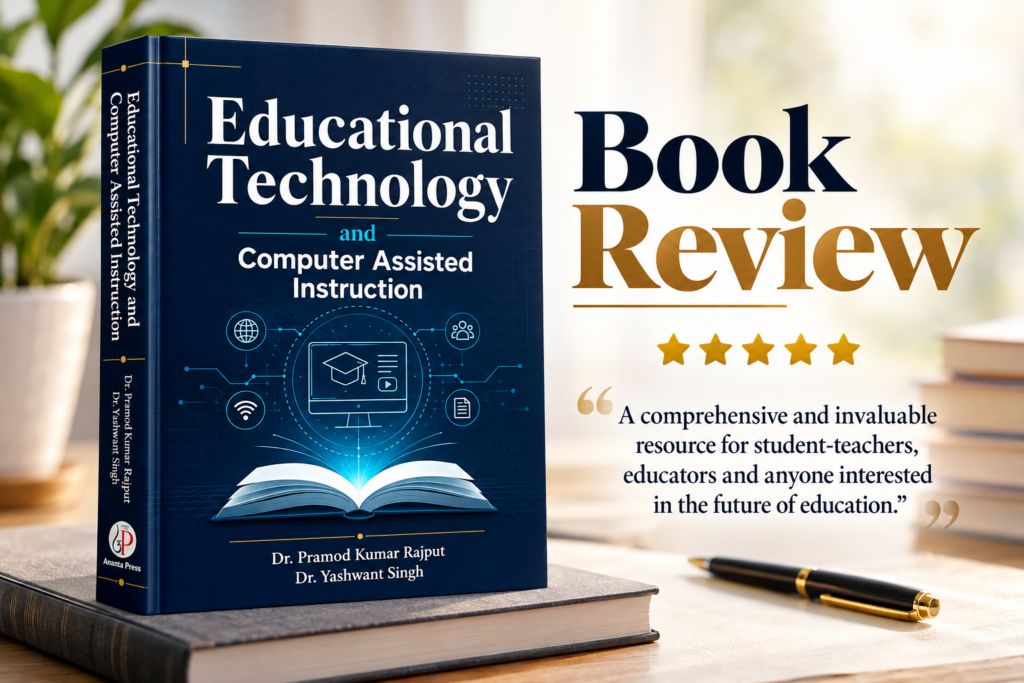
Understanding Education in an Age of Technological Transformation
Education has always evolved alongside human progress, but the increasing influence of digital technology has introduced new possibilities and challenges for teachers and learners alike. The traditional classroom, once primarily dependent on textbooks, blackboards, and face-to-face instruction, now exists alongside virtual learning environments, artificial intelligence applications, digital communication platforms, and interactive educational resources. Understanding these developments has become an important responsibility for modern educators.
Against this background, Educational Technology and Computer Assisted Instruction by Dr. Pramod Kumar Rajput and Dr. Yashwant Singh emerges as a broad academic resource connecting established teaching theories with contemporary technological practices.
The book approaches technology not simply as a collection of electronic devices but as an important component of instructional planning, classroom management, learner development, and educational innovation. Its scope extends from the fundamental concepts of teaching to sophisticated developments involving artificial intelligence, cloud computing, immersive technologies, and algorithm-driven digital platforms.
One particularly valuable aspect of the book is its attention to the relationship between educational objectives and technological applications. Rather than suggesting that technological advancement automatically produces better education, the authors repeatedly return to the importance of effective teaching methods, learner participation, appropriate resources, and meaningful assessment.
This approach makes the publication especially relevant to teacher education, where understanding why and how a particular instructional method works is just as important as learning to operate the technology itself.
A Strong Foundation in Educational Technology
The opening chapter provides an extensive introduction to educational technology, tracing its historical development and examining its meaning, definitions, characteristics, objectives, and scope.
The discussion moves through earlier instructional approaches, including audiovisual teaching aids, teaching machines, programmed instruction, and computer-based learning, before considering more contemporary digital developments.
By placing present-day educational technologies within a historical framework, the book helps readers recognize that technological innovation in education is not an entirely new phenomenon. Instead, it represents a continuing effort to make teaching more systematic, accessible, engaging, and responsive to learner needs.
The authors also examine hardware, software, and systems approaches to educational technology. These distinctions are significant because they encourage readers to think beyond equipment and devices.
A computer, projector, or interactive display becomes educationally meaningful only when its use supports suitable learning objectives and instructional activities. Similarly, the psychological principles underlying instruction remain relevant regardless of the sophistication of the technology employed.
The chapter’s discussion of behaviourism, cognitivism, constructivism, social learning theory, and connectivism provides an additional theoretical foundation.
These perspectives remind readers that educational technology is deeply connected with the ways people acquire knowledge, process information, interact with others, and construct understanding.
Teaching as a Purposeful and Reflective Process
An important strength of the book is that it does not lose sight of teaching itself while examining technological advancement.
The chapters on the concept of teaching, teaching methods and techniques, micro-teaching, and teaching models address the professional foundations upon which effective instruction depends.
Teaching is presented as a planned and purposeful activity involving communication, interaction, preparation, instructional decisions, and evaluation.
This is a particularly useful emphasis for student-teachers who may initially associate educational technology primarily with computers and digital applications.
The discussion encourages them to recognize that the quality of education depends on much more than the availability of modern tools.
A successful teacher must understand the subject, identify learners’ needs, select suitable instructional approaches, communicate clearly, and evaluate learning outcomes.
Micro-teaching receives dedicated attention as an important component of teacher preparation. Its inclusion helps connect educational theory with the development of practical teaching competencies.
For aspiring educators, the opportunity to understand instructional skills through structured practice, observation, and feedback is especially relevant.
The treatment of teaching methods and models also reinforces a valuable professional principle: no single instructional strategy is equally effective in every classroom.
Teachers need flexibility, awareness, and the ability to select methods according to educational goals and individual learning circumstances.
Computer Assisted Instruction and Individualized Learning
Computer Assisted Instruction, commonly known as CAI, forms one of the central subjects of the book.
The authors examine the educational use of computers and distinguish computer-assisted instruction from related applications such as computer-managed instruction.
This discussion reflects a fundamental change in educational thinking. Computers are no longer merely instruments for storing information or preparing documents; they can also support organized instructional activities, learner practice, feedback, and educational management.
One of the important possibilities associated with computer-assisted learning is the ability to accommodate differences among learners.
Students do not necessarily understand concepts at the same speed, respond identically to teaching methods, or require the same amount of practice.
Properly designed instructional programmes can provide opportunities for self-paced learning and repeated engagement with educational material.
The book’s discussion of programmed instruction complements this perspective by examining systematic learning sequences, reinforcement, learner responses, and feedback.
Together, these sections demonstrate how instructional theory and computing technology can contribute to more structured educational experiences.
Importantly, the book also acknowledges limitations associated with computer-assisted learning, including excessive mechanization, distraction, and difficulties in obtaining suitable educational software.
Such considerations make the discussion more balanced and remind readers that technology should support, rather than dominate, the educational experience.
Communication and Information Technology in Education
Effective communication remains essential to successful teaching, whether instruction occurs in a physical classroom or through a digital platform.
The chapters addressing communication and Information and Communication Technology explore the importance of transferring information, supporting interaction, and creating effective learning environments.
The book recognizes ICT as a broad field encompassing hardware, software, networking, information management, and communication systems.
This understanding is particularly useful because digital education involves much more than delivering lectures online.
Modern institutions depend on interconnected technologies for educational resources, administrative coordination, communication, assessment, and collaborative learning.
For teachers, developing ICT competence means acquiring the ability to select and use technological resources appropriately.
For learners, it involves understanding how to locate information, participate responsibly in digital environments, and develop the skills needed for continued education.
The treatment of communication alongside technology highlights an important lesson: sophisticated digital infrastructure cannot compensate for unclear explanations, unsuitable teaching methods, or ineffective learner engagement.
Educational success still depends on the quality of the learning experience.
India’s Educational Satellite Initiatives
A distinctive feature of the book is its inclusion of dedicated chapters on the Indian Satellite System, INSAT, and EDUSAT.
These chapters broaden the discussion beyond conventional classroom technology and examine the role of communication infrastructure in educational access.
In a country as geographically and socially diverse as India, the ability to distribute educational resources across distant locations is especially significant.
Satellite-supported educational initiatives demonstrate how communication technology can help address challenges associated with distance, infrastructure, and the availability of educational expertise.
By including INSAT and EDUSAT, the authors place educational technology within an Indian institutional and developmental context.
This makes the discussion more relevant to readers interested in the relationship between national technological initiatives and opportunities for learning.
The chapters also provide a useful reminder that educational technology is not limited to individual devices or applications.
It includes the wider systems through which knowledge can reach communities, institutions, and learners.
Online Learning and the Growth of MOOCs
The dedicated chapter on Massive Open Online Courses introduces readers to an increasingly important dimension of contemporary education.
MOOCs represent a model through which organized learning opportunities can be delivered to large audiences using digital networks.
The book explains the concept through its defining characteristics, including broad participation, online delivery, structured course content, learning activities, and assessment.
For student-teachers and practising educators, this subject is relevant to the idea of lifelong learning.
Professional development need not end with the completion of a formal degree. Online courses can help educators explore additional subjects, strengthen professional competencies, and engage with new educational approaches.
The discussion of MOOCs also connects naturally with the book’s wider emphasis on flexible and learner-centred education.
However, successful online learning requires motivation, appropriate course design, accessible technology, and consistent learner participation.
The subject therefore encourages readers to consider both the opportunities and the practical conditions necessary for effective digital education.
Artificial Intelligence and Emerging Educational Tools
Among the most contemporary sections of the book are the chapters devoted to educational applications, AI-assisted learning tools, and artificial intelligence.
The authors introduce readers to digital educational platforms and applications, including DIKSHA, ePathshala, SWAYAM, Google Classroom, Microsoft Teams, and generative AI tools such as ChatGPT and Gemini.
This coverage makes the book particularly relevant to educators seeking an introduction to technologies that are increasingly discussed in academic and professional settings.
Artificial intelligence is an especially important subject because it raises questions about content creation, information access, personalized assistance, assessment, academic integrity, and responsible educational practice.
The book’s broader approach encourages readers to recognize both the possibilities and limitations of such tools.
The inclusion of a separate chapter on artificial intelligence in everyday life further demonstrates that technological literacy extends beyond classrooms and educational institutions.
For teachers preparing students to participate in a digitally connected society, understanding these developments is becoming increasingly valuable.
The discussion is best understood as a foundation for further exploration rather than an exhaustive technical examination of artificial intelligence.
Creativity, Cloud Computing, and Immersive Learning
The book also gives attention to practical digital skills through chapters on Canva, cloud computing, virtual reality, and augmented reality.
Canva is presented as an accessible visual communication platform that can assist teachers and learners in developing presentations, infographics, posters, certificates, and other educational materials.
Its inclusion is valuable because effective teaching often depends upon the ability to communicate ideas visually.
Cloud computing introduces another important technological development by examining systems that support digital storage, access, and related computing services.
For educational institutions, such concepts are increasingly relevant to digital resources, collaboration, and technology-supported learning environments.
The chapters on virtual and augmented reality introduce readers to immersive and digitally enhanced experiences.
These technologies offer opportunities to visualize concepts, explore simulated environments, and consider new ways of presenting educational material.
Together, these sections demonstrate the expanding range of tools available to contemporary educators.
They also underline the importance of selecting technology according to educational relevance rather than novelty alone.
Cybersecurity, Social Media, and Responsible Digital Citizenship
One of the more thoughtful dimensions of the book is its recognition that technological education must include responsible use.
The chapters on cybersecurity, social media, and social media algorithms address issues that extend beyond instructional efficiency.
Digital participation requires awareness of privacy, information reliability, online safety, and the influence of platform design.
For teachers and students, such matters are directly connected with academic responsibility and personal wellbeing.
The book discusses the importance of protecting sensitive information, examining sources critically, and managing digital engagement.
Its treatment of social media recognizes that online platforms can support learning, communication, and creativity while also creating opportunities for distraction and misuse.
The inclusion of algorithms adds another dimension by encouraging readers to consider how digital platforms shape the information people encounter.
This is a valuable subject for educators because digital literacy involves not only using technological systems but also understanding their influence on behaviour, attention, and decision-making.
Academic Organization and Practical Reader Value
Structurally, the book covers a considerable range of subjects across twenty-one chapters, followed by a glossary and references.
Its progression from educational foundations to modern technological applications creates a broad learning pathway for readers.
Several sections include learning exercises, multiple-choice questions, and answer keys, which can support revision and self-assessment.
The glossary also provides a useful reference for readers who are developing familiarity with educational and technological terminology.
The book’s principal strength lies in its breadth. It brings conventional instructional concepts and contemporary digital subjects together within a single academic publication.
This makes it potentially useful for B.Ed. and M.Ed. students who need exposure to both theoretical and practical dimensions of educational technology.
At the same time, the wide scope creates certain limitations. Some emerging technologies are introduced at a general level, and readers seeking advanced technical instruction or detailed empirical research may need supplementary sources.
The manuscript would also benefit from careful editorial refinement in places, as some explanations and terminology are uneven.
These considerations do not diminish its usefulness as an introductory and wide-ranging educational resource, but they are worth recognizing when assessing its academic purpose.
Final Assessment: Connecting Educational Foundations with the Digital Future
Educational Technology and Computer Assisted Instruction offers readers a substantial introduction to the relationship between teaching, learning, instructional science, and technological development.
Dr. Pramod Kumar Rajput and Dr. Yashwant Singh have brought together a diverse range of subjects, from teaching methods and programmed instruction to artificial intelligence, cybersecurity, immersive learning, and social media algorithms.
What gives the book particular relevance is its recognition that contemporary educators must understand both pedagogical principles and digital possibilities.
Technology can extend access to knowledge, support individual learning needs, improve educational communication, and introduce new forms of participation. Yet meaningful education continues to depend on professional judgement, human interaction, ethical responsibility, and thoughtful instructional design.
For student-teachers, practising educators, and readers interested in educational innovation, this book offers an informative starting point for exploring these interconnected issues.
Ultimately, its central value is the perspective that educational progress is not achieved merely by introducing new technology, but by using appropriate tools and methods to create more effective, inclusive, and purposeful learning experiences.
In that sense, Educational Technology and Computer Assisted Instruction is a timely contribution to discussions about teacher preparation and the changing future of education.
About the Authors
Dr. Pramod Kumar Rajput
Professor (Dr.) Pramod Kumar Rajput is an experienced academic professional with approximately 19 years of teaching experience in undergraduate and postgraduate programmes. His academic contributions encompass teaching, research, educational leadership, curriculum development, and institutional development. According to his supplied biography, he has published 50 research papers in national and international journals, authored two books, edited four books, and contributed to research supervision and numerous academic programmes.
Dr. Yashwant Singh
Dr. Yashwant Singh is an Assistant Professor in the Department of Education at Shri Rawatpura Sarkar University, Raipur, Chhattisgarh. He holds a Ph.D. in Education and has more than 15 years of experience in teacher education. His research interests include Educational Technology, Teacher Education, and Inclusive Education. His supplied biography records more than ten research papers, one edited book, and experience supervising doctoral researchers.