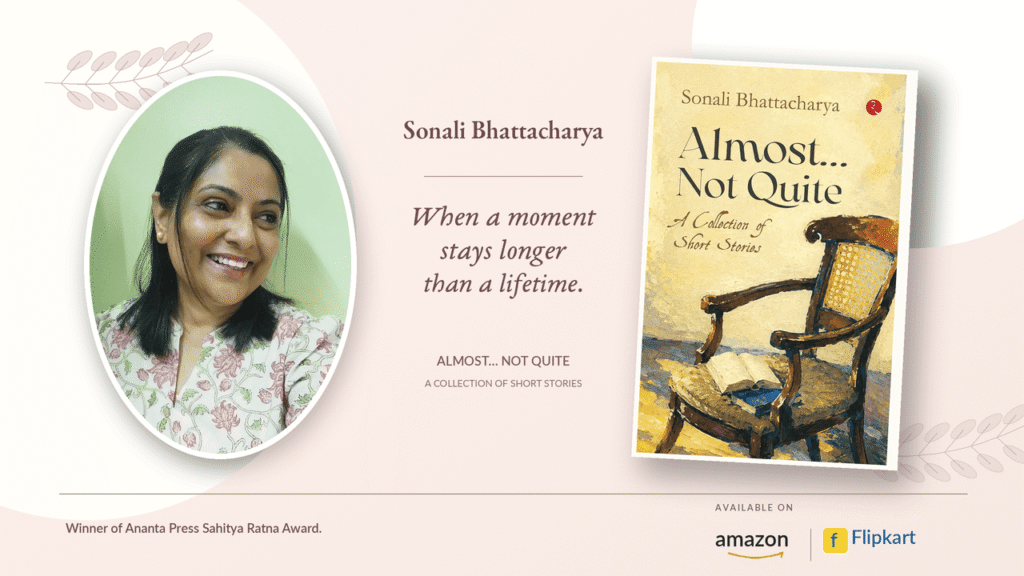
Modern life encourages us to tell our stories through achievements. We describe degrees earned, careers built, cities moved to, responsibilities fulfilled and milestones reached. Even when we speak of setbacks, we often frame them as obstacles on a route toward something demonstrably better. Sonali Bhattacharya’s Almost… Not Quite: A Collection of Short Stories offers a different way of understanding a life. Its twenty-four stories are united by na pawa, the Bengali expression for something longed for but never quite received. The theme proposes that our biographies are not made only from decisions and outcomes. They are also shaped by abandoned plans, unnoticed sacrifices, relationships that never found the right moment and possibilities that continue to matter despite never becoming facts.
This is a particularly relevant idea in contemporary India, where personal aspirations have expanded rapidly while older networks of family, duty and belonging remain deeply influential. The narrative of progress is often told in large terms: new opportunities, changing professions, social mobility, movement between cities and growing independence. Such changes are real, but the emotional consequences of navigating them can be difficult to discuss. What happens when someone makes a sensible choice that still hurts? What if moving forward requires leaving behind a version of oneself that was genuinely loved? And who gets to decide which dreams are practical, responsible or worth pursuing? The book’s premise makes space for these questions without needing to turn them into arguments about whether tradition or modernity is inherently better.
Bhattacharya brings an interesting personal perspective to this territory. She is an engineer trained at Jadavpur University and a technology professional with nearly thirty years of experience, including leadership and transformation work. Those are fields in which people are expected to plan, adapt, measure change and solve problems. Her literary interest moves in another direction: toward human situations that cannot be settled by a decision tree. It is a productive contrast. A professional achievement can be recorded in a résumé, but the emotional cost of a missed possibility usually remains undocumented. A career may thrive while an old attachment quietly persists. The language of accomplishment has little room for the sentence, “I am grateful for my life, but part of me still wonders.”
The collection’s theme is not anti-ambition. In fact, it seems to take aspiration seriously by refusing to pretend that every heartfelt wish can be accommodated by circumstance. To want something and not receive it is not automatically evidence of poor judgment or a weak character. Timing, geography, relationships, age and obligation all intervene. Sometimes the opportunity comes after a person has already built another life. Sometimes it never arrives. Sometimes an individual makes a choice that is appropriate for the needs of a family but painful for a private dream. Literature earns its relevance by examining the human experience hidden behind such familiar decisions. Almost… Not Quite chooses that examination as its central concern.
Its focus on relationships is equally timely. Contemporary discussions of love and friendship often privilege decisive declarations: choose yourself, pursue the relationship, end the relationship, secure closure. Those instructions can be useful in some circumstances, but ordinary emotional life is rarely so orderly. A connection may be significant even if it never becomes a formal relationship. Two people may care for one another and still be unable to create a shared future. A friendship may grow distant without either person meaning to abandon it. In such cases, unfinishedness is not necessarily a failure to communicate or a failure of courage. It may be the product of two changing lives. The book’s announced interest in love remembered rather than completed respects that ambiguity.
There is also a generational dimension to the idea of na pawa. Family members do not inherit only property, traditions and stories of success; they inherit expectations and unfinished wishes. A parent may hope a child experiences a freedom that was unavailable earlier. A younger person may feel gratitude for that hope and discomfort at carrying it. The publisher’s account of the collection includes the image of a journey undertaken by a child in place of a parent, an evocative sign of dreams moving across generations. It prompts a question that many families recognize: when a wish is fulfilled by someone else, has it been completed, transformed or replaced? None of those answers is entirely satisfactory, which makes the question worth exploring in fiction.
The setting in Kolkata and towns across West Bengal helps prevent these themes from drifting into abstraction. The negotiation between individual ambition and collective identity takes place somewhere: around a family table, along familiar streets, in the memory of a neighborhood or through a departure that changes the meaning of home. A place can hold an old version of a person even after that person has changed professionally or socially. Return may be physically possible yet emotionally impossible. Someone can revisit the geography of childhood and discover that the relationships and assumptions that once made it home have shifted. The idea of na pawa is particularly apt for such experiences because the missing thing may not be a location but the time in which that location had a particular meaning.
The way the book is arranged is significant. The Echoes, The Storm and The Harvest correspond to what was never had, what was lost and what can be carried into the future. This sequence complicates the familiar demand for closure. An echo may coexist with a perfectly functioning present; a storm may upset patterns that appeared secure; a harvest may consist of learning rather than receiving what was originally wanted. By organizing the collection this way, Bhattacharya frames emotional change as an ongoing process. People are not obligated to forget their disappointments before becoming capable of joy. Nor must they manufacture a happy ending in order to deserve peace.
The publisher also identifies Tara as a keeper of thresholds who guides the stories’ movement. The threshold metaphor belongs naturally in a book about the tension between possible and actual lives. A threshold is where one thing stops being what it was without yet becoming something else. Modern Indian life is full of such crossings: from home to workplace, one generation to another, local familiarity to global mobility, responsibility to independence, memory to reinvention. Tara’s presence as a framing figure suggests that the collection understands transition not as a brief interruption between stable identities, but as a place where meaningful human experience occurs.
A strength of the book’s concept is that it resists easy prescriptions. One might be tempted to turn na pawa into a self-help message: every missed chance teaches an important lesson, every loss makes us stronger and every unfinished dream should be reframed as a gift. That would cheapen the experience. There are disappointments that do not make a person wiser, losses that remain unfair and opportunities whose absence cannot be compensated. The more mature proposition is simply that people are larger than their outcomes. We can recognize the real cost of what did not happen and still acknowledge the life that developed around that absence. It is that balance, rather than compulsory optimism, which gives the theme its appeal.
The collection should also speak to readers who are tired of treating emotional ambiguity as a problem that must be fixed immediately. The modern world offers endless strategies for increasing productivity and reaching goals; fewer of its dominant narratives teach us how to sit with the fact that some meaningful desires will remain unresolved. Fiction can offer a different form of usefulness. It can slow down judgment, encourage the reader to imagine motives beyond the obvious and make private feelings more discussable. A story need not deliver a solution to make a problem easier to understand. Indeed, a story about an unfinished life may be most respectful when it leaves some questions open.
That said, prospective readers should understand the type of experience the book promises. The collection is described in terms of subtlety, memory, relationships and emotional resonance, not intricate mystery plotting or theatrical conclusions. Those who prefer forceful narrative twists may find its guiding concerns quieter than their usual reading choices. For readers who like to think about the social pressures behind intimate decisions, however, the subtlety is a virtue. The book’s originality lies in treating the missed possibility not as a minor detail of a success story but as a central part of how identity is created.
Sonali Bhattacharya’s earlier fiction, Safety Pin and The Broken Bridge, also reflects an interest in lives shaped by relationships and circumstance. With Almost… Not Quite, that continuing concern is articulated through an especially clear theme. The book addresses not just a Bengali feeling but a widespread modern condition: having more visible options than previous generations while still being unable to live every desired life. It asks whether those unchosen paths become meaningless once we pass them. Its proposed answer is gentler and more complex: the paths not taken may remain part of the way we love, remember, decide and offer possibilities to others.
The best reason to consider this collection is therefore not that it promises to make disappointment disappear. It is that it asks readers to reconsider the categories by which they judge themselves and other people. A life cannot be evaluated only by its completed milestones. The unrealized choices and quietly surrendered hopes matter too, not because they cancel achievement but because they give it depth and context. For readers interested in contemporary Indian society, family expectations, changing identities and the private costs of progress, Almost… Not Quite offers a thoughtful invitation to look beyond the résumé and listen to the story underneath.
Amazon purchase link: https://amzn.in/d/0bpjpD81