Introduction: Understanding AI Beyond the Hype
Artificial intelligence has become one of the most discussed and influential technologies of our time. From business operations and healthcare to education and everyday decision-making, AI is changing how people work, communicate, and solve problems. Yet, despite its growing presence, a fundamental question remains: do we truly understand the technology we are increasingly trusting?
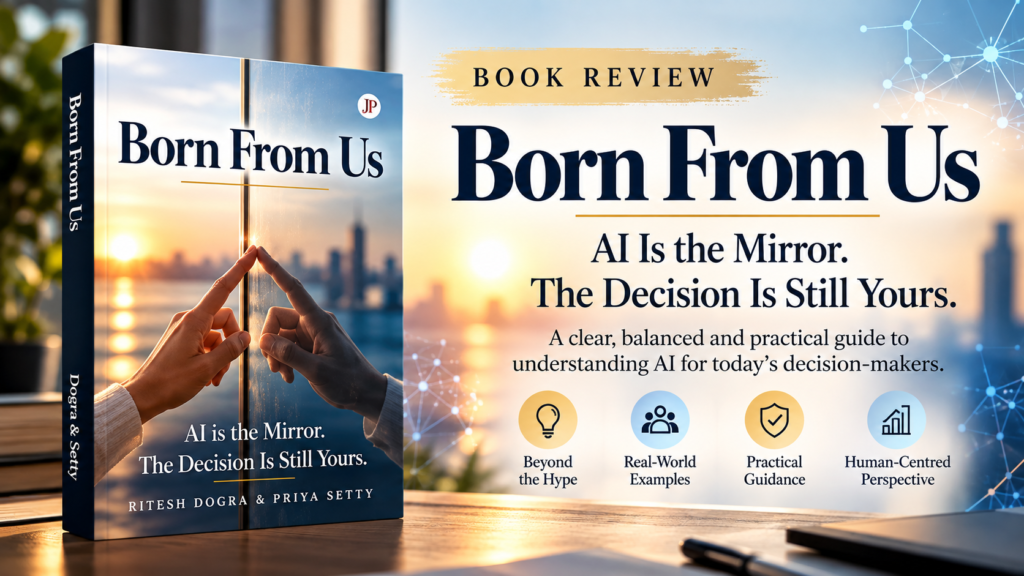
Born From Us: AI Is the Mirror. The Decision Is Still Yours., written by Ritesh Dogra and Priya Setty, approaches this question with remarkable clarity and practical insight. Rather than presenting artificial intelligence as either a miraculous invention or a dangerous force destined to replace humanity, the authors offer a balanced perspective grounded in professional experience, organizational realities, and human responsibility.
The book challenges readers to reconsider their assumptions about AI and recognize that its effectiveness depends not only on technological capabilities but also on the quality of human decisions, data, processes, and oversight.
With twenty-five chapters organized into five thematic parts, Born From Us is an accessible and thought-provoking guide for business leaders, professionals, decision-makers, and curious readers who want to move beyond superficial conversations about artificial intelligence.
AI as a Mirror of Human Intelligence
The Central Philosophy of the Book
One of the book’s most distinctive ideas is its interpretation of artificial intelligence as a mirror reflecting humanity’s collective knowledge, assumptions, strengths, and weaknesses.
The authors explain that AI has not emerged independently of human experience. It has developed through information generated, selected, structured, and interpreted by people. Consequently, artificial intelligence inevitably carries traces of the decisions and limitations embedded in its development.
This perspective creates an important shift in how readers understand technological responsibility.
Instead of treating an AI-generated response as unquestionable authority, the book encourages readers to examine the information, assumptions, and processes that contributed to that response.
The mirror metaphor is particularly effective because it makes a complicated subject understandable without requiring advanced technical knowledge. It also highlights a larger truth: technology may significantly expand human capabilities, but it does not automatically eliminate human weaknesses.
The authors acknowledge the limits of the metaphor, recognizing that AI can combine information and identify patterns in genuinely new ways. This willingness to qualify their central argument adds credibility to the discussion.
Breaking Down Common Misconceptions About AI
Moving Beyond Fear and Blind Optimism
Public conversations about artificial intelligence frequently move between two extremes. Some individuals imagine AI as an almost limitless intelligence capable of resolving every problem. Others regard it with suspicion, fearing that its increasing capabilities will undermine human expertise and decision-making.
Born From Us refuses to accept either position unquestioningly.
Instead, the authors explain why AI should be assessed according to its actual capabilities, intended applications, limitations, and operating conditions.
A particularly valuable discussion appears in the book’s examination of different technologies grouped under the broad term artificial intelligence.
By distinguishing between rules-based systems, classical machine learning, deep learning, and generative AI, the authors demonstrate how misleading it can be to discuss every automated or intelligent system as though it operates identically.
This distinction is especially relevant for organizations evaluating new technologies. A system generating written content presents different risks and requirements from a model evaluating medical images or supporting financial decisions.
The book therefore encourages leaders to develop a more precise understanding of the tools they intend to adopt.
The Human Element Behind Artificial Intelligence
Why Judgment Cannot Be Fully Automated
One of the strongest aspects of Born From Us is its consistent emphasis on human judgment.
The authors challenge the assumption that automation necessarily produces better decisions. They explain how AI can generate impressive results while still relying on incomplete information, unclear objectives, or inadequate organizational processes.
The discussion becomes particularly compelling when the authors examine how repeated dependence on automated assistance may weaken professional knowledge.
AI can undoubtedly increase productivity, but the ability to obtain an answer quickly is not equivalent to developing a deep understanding of the problem.
This distinction matters in professional environments where employees must evaluate evidence, recognize unusual circumstances, and take responsibility for consequential decisions.
The book also questions whether traditional approaches to human oversight are sufficient. Simply placing a person somewhere in an automated workflow does not guarantee meaningful supervision.
That person must possess the knowledge, authority, time, and information required to identify problems.
Through these discussions, the authors make a persuasive case that responsible AI adoption requires stronger human capabilities rather than their gradual abandonment.
Real-World Relevance and Practical Examples
Lessons From Healthcare and Life Sciences
The professional backgrounds of Ritesh Dogra and Priya Setty contribute sig