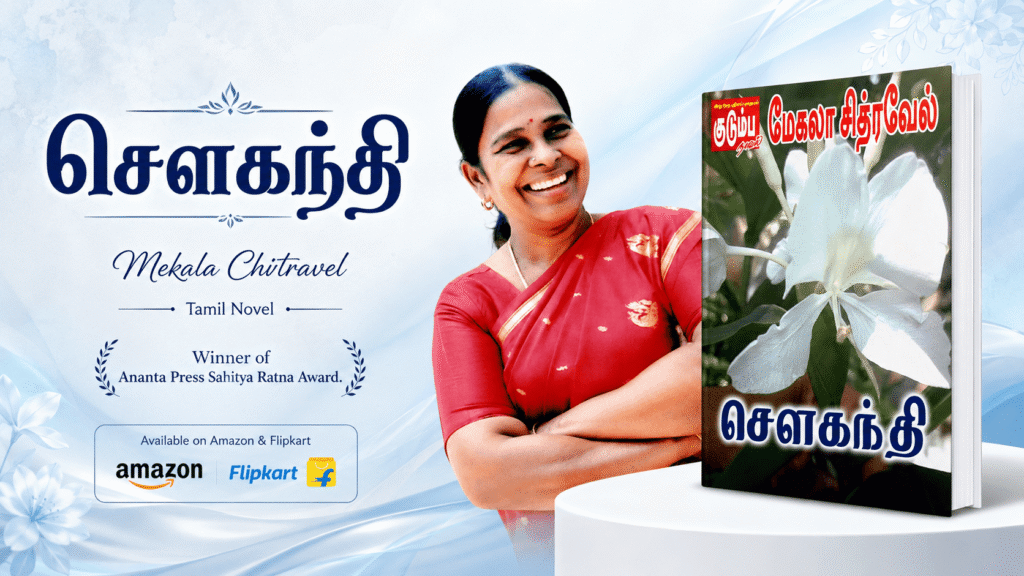
There is a reason stories about parents and children never become outdated. Technology changes, careers change, cities expand, and lifestyles become more complicated, but the emotional questions inside a family remain surprisingly constant. Do our parents feel remembered? Do children understand what was done for them? Can love survive the transition from childhood dependence to adult independence? Sowganthi, a Tamil novel by Mekala Chitravel, is built around these enduring questions through the affectionate relationship between a mother, Sowganthi, and her son, Rishi. Its premise is simple, but that simplicity gives the book the ability to speak to readers of very different ages.
For younger readers, the novel can function as a gentle lesson in perspective. Children naturally experience parents as providers of food, guidance, discipline, comfort, and security. It can take years to realise that a mother is also a person with her own emotional needs. She may worry about being forgotten, fear becoming dependent, or simply long for the warmth that she once gave so freely. Rishi’s care for his mother offers younger readers a model of what growing up can mean. Maturity is not merely earning, achieving, or making one’s own decisions. It also includes learning to notice the people who spent years noticing us.
For adults in the middle of busy careers and family responsibilities, the book’s message may land differently. This stage of life often creates a painful shortage of time. People may be caring for their own children while also watching their parents grow older. Love remains, but attention becomes fragmented. In such a situation, a story like Sowganthi becomes a reminder that affection cannot live entirely in intention. We may say, “Of course I love my mother,” but the real question is whether she experiences that love in the form of time, conversation, respect, and care. Rishi’s example invites readers to make love visible.
For older readers and parents, the novel can touch an even more intimate emotional place. The phrase “lucky mother” used to describe Sowganthi says a great deal. A parent may spend decades putting children first without knowing what the relationship will look like later. Will the children call? Will they listen? Will they remain patient when age slows the parent down? Will they continue to include the person who once included them in every decision? Sowganthi’s good fortune lies in receiving a positive answer to these questions through Rishi. That can make the novel reassuring, hopeful, and emotionally satisfying.
This intergenerational quality is one of the book’s strongest features. A story does not need a complex plot to produce complex feelings. In fact, the more familiar the relationship, the more personal the reader’s response can become. Almost everyone has some history with a mother figure, whether joyful, difficult, incomplete, or deeply missed. Because of that, the book’s theme acts like a mirror. Readers may not only think about Sowganthi and Rishi; they may begin thinking about their own homes, conversations, regrets, and expressions of gratitude. That movement from fictional characters to personal reflection is often what makes a family novel memorable.
The title adds an appealing cultural dimension. Sowganthi is described as a divine flower associated with the Mahabharata, the heavenly flower brought by Bhima for Panchali. This is a beautiful choice because a flower is both delicate and powerful as a symbol. It can represent love, memory, beauty, and something given as an offering. In the context of the novel, the image can be associated with the mother herself, whose presence gives emotional fragrance to the family, or with the care that Rishi gives her. The Mahabharata connection also makes the title distinctly rooted in Indian cultural memory, giving the book an identity beyond a generic family drama.
I particularly like how the sacred image and the domestic theme can coexist. Indian storytelling has long moved comfortably between the epic and the everyday. Great ideas about duty, affection, sacrifice, and loyalty do not remain confined to ancient heroes; they reappear in ordinary households. Sowganthi reflects that continuity. The divine flower from an epic becomes a way of thinking about love between a mother and son. It reminds us that devotion is not always performed in extraordinary circumstances. Sometimes it looks like caring for an ageing parent, listening without irritation, or making someone feel that they still belong.
Mekala Chitravel’s background makes the book even more interesting as a reading experience. She has completed one hundred books in Tamil across an unusually broad range of subjects: novels, children’s books, cookery, folk stories, spiritual literature, a life history of Indira Gandhi, works on kolam, and eleven books about MGR. Few writers sustain that level of productivity without developing a strong understanding of audience. Writing for children is different from writing about spirituality; biography demands different skills from fiction; cookery writing depends on clarity and usefulness. Her career suggests adaptability as well as commitment to Tamil readership.
She is also an educator with M.A., B.Ed., and Ph.D. qualifications, and she ran a matriculation school where hundreds of students were educated. Many of those students have gone on to good positions. This is relevant because educators spend their lives watching generations change. They see children’s dependence, adolescence, ambition, and adult growth. They also interact with parents who invest enormous hope in their children. That experience can give a writer a particularly deep awareness of what family expectations mean over time.
Her public life as a stage debater and storyteller adds another dimension. Nearly a thousand stages represent not only confidence but repeated contact with audiences. A speaker learns quickly that people connect with clear human truths. The theme of Sowganthi has exactly that quality. It does not require explanation before it can be felt. A mother’s wish for love and a son’s decision to care for her are emotionally legible from the beginning. This directness is likely part of the book’s appeal.
The author’s literary standing is also indicated by the fact that three students from different universities have completed Ph.D. research on her novels. Academic study does not automatically make a book enjoyable, but it does show that a writer’s body of work has enough substance, social context, or literary significance to invite sustained examination. Sowganthi therefore sits within a broader career that has both popular and scholarly dimensions.
What makes the novel different from many family stories is its positive centre. Fiction often uses the family as a source of trauma, secrets, betrayal, or conflict because those elements create immediate drama. Sowganthi is interested in something quieter: the fulfilment of a mother’s emotional hope. This creates a different kind of tension and reward. Instead of asking whether a relationship will collapse, the book asks readers to appreciate what it means when love is preserved. That is valuable because healthy relationships also deserve representation. Goodness can be narratively meaningful when the reader understands how much it matters.
The story’s core also has practical relevance. It can inspire readers to act, not just feel. A person may finish the book and decide to speak more gently to a parent, call them more often, spend time with them, or express gratitude directly. That possibility gives the novel social usefulness without turning it into a self-help manual. Fiction works through identification. We care about a relationship on the page, then notice a similar relationship in our own life.
Sowganthi is therefore a book I would recommend especially to readers who enjoy emotionally sincere fiction, stories centred on family values, and Tamil writing with a clear cultural foundation. It is suitable for readers who prefer warmth over sensationalism and reflection over excessive complication. Its divine-flower symbolism gives the title elegance, while the mother-son bond gives the book universality. Most importantly, it treats care as something worth celebrating. In an age where everyone is busy proving how independent they are, Sowganthi quietly reminds us that remaining connected to those who loved us first is also a form of strength.Amazon Purchase Link: https://www.amazon.com/%E0%AE%9A%E0%AF%8C%E0%AE%95%E0%AE%A8%E0%AF%8D%E0%AE%A4%E0%AE%BF-Tamil-Megala-chitravel-ebook/dp/B08QHXX1YX/ref=sr_1_1?crid=14UCY7JUZSG76&dib=eyJ2IjoiMSJ9.T9HpY4IwtsVh4EPOLSOJOw.elPq1AOHf0OkGkPQwJUvaX8h39c6ftPIQISOfgKV5A4&dib_tag=se&keywords=megala+chitravel&qid=1779947276&s=books&sprefix=megala+chitravel%2Cstripbooks-intl-ship%2C366&sr=1-1