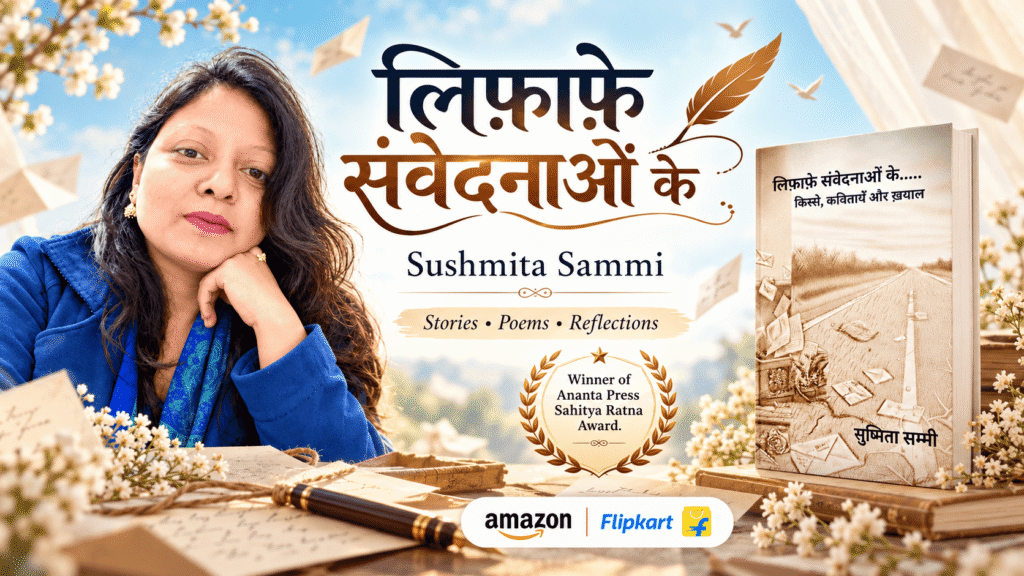
Book: लिफ़ाफ़े संवेदनाओं के — किस्से, कविताएँ और ख़याल | Author: Sushmita Sammi
Some books are chosen for the speed of their plots; others are kept nearby because they suit the changing pace of a human life. लिफ़ाफ़े संवेदनाओं के by Sushmita Sammi belongs, in intention, to the second category. Introduced as a Hindi collection of stories, poems, and reflective thoughts, it revolves around feelings that readers may recognise without being able to name immediately. Love, hurt, remembrance, faith, hope, and the effort to begin again are not specialist subjects. They are part of ordinary living, though people differ greatly in how openly they discuss them. The collection’s appeal is that it treats these experiences as worthy of patient attention. Rather than demanding a single continuous reading experience, its mixed form suggests a book readers can enter according to their own circumstances and return to when those circumstances change.
What makes a book feel companionable?
Emotional companionship in literature does not mean that a book can replace relationships or solve every difficulty. It means that language can occasionally create the sense of being understood. A reader may encounter an idea that makes an old thought clearer, or a description that shows a private feeling is not entirely unique. The supplied account of Sammi’s writing makes this intention explicit: she wants people who feel alone to find recognition through words. That purpose is an important part of the book’s identity. Its emphasis on sensitive expression is not simply a preference for sad or romantic topics; it reflects a belief that reading can foster connection even when writer and reader never meet. Such connection is modest, but it can be meaningful.
The proposed combination of literary forms supports this companionable quality in several ways. A poem can be encountered in a small window of time. A story can create the emotional distance needed to think about a difficult relationship without approaching it directly. A reflection can be read slowly, leaving room for the reader’s own questions. This variety matters because attention is not constant. The same reader who enjoys an extended narrative on a weekend may seek only a brief page after a demanding day. A collection of short and varied forms can respect that uneven rhythm. Its usefulness lies not in supplying a fixed programme but in offering choices about how closely, and how long, to engage.
The value of approachable language
Literature concerned with personal pain can become distant when it relies too heavily on elaborate abstraction. Readers often come to such writing with lived experiences that are already complex enough. The book’s description emphasises simplicity and emotional immediacy, positioning it as accessible to people who may not consider themselves habitual readers of poetry. This is a significant reader-facing quality. Approachable language can lower the threshold of participation, allowing a poem or thought to be shared, discussed, and remembered beyond the small circle of literary specialists. That does not guarantee artistic success—simplicity still requires precision—but it identifies an appealing ambition: to welcome readers before asking them to reflect.
Hindi strengthens that welcome for readers whose strongest emotional vocabulary lives in the language. Some experiences are easiest to recall in the words through which we first encountered them. Family conversations, childhood phrases, familiar terms of affection, and customary ways of expressing sorrow can give Hindi emotional literature a distinctive immediacy. Even the book’s title feels like an invitation to open a personal message. This matters in a reading culture where people often encounter professional information in one language and private emotions in another. A collection rooted in familiar Hindi words may offer a gentle route back to the language of intimate thought.
A reading experience shaped by the reader
There is no single proper way to approach a book of emotional fragments. One person might read it from beginning to end in order, tracing changes in mood. Another might choose a few pages at random, guided by curiosity. A third might pause after each piece, allowing memory to answer the writing. The presence of stories, poetry, and khayal makes all these methods plausible. A flexible reading design is an often-overlooked virtue, especially for adults balancing work, family, and interruptions. A book does not become less serious because it can be read in short intervals. Sometimes short intervals allow a thought to travel further into daily life than a hurried continuous reading would.
This is also a collection whose central metaphor can prompt an active response. An envelope suggests words stored, withheld, delivered, and rediscovered. Readers may find themselves remembering a letter never posted, a message saved on a phone, or a sentence that should have been spoken. Those associations are not contents one should invent for the book; they are possibilities opened by its title and described themes. They show how a literary idea can continue beyond the printed page. A worthwhile reflection often gives the reader something to do inwardly: not an assignment, but a question that follows them into the ordinary world.
Comfort without pretending that pain is simple
Books about healing sometimes fall into the trap of implying that suffering is valuable simply because it can later be described beautifully. Sammi’s stated creative philosophy is more promising when understood carefully. Her profile speaks of acknowledging pain without glorifying it and of presenting strength without making the process appear effortless. This distinction matters. Pain does not become desirable because it inspires art. Rather, expression can help a person recognise an experience that would otherwise remain difficult to communicate. For a collection about emotion, that is a more humane starting point than any promise of instant transformation. It leaves readers free to feel what they feel without requiring a triumphant ending.
The book’s attention to hope, faith, and renewed courage adds balance to this orientation. Emotional writing need not choose between darkness and cheerful certainty. The more interesting space often lies between them, where a person can acknowledge disappointment while retaining the possibility of change. The notion of beginning again is particularly relevant here: beginnings are rarely clean breaks from the past. Often they happen while memories remain vivid and questions unanswered. Literature that makes room for that unfinished quality can feel truer to readers’ lives than writing that treats recovery as a straight line. The described thematic range of this collection points toward such an understanding.
Readers who may find it meaningful
The strongest audience for Lifafe Samvednaon Ke includes people who appreciate introspective Hindi writing, those who enjoy poetry in conversation with prose, and readers seeking language for personal experiences. It may also interest people who usually prefer short narrative pieces but are curious about reflective verse. Its intergenerational subject matter is another point in its favour. The emotions associated with the book can be interpreted through youthful hope, adult responsibility, or later-life remembrance, and the collection’s accessible intention gives these readers a common point of entry. Its pleasures are likely to be quieter than those of a mystery or an action-driven novel, but quiet reading can be a deliberate and rewarding choice.
It is important, however, not to confuse this kind of literary companionship with therapeutic advice. A poem can express loneliness powerfully without diagnosing it. A reflection can offer consolation without becoming a treatment plan. The book is presented as literature, and its most compelling value belongs to that domain: the way words can articulate experience, widen empathy, and make private responses available for consideration. In an age of constant recommendations and quick solutions, writing that permits uncertainty can itself feel refreshing. A reader need not agree with every sentiment to benefit from having space to consider it.
An invitation rather than a demand
The distinctive achievement suggested by the book’s concept is its hospitable attitude to feeling. Its envelope metaphor encourages the reader to imagine emotional contents, while its combination of forms makes several kinds of reading possible. These qualities are grounded in the supplied cover and description; without access to the complete collection, judgments about the execution of particular poems and stories would be premature. Even with that necessary distinction, the intention is clear and appealing. Sushmita Sammi has conceived a book for the reflective pauses that ordinary life too rarely protects. लिफ़ाफ़े संवेदनाओं के offers the idea that words can meet us in different moods, at different ages, and under different circumstances. Its promise is not to have the final answer to a reader’s pain or joy. It is to keep the conversation open.AMAZON PURCHASE LINK: https://www.amazon.in/dp/8199672064