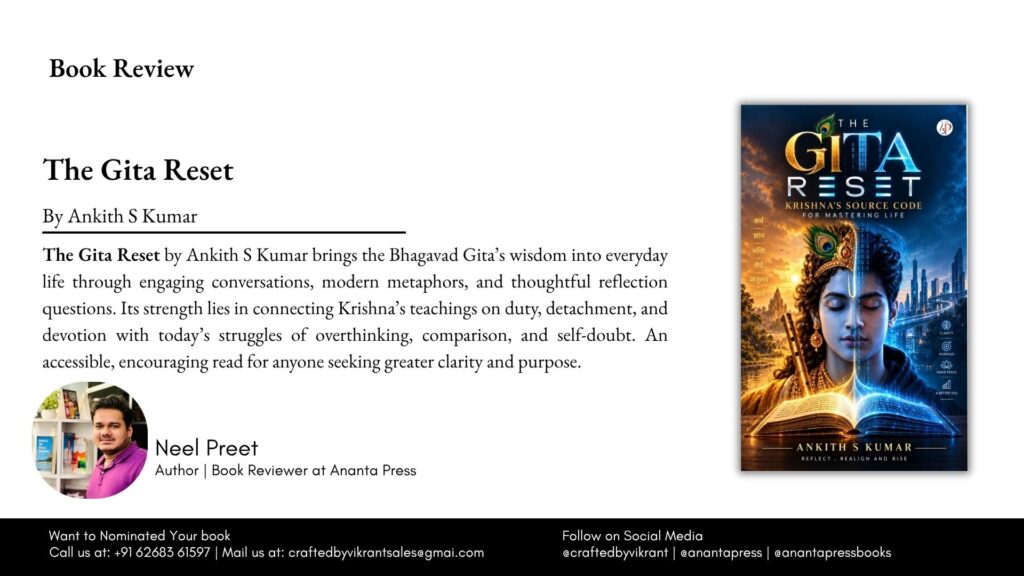
Ankith S Kumar brings ancient wisdom into everyday life
The Gita Reset by Ankith S Kumar offers an inviting introduction to the Bhagavad Gita for readers who find traditional spiritual writing difficult to approach. Subtitled Krishna’s Source Code for Mastering Life, the book retells the conversation between Krishna and Arjuna through contemporary language, familiar situations, and questions for personal reflection. Its greatest strength is its ability to make an ancient dialogue feel emotionally close. By connecting spiritual ideas with career pressure, overthinking, social comparison, and uncertainty, Kumar gives readers a practical reason to engage with the Gita and consider how its teachings might influence their daily choices.
The book begins with a persuasive observation: the Gita opens with a capable person becoming overwhelmed. Arjuna’s distress provides the emotional foundation for Kumar’s interpretation. He presents the warrior’s hesitation as a struggle that modern readers can recognise in themselves, particularly when responsibility conflicts with affection, fear, or personal expectations. This approach gives the narrative an accessible point of entry. Readers do not need to feel spiritually accomplished before beginning. Confusion itself becomes a reason to listen, and the search for clarity becomes a process that unfolds through conversation rather than through a lecture delivered from a distance.
Kumar’s treatment of vulnerability is one of the book’s most appealing qualities. Arjuna’s breakdown receives attention because it exposes the limits of outward confidence. Someone may appear successful and still feel unable to face an important decision. The author connects this experience with examinations, interviews, family expectations, and the effort of pretending to be fine. These examples establish a compassionate tone and help younger readers understand why the opening chapter matters. The narrative makes room for admitting uncertainty, asking for guidance, and examining emotions before deciding what action a difficult situation requires.
The structure supports this approachable style. Each of the eighteen chapters is organised around a particular reset, describing a movement in understanding or behaviour. Short explanations, imagined exchanges, summaries, and reflection questions keep the reading manageable. Sections titled Your Modern Kurukshetra connect the chapter’s ideas with present concerns, while selected shlokas, transliterations, and meanings provide points of contact with the original scripture. This recurring pattern gives the book continuity. Readers can follow the complete journey or return to a chapter that speaks to a current difficulty, such as distraction, emotional exhaustion, attachment, or loss of direction.
Its most distinctive stylistic choice is the use of digital metaphors. The mind becomes a system that needs attention; habits resemble an algorithm; spiritual understanding is described through source code, connectivity, and resetting. These comparisons make abstract subjects easier to picture for readers familiar with screens and technology. They also give the writing a playful, conversational energy. The tone sometimes resembles an informal exchange with a supportive mentor. This will especially appeal to readers who want a friendly first encounter with spiritual thought and appreciate explanations that begin with experiences already present in their lives.
The discussion of karma yoga forms a particularly useful part of the book. Kumar repeatedly asks readers to examine their relationship with results. Studying, working, creating, and caring for others become opportunities to consider whether effort is driven by purpose or by a need for recognition. His interpretation encourages committed action while loosening the emotional grip of applause, rewards, and approval. This distinction has clear relevance in a culture where achievement is constantly displayed and compared. The chapters invite readers to remain responsible for their effort without allowing every outcome to determine their sense of worth.
The book also handles detachment in a way that makes it relevant to ordinary responsibilities. Kumar associates spiritual growth with the attitude a person brings to work and relationships. Everyday roles remain part of the discussion: students, teachers, parents, and professionals can all practise greater awareness. This makes the book’s message practical because readers can reflect within their existing circumstances. Its account of inner balance encourages them to notice how strongly praise, disappointment, success, and criticism govern their mood. The value lies in the invitation to respond more thoughtfully while continuing to participate fully in life.
The chapter on meditation extends this emphasis on participation and practice. Presented as a mental workout, meditation involves steadiness, attention, and gently returning a wandering mind to its focus. The author’s preference for consistency makes the subject less intimidating. He connects it with notification overload, restless thinking, and difficulty spending time in silence. These observations fit naturally with the book’s intended audience. The chapter encourages readers to take their attention seriously and recognise the influence of repeated habits. Its accessible explanation gives beginners a useful starting point for thinking about discipline and the quality of their inner life.
Another thoughtful strand concerns identity. Through the distinction between the field and its knower, Kumar invites readers to question whether their thoughts, social image, achievements, and failures provide a complete account of who they are. This section gives the book more depth than its casual vocabulary might initially suggest. It encourages observation of experience and reflection on the self that witnesses change. For readers accustomed to defining themselves through performance or labels, these questions can be absorbing. They also connect the earlier discussions of anxiety and attachment with a broader spiritual enquiry into awareness.
The exploration of the three gunas develops this enquiry through a memorable account of clarity, restlessness, and inertia. Kumar uses everyday comparisons to help readers recognise patterns in their energy and behaviour. The practical emphasis falls on what they repeatedly consume, encourage, and practise. Readers are asked to consider which habits support peace and which increase agitation or dullness. This is an effective use of the book’s reflective format because it turns a philosophical classification into a prompt for self-examination. The discussion works best when approached as a spiritual framework for reflection, with space for the complexity of individual experience.
Devotion receives substantial attention throughout the later chapters. Kumar presents bhakti through sincerity, compassion, gratitude, and connection, making it approachable for readers who associate spirituality mainly with formal ritual. The emphasis on beginning from one’s present circumstances gives these chapters warmth. A reader does not have to appear perfect to reflect on faith or develop a more generous way of living. The writing also connects devotion with conduct: kindness, forgiveness, and humility matter in everyday interactions. This relationship between belief and behaviour helps the book maintain a meaningful connection between spiritual feeling and personal responsibility.
The Vishwarupa chapter stands out because its descriptive style becomes more expansive and dramatic. Images of galaxies, overwhelming light, creation, and destruction communicate Arjuna’s encounter with something beyond his familiar understanding. The change in tone gives the book a memorable narrative centre. Kumar uses this scene to explore humility and the limits of control, inviting readers to place their concerns within a larger perspective. It adds a sense of wonder to a book otherwise grounded in daily pressures and serves as a reminder that spiritual enquiry can involve awe alongside practical guidance.
The questions at the end of chapters are among the book’s strongest features. They ask readers to identify fears, attachments, habits, and motivations rather than merely agree with uplifting statements. Questions about seeking approval, avoiding responsibility, feeding distraction, or confusing attention with love encourage active engagement. Their usefulness depends on a reader’s willingness to pause and answer honestly, but the opportunity is clearly provided. They can also support journaling or thoughtful conversation. By repeatedly bringing the discussion back to the reader’s own choices, Kumar gives the book a reflective function beyond its retelling of the narrative.
There are limits to this approach. The frequent slang and technology references may feel too casual for readers who prefer the dignity and precision of traditional commentaries. Some philosophical distinctions are compressed into short, memorable statements, and repeated themes occasionally reduce the sense of progression. Readers seeking detailed verse analysis or sustained discussion of different interpretations will need further reading. The author acknowledges the book’s role as a conversational adaptation and encourages engagement with the original Gita. Judged within that purpose, its accessible style makes sense, though it will suit some reading preferences more comfortably than others.
The author’s counselling background helps explain the attention given to emotional struggles and questions of meaning. His interest lies in helping people recognise themselves in Arjuna’s uncertainty. That intention gives the adaptation a clear audience and a consistent emotional purpose. Its informal presentation can encourage hesitant readers to begin a conversation with spiritual ideas that previously seemed remote from their everyday concerns.
Overall, The Gita Reset succeeds as a warm, readable invitation to explore the Bhagavad Gita’s relevance to contemporary life. Its blend of conversation, metaphor, and reflection offers younger readers a welcoming place to begin. Kumar’s strongest contribution is connecting questions of action, identity, devotion, and inner balance with experiences that readers already understand. The book encourages them to examine how they live, what they value, and where their attention goes. For those seeking an approachable spiritual read that prompts personal reflection, it offers encouragement while opening a path towards deeper study of the scripture that inspired it.