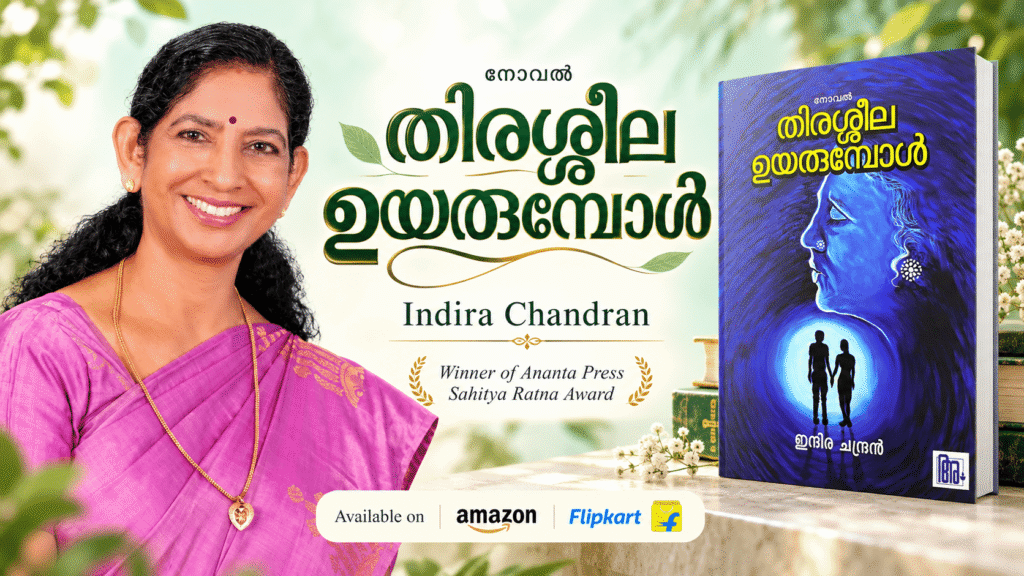
Book: Thirasseela Uyarumbol (തിരശ്ശീല ഉയരുമ്പോൾ) Author: Indira Chandran
The modern vocabulary of success is often individual. People speak about independence, personal advancement and the right to create a life on their own terms. Those are important aspirations, but they do not exhaust the human experience. Thirasseela Uyarumbol, Indira Chandran’s novel set in early twentieth-century North Kerala, directs attention toward a question that is both older and newly urgent: how do people live well together? The family of Lakshmikkutty, a young Hindu Nair woman married at an early age, provides the starting point. The novel’s description emphasizes the ability to keep a joint family united, preserve a supportive marriage and maintain neighborly relationships through the demands of everyday life.
The central theme is not simply family affection but family organization. Love does not eliminate differences of opinion. A shared household may bring together people at distinct stages of life, each with expectations about money, privacy, work, recognition and authority. A disagreement that looks trivial in isolation can become deeply personal when it is repeated over time. Maintaining unity therefore requires social intelligence: the ability to understand competing needs without assuming that one person’s discomfort is automatically another person’s wrongdoing. Lakshmikkutty’s success in navigating complicated situations suggests why she occupies the center of this account. Her role gives the book a practical moral dimension.
A joint family is sometimes imagined either as a perfect sanctuary or as an unavoidable source of conflict. The more interesting position lies between those extremes. Living together can offer shared resources, intergenerational care and a strong feeling of security, but it may also demand sacrifices of space, autonomy and convenience. Chandran’s stated interest in avoiding disputes invites readers to ask what makes collective living constructive rather than suffocating. The answer cannot be the suppression of every disagreement. Lasting harmony depends more plausibly on fairness, consideration and the willingness to solve problems before resentments harden. This tension gives the subject relevance well beyond the period of the story.
Lakshmikkutty’s limited formal education is significant within this framework. Formal study may provide knowledge, but the ability to sustain a group of people rests on other forms of learning as well. Some of those skills are acquired through observation and experience: recognizing a person’s unspoken concern, mediating a misunderstanding or choosing the right moment to discuss a sensitive issue. The synopsis describes Lakshmikkutty as running her family with dignity despite difficult circumstances. Such dignity should not be confused with mere politeness. It implies a steadier way of holding responsibility, one that allows individuals to feel respected even when life is demanding.
The husband contributes an equally essential part of the social design. Employed in the Railway Department, he is described as devoted to the family and supportive of his wife. That partnership matters because a household cannot rely indefinitely on the emotional effort of one individual. When responsibility is shared, family unity becomes the achievement of a relationship rather than the obligation of a single person. The novel’s described marriage therefore has a potentially valuable message for current readers: practical support is one of the clearest expressions of affection. Respect becomes convincing when it influences decisions, conduct and the distribution of everyday burdens.
Neighborhood ties expand the theme from household management to community life. In a village, neighbors may be witnesses to important family events, sources of assistance in difficulty and partners in routine social exchanges. They may also have different opinions, competing interests and their own frustrations. The ability to sustain relationships across those differences can shape the emotional climate of an entire locality. It is refreshing that the novel’s synopsis names neighborhood relations as a subject worthy of attention. Contemporary life often celebrates networks in the abstract while giving less thought to the actual work of being a reliable person to those living nearby.
The opening decades of the twentieth century provide a meaningful setting for these questions. The family exists within a world of inherited practices, developing institutions and gradually widening ambitions. Without the complete text, it would be unwise to assign specific customs or political events to the narrative, but the historical frame itself is valuable. It asks modern readers to encounter family arrangements on their own terms while still bringing ethical questions to the reading. How much should an individual give up for collective peace? When is compromise generous, and when does it become unjust? Does family harmony leave room for personal growth? A thoughtful family novel can keep these questions alive rather than settling them too quickly.
The next generation adds movement to the portrait. Lakshmikkutty’s son founds a school in a remote village despite major difficulties and later becomes a district collector. On the surface, this is the familiar arc of upward achievement. Within a story so deeply concerned with relationships, however, it suggests a further possibility: values first practiced in a small circle can be extended outward. Cooperative living at home is not the same thing as public service, but both require a recognition of other people’s needs. The school’s creation is especially important because it turns concern for the future into a shared social resource.
This intergenerational link prevents the novel from being only nostalgic. The aim is not simply to preserve an old household unchanged. The son’s trajectory points toward new institutions, new responsibilities and new forms of opportunity. Continuity and change appear together. A family can remain anchored in mutual support while encouraging members to contribute beyond its boundaries. That idea gives the work a possible place within discussions of how tradition can adapt rather than merely resist. The healthiest inheritance from one generation to another may be a set of values flexible enough to serve unfamiliar circumstances.
Readers may find themselves thinking about their own relationships as much as Lakshmikkutty’s. The novel’s concerns translate easily into contemporary forms: siblings disagree about elder care, couples balance employment and home responsibilities, extended families negotiate distance, and neighbors decide whether to remain strangers. Technology can simplify communication while doing little to guarantee understanding. Against that background, a book centered on patient coordination and durable affection feels timely. It may encourage readers to view family harmony not as good fortune bestowed on the fortunate but as an ongoing practice requiring time, restraint and mutual accountability.
There is a necessary caution in admiring social harmony. Peace is not genuine if it is purchased by silencing the most vulnerable family member. Women in particular have often been expected to absorb the cost of keeping everyone satisfied. Lakshmikkutty’s personal strength should therefore be appreciated alongside the need for reciprocity. The synopsis’s mention of a supportive husband is significant here: it allows the marriage to be read as a partnership rather than as an endless test of the wife’s endurance. A rewarding discussion of this novel would ask not only how disputes are avoided but whose interests are protected when they are.
Indira Chandran brings substantial human experience to the material. Her long career in education included leadership of schools and educational offices, responsibilities that undoubtedly required working with people in groups. This is not proof that the novel directly draws from incidents in her career. It is, however, a reasonable context for appreciating her interest in cooperation, institution building and the resolution of practical difficulties. The author has also returned to literary work after retirement, producing a novel, short-story collections and poetry. That range suggests a creative commitment to observing life through more than one literary form.
The strength of Thirasseela Uyarumbol lies in the seriousness with which it treats ordinary human bonds. The promise of the story is not that a joint family never encounters difficulty; it is that living together well is an accomplishment deserving literary recognition. Lakshmikkutty, her husband, their children and the surrounding community offer an inviting framework for reflecting on that accomplishment. Readers who enjoy multigenerational fiction, domestic stories with ethical depth and portraits of regional social life should be drawn to the novel. In an age when many forms of connection can feel temporary, its central question remains compelling: what habits of character make belonging possible, and how might we carry them into a changing future?