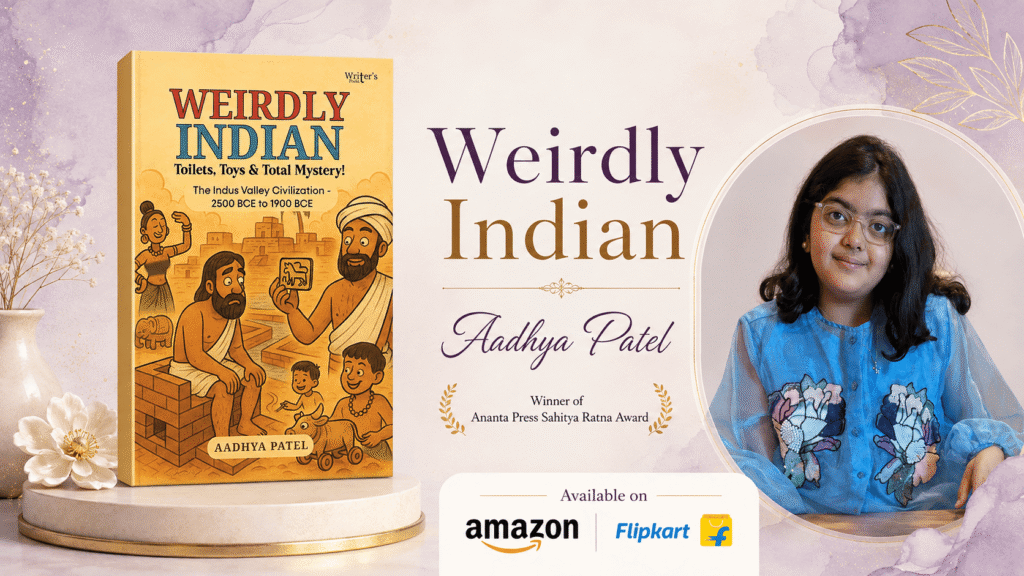
The best educational books do more than transfer information. They teach readers how to approach information. Weirdly Indian – Toilets, Toys & Total Mystery! is especially successful in this respect because its central subject is not only the Indus Valley Civilization; it is curiosity itself. Aadhya Patel uses the civilization as a field of evidence, questions, discoveries, and uncertainties, showing young readers that learning becomes richer when they ask how we know something and what we still do not know.
This approach is educationally significant because children often encounter history as a finished product. A date is given. A city is named. A fact is memorised. A test asks for the same fact back. That method may produce recall, but it rarely produces historical thinking. Weirdly Indian moves in the opposite direction. It draws attention to clues. Why does a city’s drainage system matter? What can a toy reveal? What might a seal have been used for? What do archaeologists infer from jewellery, homes, tools, trade goods, or city plans? Once children begin asking questions like these, history becomes an interpretive activity.
The book’s accessible humour is one reason this method works. The choice to foreground toilets and toys immediately signals that no detail is too ordinary or too funny to investigate. That is a liberating message for children. It tells them that curiosity does not need to sound serious in order to lead somewhere serious. A question about bathrooms can become a question about engineering, water management, urban planning, and public systems. A question about toys can become a question about childhood, craftsmanship, movement, animals, and family life. The intellectual path begins with interest rather than obligation.
Patel’s young voice strengthens this invitation. The tone resembles a curious reader thinking aloud rather than a lecturer summarising conclusions. This matters because children often learn most confidently when they feel that questions are welcome. The book repeatedly models the act of noticing something odd, asking what it means, and following the question into a larger historical idea. It therefore creates a reading environment in which uncertainty is productive.
The treatment of the undeciphered Indus script is an excellent example. Rather than presenting the lack of translation as a frustrating gap, the book treats it as a genuine mystery. The symbols survive. Researchers have studied them. Yet no universally accepted decipherment has unlocked the system. For a young reader, this can be transformative. It reveals that human knowledge is incomplete and that expertise does not mean pretending otherwise. There are still questions to solve.
The same principle applies to government and decline. The civilization’s political organisation is not explained through a convenient list of kings because the evidence does not provide that certainty. Its decline is not reduced to one simplistic cause. By leaving room for debate, Patel teaches an important intellectual habit: different explanations can be considered when evidence is incomplete. That is a more mature lesson than simply memorising one answer.
The book also demonstrates how archaeological reasoning differs from reading a written narrative. Because so much of the Indus world must be understood through material remains, the reader learns to take objects seriously. A seal is not only an attractive artifact; it is possible evidence of exchange, communication, authority, identity, or belief. A brick is part of a building tradition and also part of the modern story of rediscovery. Drains reveal coordinated planning. Toys reveal domestic and social life. In this way, children learn that evidence can be physical, spatial, and technological as well as textual.
Another educational strength is the emphasis on connections. The book does not isolate “history” from other fields. City planning touches engineering. Sanitation touches public health. Trade touches geography and economics. Farming touches environment and food systems. Seals touch language and visual communication. Archaeology touches science, preservation, and interpretation. The disappearance or transformation of a civilization raises environmental and social questions. A curious reader can move naturally from one subject to another.
This interdisciplinary potential makes Weirdly Indian especially useful in homes and classrooms. A teacher could use a section on planned cities to compare ancient and modern urban design. A parent could ask a child to invent a symbol system after discussing the seals. Students could design a map of a hypothetical Indus neighbourhood, identify what a drainage system would require, or debate possible explanations for decline. The book provides factual content, but its greatest educational value may lie in the questions it generates after a chapter ends.
The visual and humorous elements further support different learning styles. Not every child responds to dense prose, and not every concept becomes clear through description alone. Illustrations help readers imagine the physical environment, while unusual details provide memory hooks. A child may forget a formal term but remember that a civilization thousands of years old had sophisticated drainage or moving toys. Those memorable images can later support deeper learning.
The rediscovery narrative is another strong teaching device. The fact that ancient bricks could be reused by railway workers before the site’s historical value was fully understood raises questions about evidence, preservation, and historical awareness. It helps readers see that archaeology is not simply about digging up objects. It is also about recognising significance. Cultural heritage can be damaged when people do not know what they are looking at. This makes the past feel vulnerable rather than safely finished.
The book’s tone is also noteworthy for what it avoids. It does not depend on fear, exaggerated reverence, or nationalistic boasting to make ancient India interesting. The civilization is fascinating because its surviving evidence is fascinating. Readers are invited to feel pride and connection, but that feeling is grounded in investigation. This creates a healthier form of engagement with heritage: admiration that can coexist with questions.
Aadhya Patel’s biography makes this educational philosophy especially resonant. She is presented as a young reader and writer whose curiosity began with the details that standard textbooks often omit. Her broader interests in public speaking, theatre, music, and disciplined activities suggest a life built around expression and learning, but the book itself does not rely on biography for its appeal. What matters is that her own curiosity has been converted into a structure other children can use.
The author’s motto, “Awards are nice. Curiosity is better,” is therefore not merely a charming line. It describes the book’s central value system. Recognition may celebrate an achievement, but curiosity produces the next question. In Weirdly Indian, every answer seems designed to lead to another question: if the drains were so sophisticated, how were they maintained? If the seals were used for trade, what exactly did they communicate? If the cities were so organised, how was authority arranged? If the civilization declined, where did people go and what changed? The reader is never asked to stop thinking.
This is what makes the book distinctive within children’s non-fiction. It is not content with being “easy history.” Its ambition is different: to make historical inquiry feel natural. It trusts that children can understand uncertainty, inference, and evidence when these ideas are presented through concrete examples. That trust is one of the book’s strongest qualities.
The result is a text that can appeal to children who already love history and to those who think they do not. The first group will enjoy the details and mysteries. The second may discover that what they disliked was not the past itself but the way it had been presented. Toilets, toys, drains, seals, bricks, and unanswered symbols make excellent ambassadors for a subject too often reduced to memorisation.
Weirdly Indian – Toilets, Toys & Total Mystery! deserves attention because it understands education as an active relationship between reader and evidence. It provides facts, but it also provides permission: permission to laugh, to doubt, to speculate carefully, to ask obvious questions, to ask strange questions, and to admit when nobody knows the answer yet. Those are not secondary skills. They are the foundation of thoughtful learning.
By the time young readers finish the book, they may know far more about Harappa, Mohenjo-daro, sanitation, trade, archaeology, toys, seals, and the unresolved decline of the Indus Valley Civilization. More importantly, they may have acquired a new reflex: when they encounter a historical claim, they may ask, “How do we know?” A children’s history book that produces that question has achieved something genuinely valuable.
Amazon Purchase Link: https://amzn.in/d/0aBM1ljI