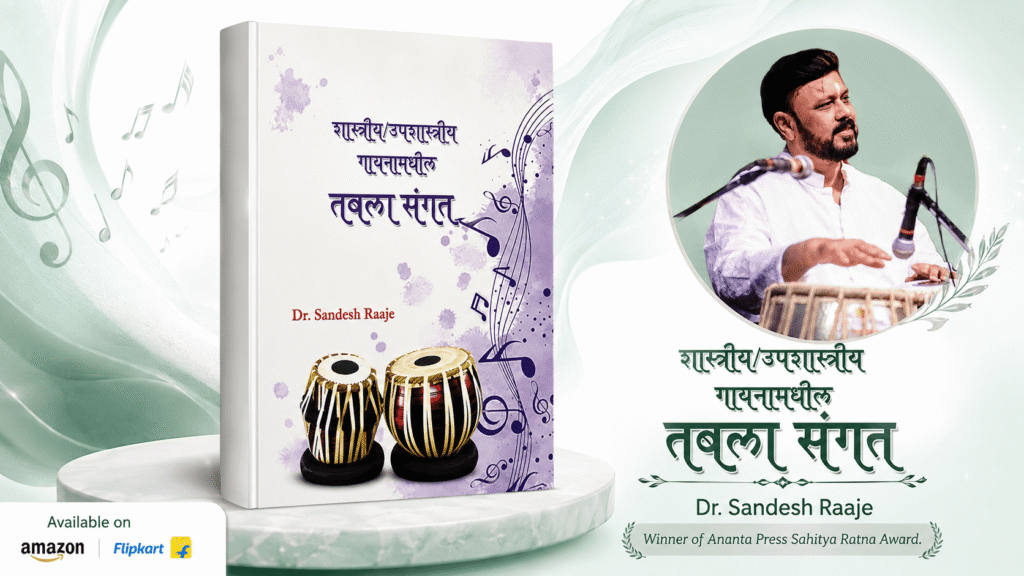
“Shastriya/Upashastriya Gayanamadhil Tabla Sangat” by Dr. Sandesh Raaje can be appreciated as a book about tabla, but it is even more illuminating when read as a book about musical conversation. Hindustani vocal performance is an interactive art. The vocalist, tabla player, and other accompanists share a common time-space, and the quality of a concert often depends on how sensitively they listen and respond to one another. By examining tabla specifically in the context of classical and semi-classical vocal accompaniment, Dr. Raaje brings this interactive dimension into focus.
The book’s subject is important because rhythm in Hindustani music is both structural and expressive. Tala provides an organized cycle, but a great performance does not feel like a mechanical sequence of counts. The cycle breathes. It can feel expansive in vilambit, urgent in faster passages, delicate in lyrical moments, and dramatically charged near sam. The tabla accompanist has the responsibility of keeping this structure audible while allowing the singer freedom to shape melody and expression. That combination of stability and flexibility is one of the most sophisticated aspects of North Indian performance practice.
A book devoted to accompaniment therefore addresses a musical function that is easy to underestimate. To an inexperienced listener, the tabla may seem to “keep the beat.” To an experienced musician, the role is far richer. The accompanist interprets the flow of lay, senses the vocalist’s intention, reinforces important points, manages density, and decides how much rhythmic information the moment can carry. These decisions happen continuously and often instantly. The art lies in making them feel natural.
Dr. Raaje’s decision to focus on this subject gives the book its uniqueness. He is fully aware that tabla has already been studied by many distinguished musicians and authors. There are important works on the instrument’s development, physical construction, grammar, compositions, and solo repertoire. Instead of repeating those areas, he identifies a field that he believes requires deeper and more illustrative attention: tabla as an accompanying instrument in Hindustani classical and semi-classical vocal music. This specialization gives the book a clear intellectual purpose.
The author’s musical lineage further enriches that purpose. He comes from a family associated with tabla and pakhavaj, and he spent twenty-eight years learning under Pt. Bhai Gaitonde, the renowned tabla maestro and Sangeet Natak Akademi Award winner. Such an extended discipleship provides more than technical training. It creates exposure to a way of thinking about music. In accompaniment, this is especially significant because many essential principles are absorbed through repeated experience—through sitting in concerts, hearing corrections, observing senior artists, and gradually developing sensitivity to musical context.
The guru-shishya dimension also connects the book to a broader question of transmission. Hindustani music has traditionally depended on oral and embodied teaching. A phrase is demonstrated, imitated, corrected, and refined. A student learns not only from direct instruction but from proximity to musicians. Written documentation cannot replace this process, but it can support it. A book like this can help articulate principles that students may have encountered intuitively. It can give them a language for reflecting on stage experiences and discussing accompaniment with teachers.
The book’s treatment of classical and semi-classical contexts is particularly valuable because it recognizes that accompaniment is not uniform. Different genres place different demands on the rhythmic partner. The weight of a stroke, frequency of variation, degree of interaction, and relationship to text may all change. An accompanist must understand style, not merely tala. This is where musical literacy becomes broader than rhythmic literacy. Knowing the cycle is essential; knowing the character of the music is equally important.
For scholars and students of performance practice, the book also draws attention to the social structure of a concert. The stage is a space of negotiation. The vocalist may lead the melodic narrative, but the accompanist contributes to momentum and shape. Too little engagement can make the performance feel inert; too much can shift attention away from the singer. The ideal lies in proportion. This makes accompaniment a sophisticated form of collaboration in which artistic ego must be disciplined by musical purpose.
That idea has educational consequences. Students often admire spectacular solo playing because it is easy to recognize. Complex compositions, speed, clarity, and dramatic tihais are exciting and important. Yet accompaniment teaches another measure of excellence: the ability to enhance without overpowering. A beautifully maintained theka, played with the correct touch and responsive variation, may require as much artistry as an elaborate solo passage. Dr. Raaje’s focus helps rebalance the way young players think about achievement.
The book may also influence vocalists and listeners. Vocal students who understand the accompanist’s perspective can learn to communicate more clearly and develop better ensemble awareness. They may become more conscious of tempo stability, rhythmic cues, and how their improvisation relates to tala. Listeners, meanwhile, can begin to hear the concert as an integrated structure rather than as a featured singer with supporting background. They may notice how tabla participates in tension, release, anticipation, and arrival.
Dr. Raaje’s own educational and professional journey gives the work a broad foundation. He is a graduate of Mumbai University, holds a Master of Performing Arts from Shivaji University, Kolhapur, has a B High grade from All India Radio, and holds Sangeet Alankar from ABGMV. He has also received the Rashtriya Gaurav Award and an honorary doctorate in Music and Performing Arts. These qualifications complement his traditional discipleship and suggest an author who has encountered music through multiple systems of learning and recognition.
The book’s value also lies in preservation. Accompaniment practices are often highly nuanced and connected with individual artists, stylistic schools, and concert traditions. If such knowledge remains entirely unwritten, future generations may have fewer tools for understanding why certain approaches evolved. Documentation can preserve observations while still leaving room for flexibility. Music is not frozen by writing; rather, thoughtful writing can provide a map that helps learners navigate living practice.
The author’s stated motivation adds another layer. His family heritage, guru’s teaching, and association with many artists created in him a feeling of obligation to contribute to music. That motivation gives the project a sense of service. The book is not simply an academic exercise but part of a larger chain of musical inheritance. A student receives knowledge, becomes a practitioner, and eventually finds ways to share it.
From a musicological point of view, the work stands out because it shifts attention from object to relationship. Instead of asking only “What is tabla?” it asks “What does tabla do in a vocal performance?” That second question is richer because it includes time, interaction, aesthetics, genre, and human communication. It invites readers to understand the instrument through function and context.
For anyone interested in Hindustani performance, this perspective is highly rewarding. It reminds us that great music depends not only on individual brilliance but on coordination among artists. The tabla accompanist must hold the rhythmic foundation, respond to the singer’s imagination, and contribute creative energy without disturbing the balance. When this is done well, the audience may experience the performance as effortless, even though the accompanist is making countless refined decisions.
“Shastriya/Upashastriya Gayanamadhil Tabla Sangat” is therefore more than a specialist book for percussionists. It is a study of collaboration through rhythm. Its focused subject, the author’s deep training, and the combination of traditional and academic experience make it a meaningful addition to literature on Hindustani music. For tabla players it offers direction; for vocalists it offers perspective; for teachers it offers discussion; and for listeners it offers a deeper way of hearing the musical conversation that unfolds every time voice and tabla meet on stage.