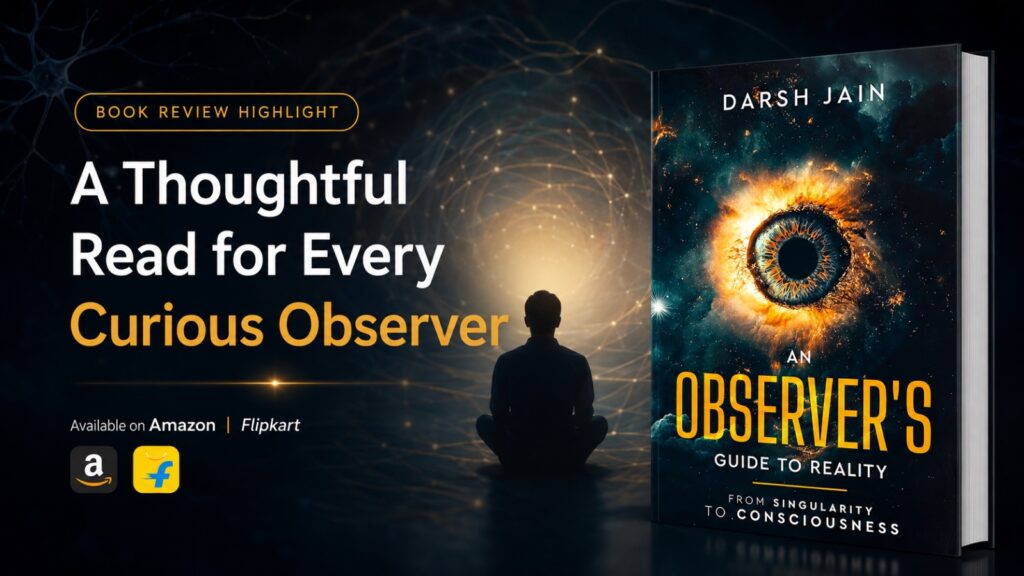
An Observer’s Guide to Reality feels especially relevant in a time when people are surrounded by information but often short of understanding. We can access scientific claims, political opinions, spiritual explanations, health advice, historical arguments, and social commentary within seconds. The problem is no longer simply finding information. The problem is deciding what deserves belief. Darsh Jain’s book is important because it repeatedly returns to the habits needed for that task: curiosity, evidence, humility, questioning, and the willingness to change an idea when better understanding becomes available. These are not only scientific habits. They are survival skills for modern life.
The book begins by teaching the reader how to think about claims concerning the physical universe. The Big Bang, quantum particles, energy, atoms, and the formation of matter are discussed as evidence-based attempts to describe reality. The author emphasizes that science becomes strong not by pretending to know everything, but by being willing to say, “We do not know,” and then investigate. That attitude is valuable far beyond cosmology. In public conversation, certainty is often rewarded. People who sound confident can appear more trustworthy than people who admit uncertainty. This book reminds us that intellectual humility can be a strength rather than a weakness.
As the book moves into evolution, the same method is applied to life. Species are not explained through intention but through variation, adaptation, environmental pressure, and reproduction across enormous timescales. This matters because evolutionary thinking trains the mind to look for processes rather than single causes. Human behaviour, too, becomes easier to understand when we see layers of biology, culture, and history. Aggression, cooperation, tribal loyalty, parental care, fear, status-seeking, and empathy did not appear yesterday. They have deep roots. Recognising those roots can prevent the simplistic idea that every social problem is caused by one bad group or one bad generation.
The chapter on Homo sapiens becomes particularly relevant to modern society because it explains how cooperation and culture allowed humans to scale beyond small groups. Our world depends on trust between strangers. We board aircraft built by people we have never met, use money guaranteed by institutions we may not understand, take medicines produced through global research, and rely on laws that coordinate millions of people. This enormous network is possible because human beings can share symbolic systems. The book’s concept of imagined orders helps readers appreciate both the brilliance and fragility of those systems. They work because people believe, participate, and maintain them.
That insight becomes crucial when thinking about polarization. Human beings are skilled at creating “us” and “them.” A national, religious, political, or cultural identity can give belonging and meaning, yet it can also narrow perception. The book asks readers to notice that identities are shaped by language, stories, geography, family, and history. We usually do not choose the first labels placed upon us. They arrive before we are capable of examining them. This does not mean identities should disappear. It means they should become visible to the person carrying them. Once we see an identity as a story we inherited, we are less likely to confuse it with the total truth about reality.
The book’s treatment of belief also matters in an age of viral misinformation. Human brains are pattern-making machines. We remember emotional stories. We seek explanations that fit existing ideas. We can interpret coincidence as intention and repetition as truth. Jain’s emphasis on scientific temperament offers a practical defence: ask what can be tested, what evidence supports a claim, whether an alternative explanation exists, and whether the belief is being protected because it is true or because it is tied to identity. These questions are simple, but they can transform how a person reads news, evaluates social-media posts, or responds to claims that exploit fear.
The later chapters add an equally important psychological layer. Critical thinking is not only about detecting errors in other people. We must also detect them in ourselves. The brain constructs a self, tells stories about its decisions, and interprets the world through emotion and memory. A person can be highly educated and still become defensive, tribal, jealous, or cruel. Jain’s own reflection on civil-services preparation makes this point clearly: accumulating information does not automatically produce wisdom. Knowledge can strengthen the ego if it is used only to win arguments. Understanding becomes deeper when knowledge changes how we see suffering and our own behaviour.
This is why the final emphasis on observation is so valuable. When anger arises, observe it. When fear arises, notice the body and the story. When a belief is challenged, notice the urge to defend identity. When another person behaves badly, ask what causes might be operating before rushing to a simple label. These habits can make a reader more thoughtful without making them passive. Boundaries, laws, consequences, and accountability still matter. But the book argues that understanding causes is more useful than hatred because causes are where change becomes possible.
The book is also important because it protects wonder from superstition. Many people fear that scientific explanation makes the world dull. Jain writes in the opposite spirit. A mountain shaped by geological processes can still be breathtaking. A tree converting sunlight into chemical energy can still be beautiful. A brain built from billions of neurons can still produce love, music, art, and compassion. The universe does not have to be magical in a supernatural sense to be astonishing. In fact, the book suggests that understanding the real processes can make them more impressive because we begin to see how much had to happen for a conscious observer to exist at all.
Who should read this book? Students who want science to feel alive. Adults who once stopped reading science because it seemed technical. Readers of popular history who want to continue into neuroscience and philosophy. People questioning inherited beliefs. Readers interested in free will, identity, consciousness, or human cooperation. Teachers looking for ways to connect scientific ideas to everyday questions. And perhaps most of all, anyone who feels overwhelmed by a world of confident claims and wants to rebuild a habit of careful observation.
An Observer’s Guide to Reality is not a quick motivational book, and it does not promise a final formula for life. Its scale is large, its arguments are sometimes uncomfortable, and some readers will disagree strongly with its materialist conclusions. That is part of its usefulness. A book about questioning should itself be questioned. The best reading experience comes from marking passages, checking ideas, discussing them, and deciding where the author persuades you and where he does not. The book succeeds when it makes the reader more active rather than more obedient.
Its final value is ethical as much as intellectual. Scientific thinking without compassion can become cold. Compassion without clear thinking can be manipulated. Jain tries to bring the two together. Understand the universe through evidence. Understand life through evolution. Understand society through shared imagination. Understand behaviour through biology and history. Understand yourself by observing thought. Then use that understanding to become less certain, less judgmental, and more awake. In a noisy age, that is a meaningful invitation. The universe may not have written a purpose for us, but we can still choose to pay attention to the brief, astonishing fact that we are here and capable of understanding anything at all.
Why readers should consider this book
- It develops habits useful in an age of misinformation and polarization.
- It combines critical thinking with empathy and wonder.
- It encourages readers to question both public claims and their own internal certainty.
Book link: https://www.amazon.in/dp/934747276X