Love, distance, memory and resilience as different ways into दश्त-ए-सुख़न
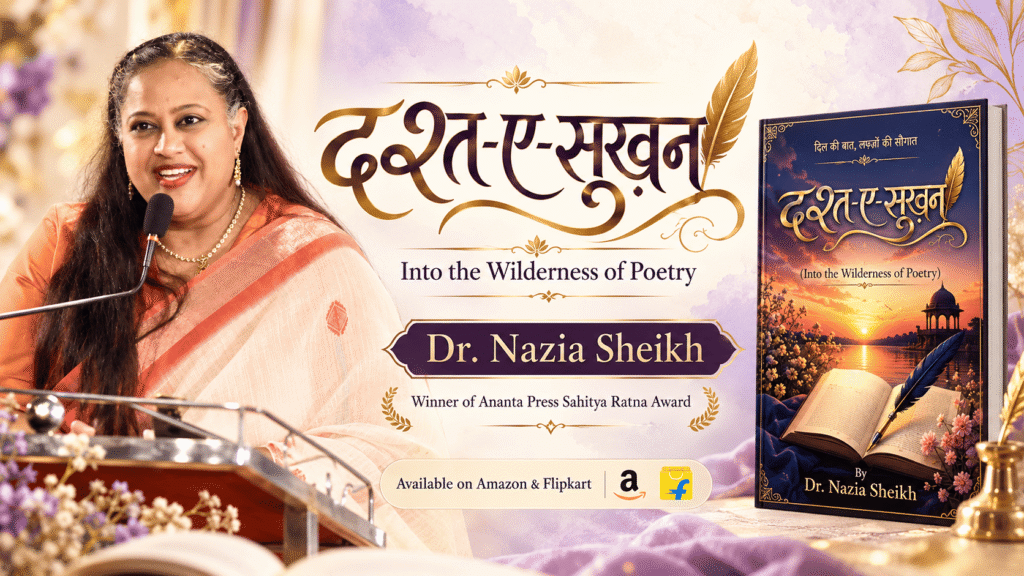
A person rarely experiences love, loss, hope and solitude one at a time. More often these feelings overlap. A happy memory becomes painful without losing its beauty; a disappointment changes shape as years pass; a moment of strength is interrupted by sudden longing. The appeal of Dr. Nazia Sheikh’s दश्त-ए-सुख़न rests on its willingness to address such emotional intersections. Rather than presenting the human heart as a place of tidy conclusions, the collection is described as a poetic exploration of love, separation, resilience and self-reflection. Its most promising quality is the recognition that inner life contains seasons, and that each season alters how we remember those that came before.
The first of these seasons is love, but love need not be treated as a single bright beginning. In poetry, affection can appear through an encounter, a remembered voice, an ordinary habit or even the awareness of someone else’s absence. Such details matter because the language of romance is often crowded with large declarations. An intimate poem can draw attention instead to how affection changes one’s perception of everyday life. The thematic description of दश्त-ए-सुख़न suggests a collection interested in emotional sincerity rather than display. Its invitation is to consider love as a lived experience, not merely as a beautiful word.
From love, the reader moves naturally toward distance. Separation has a special place in the traditions of Hindi and Urdu verse, where physical absence often becomes a way of exploring time, desire and identity. But distance is not always geographical. Two people can sit close to one another and fail to understand each other; someone can remain present in memory long after direct contact has ended. The emotional focus attributed to Dr. Sheikh’s poems allows readers to bring these varied forms of separation into the encounter. What makes the subject powerful is not its novelty, but the almost endless number of lives it can describe.
Then comes longing, which is different from simple sadness. Longing contains motion. It reaches toward a person, a place, a future or a former self. It can keep hope alive, but it can also make the present seem insufficient. This ambiguity is one reason longing has proved so durable a subject for lyric poetry. A poem can admit that desire is both a source of beauty and a source of vulnerability. The stated emotional range of दश्त-ए-सुख़न makes space for that tension. It encourages a reading in which the heart’s contradictions are not evidence of failure, but part of its complexity.
Memory forms another season, although it rarely announces itself as such. Sometimes it arrives through a photograph or familiar sound; at other times it appears without warning. The past is not a fixed object inside the mind. We reinterpret it through our present needs, disappointments and discoveries. This is why poems of love and loss can remain meaningful over many years. A reader who encounters the same reflection at twenty and forty may hear different emotional truths. Dr. Sheikh’s project, with its emphasis on timelessness and personal recognition, is well suited to that changing relationship between language and lived experience.
Solitude introduces a quieter mood. In a world that often demands visible achievement, constant connection and quick answers, the ability to sit with an unresolved feeling can seem almost radical. Poetry offers a different tempo. It asks a reader to listen to the interior life rather than immediately improve or explain it. The book is described as interested in the intensity of what remains unspoken, and this concern gives solitude an important dignity. Silence is not necessarily emptiness; it can contain hesitation, endurance, private devotion or a thought that has not yet found a safe form. Poetry gives such silences room to be noticed.
It would be easy for an exploration of absence and inwardness to remain overwhelmingly sorrowful. But hope is also central to the collection’s stated emotional world, and hope becomes more credible when it has looked directly at difficulty. The most persuasive expressions of hope do not deny loneliness. They acknowledge what has been lost while refusing to believe that loss is the whole story. That distinction makes resilience a particularly interesting theme. It can mean beginning again with confidence, but it can also mean continuing while uncertain. The book’s emphasis on resilience suggests that human fragility and human strength may be understood together rather than forced apart.
Self-reflection is the season that gathers all the others. A reader of introspective poetry may start with a question about another person and discover a question about the self. Why does this memory persist? What was left unsaid? Which expectations were reasonable, and which came from fear? Poetry cannot answer these questions for everyone. Its gift is to make them feel worth asking. The synopsis of दश्त-ए-सुख़न places self-reflection beside love and longing, recognizing that emotional maturity involves more than feeling strongly. It also involves noticing how our inner stories are formed, repeated and sometimes revised.
The book’s language contributes significantly to this inward movement. Hindi and Urdu allow for subtle shifts between direct conversation and more lyrical expression. Both traditions can communicate immense tenderness through restrained phrases. The collection is presented as rich in evocative imagery while remaining accessible to readers with different levels of familiarity with poetry. This pairing has special value for reflective work. If every line is too dense, the reader may remain outside its emotions; if every image is overexplained, there is little space for personal meaning. The most rewarding writing finds an openness between these extremes.
Dr. Nazia Sheikh brings an established literary background to this undertaking. Her biography describes a lifelong interest in poetry, several solo collections in Hindi, one English poetry book, participation in anthologies and engagements with literary communities. That continuing practice offers a useful perspective on the emotional themes. People do not write repeatedly about the heart simply because one feeling remains unchanged. They return because experience keeps producing new questions. Each stage of life can reveal another meaning in affection, grief or endurance. A writer’s sustained commitment to exploring such shifts is a valuable part of her literary identity.
As a reading experience, this collection appears most suited to those willing to move without haste. A reader seeking a conventional beginning, middle and ending may approach it differently from someone comfortable with moments of lyric concentration. There is no obligation to interpret every feeling as a coded autobiographical confession, either. Poetry makes something imaginative and shareable out of experience; its truth is not limited to a literal account of the writer’s life. The more rewarding approach is to respond to the emotional possibilities the words open. One reader may find comfort, another may find a question, and another may find the courage to acknowledge a difficult memory.
The lasting promise of दश्त-ए-सुख़न is therefore not that it will teach a universal lesson about relationships. Human relationships resist formulas, and poetry is poorer when it pretends otherwise. What the collection offers, through its announced themes and expressive aspirations, is a way of paying attention to the heart’s changing seasons. Love need not erase separation, and hope need not cancel grief. Resilience need not look like certainty. By welcoming those tensions, Dr. Sheikh’s poetic vision makes room for readers to understand their lives with more patience and complexity. That is a meaningful reason to explore this literary landscape.
Amazon purchase link: https://amzn.in/d/0042oEEO