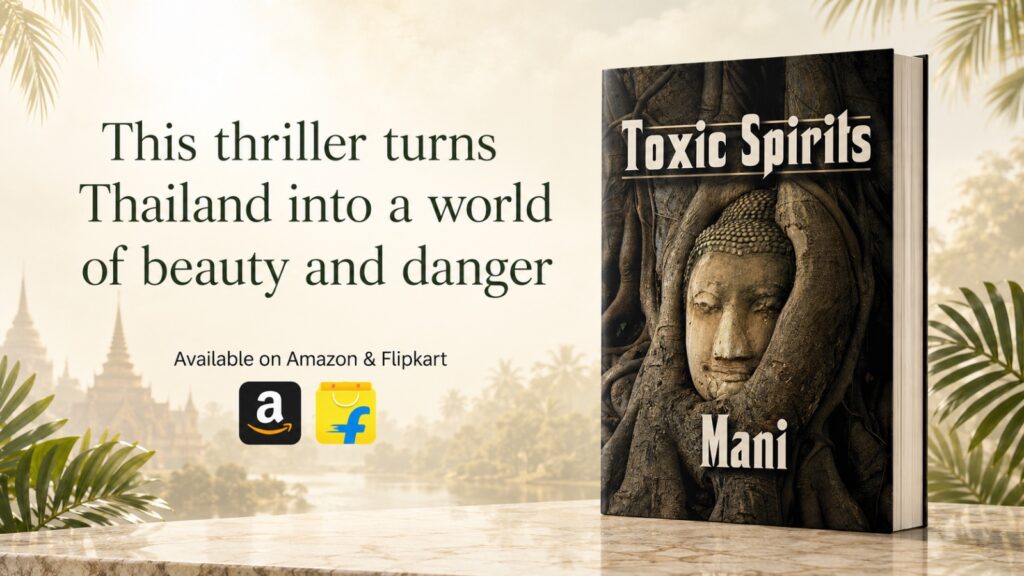
With macabre violence, dark hilarity, science, romance, and the lush landscapes of Thailand, Mani creates a genre-bending novel that refuses to behave like an ordinary mystery.
Some thrillers rely on a clever puzzle. Others succeed through action alone. Toxic Spirits combines suspense with a strong sense of place and an unusual cast of characters. It moves quickly, yet it also finds time for humour, romance, and ideas that stay with the reader long after the story ends.
The novel begins with Benton, a retired intelligence analyst who has settled in Thailand after the death of his wife. He hopes for a quieter life, but everything changes when he meets Siri, a tribal singer who disappears after speaking out about drug trials in her community. His search leads him into a world of secret research, dangerous experiments, and people prepared to sacrifice almost anything in the name of scientific progress.
An immediate engine of suspense
The narrative begins with an emotionally vulnerable protagonist in a deceptive setting. Benton is a widowed African-American intelligence analyst who retires from Washington to Thailand. A former analyst is an ideal thriller figure because he knows how to observe, connect information, and distrust appearances. Yet retirement and grief have reduced his certainty. He is skilled but tired, experienced but not protected from loneliness.
At an expat bar, Benton meets Siri, a beautiful tribal singer. Her later disappearance gives the story a strong forward pull. He discovers that she had been warning people about harmful side effects from drug trials conducted on her hill-tribe. The investigation leads him toward Pierre, the disturbed Indo-Cambodian doctor responsible for the experiments. Once Benton becomes an unwilling subject himself, the thriller stops being a search conducted from the outside. It becomes a desperate struggle within his own changing body.
A villain with intelligence and conviction
Pierre is one of the novel’s most memorable sources of tension. His scientific ability allows him to explain away cruelty as innovation. His mixed cultural background and professional authority make him difficult to reduce to a familiar stereotype. He can move between worlds, speak the language of research, appear very cosmopolitan and well-rounded, and imagine himself as someone history will eventually vindicate. He is also, like many a sociopath, a victim of and witness to childhood abuse.
A villain who believes he is right changes the tone of a thriller. Negotiation becomes harder because moral limits are interpreted as intellectual weakness. Mani uses this sociopathic character to create an atmosphere of dread: the reader understands that evidence of suffering will not stop him, as it’s just another experimental parameter.
Thailand rendered in shadow and colour
The setting supplies the novel with much of its energy. Prajawan, the fictional seaside town, has bars, tourists, local performers, retirees, and an atmosphere of casual reinvention. Beyond it lie tribal communities and the botanical richness of the Golden Triangle. The Thailand of Toxic Spirits is seductive without becoming safe. Temples, food, heat, nightlife, forests, and rivers create beauty, while medical secrecy and violence stain the same spaces.
This tension gives the book a cinematic quality. A reader can imagine the neon glow of an expat bar, the thick vegetation of the jungle, a fighter’s disciplined movement, and the cold logic of a scientific facility. Mani uses contrast effectively: spiritual imagery beside biotechnology, lush nature beside bodily corruption, tourist freedom beside tribal vulnerability. The novel’s atmosphere is not merely decorative; it keeps reminding the reader that beauty and danger can occupy the same frame.
The pleasure and discomfort of genre mixing
Toxic Spirits does not stay within one genre. The disappearance of Siri and Benton’s investigation belong to mystery. Pierre’s trials and the genetic drugs introduce science fiction. Benton’s bodily changes bring elements of horror. His relationship with Mimi adds romance. The expat community creates social satire, and the conflict between tribal healing and high-tech medicine gives the story philosophical weight.
This mixture is one reason the novel feels original. A conventional thriller might treat genetics as a device and Thailand as a location. Mani makes both part of the book’s meaning. The science raises questions about identity, while the setting reveals global inequalities. The romance is not simply relief; it asks whether love can remain possible when the body is transformed. The humour is not a break from darkness; it shows the absurd ways people behave around danger.
Macabre violence and dark hilarity
The book has been described as interspersing macabre violence with dark hilarity, and that tonal combination is important. Mani understands that horror can become numbing if every page maintains the same solemn intensity. Moments of absurdity, drunken conversation, cultural misunderstanding, or expatriate vanity create rhythm. They also expose the moral evasions of people who can turn another community’s crisis into gossip or entertainment.
The humour will not work for every reader. Some may find the shifts from violence to comedy jarring. Yet the discomfort appears intentional. Real crises do not arrive in perfectly controlled tones. People joke when frightened, behave selfishly during tragedy, and continue ordinary routines beside terrible events. The novel’s dark comedy captures that instability.
Benton and Mimi: warmth under pressure
Mimi, a young Thai-Australian muay thai boxer, brings a new physical and emotional energy to the book. Her fighting ability makes her more than a romantic figure waiting to be rescued. She belongs to the novel’s multicultural world and carries her own form of strength. Her connection with Benton offers warmth, but it develops under extreme pressure.
Their relationship is complicated by age, background, danger, and Benton’s transformation. This prevents the romance from becoming sentimental. Affection does not make the genetic crisis disappear. Instead, it raises the stakes by giving Benton another reason to resist losing himself. Mimi’s presence also balances the novel’s fascination with scientific power by emphasizing skill rooted in discipline, embodiment, and human attention.
Science without a textbook tone
Mani’s scientific background is visible in the novel’s interest in proteins, DNA, drug trials, and engineered biological effects. The technical material gives the conspiracy credibility, but the story remains accessible because the science is attached to character and consequence. Readers do not need advanced knowledge to understand the essential danger: a powerful researcher is manipulating life without meaningful ethical restraint.
At its best, the novel makes scientific ideas feel physical. Genetics is not presented as a diagram but as fear, mutation, inheritance, and uncertainty. The spread of manipulation into the botanical treasures of the Golden Triangle expands the scale from one victim to an ecosystem. What begins as a secret trial threatens to become a wider biological catastrophe.
Pace, density, and possible reservations
Toxic Spirits is relatively short and moves rapidly. This makes it easy to read in a few concentrated sittings. The plot escalates from disappearance to investigation, experimentation, transformation, romance, and environmental danger with little wasted time. Readers who enjoy momentum will appreciate the urgency.
The same speed can make the novel feel crowded. Several characters, locations, cultural questions, scientific ideas, and tonal shifts compete for attention. Some readers may wish Siri had more space, or that the wider consequences of the experiments unfolded more gradually. Others may find Benton’s nightmares and real horrors deliberately difficult to separate. These are reasonable reservations, but they arise from the book’s ambition rather than a lack of imagination.
Who should read it?
This is a strong choice for readers who like thrillers that offer more than a puzzle. Fans of international intrigue, medical conspiracies, genetic science, environmental themes, and morally ambiguous characters will find much to enjoy. Readers drawn to Thailand or Southeast Asian settings will appreciate the sensory detail, although the country presented here is far darker than a travel fantasy.
The novel is also likely to appeal to readers who enjoy works that cross literary and genre boundaries. Mani’s prose has been praised for matching the luxuriance of the Thai landscape, and the book’s emotional effect can be haunting. It may repel and attract in the same chapter, which is part of its design.
Final verdict
Toxic Spirits is fast, vivid, and strange in the best sense. It takes familiar thriller ingredients—a retired analyst, a missing woman, a brilliant criminal, a secret experiment—and contaminates them with harder questions. What does a body owe to science? What does an outsider owe to the community whose beauty he consumes? What happens when technology crosses from treatment into authorship of life?
The answers are not neat, and neither is the novel. Its power comes from the collision of paradise and poison, comedy and cruelty, romance and mutation, modern laboratories and tribal healing. Mani has created a thriller with a strong atmosphere and a distinctive moral imagination. It is not simply fun to read; it is the kind of entertainment that leaves an uncomfortable residue after the final page.
Buy the book: Toxic Spirits on Amazon India