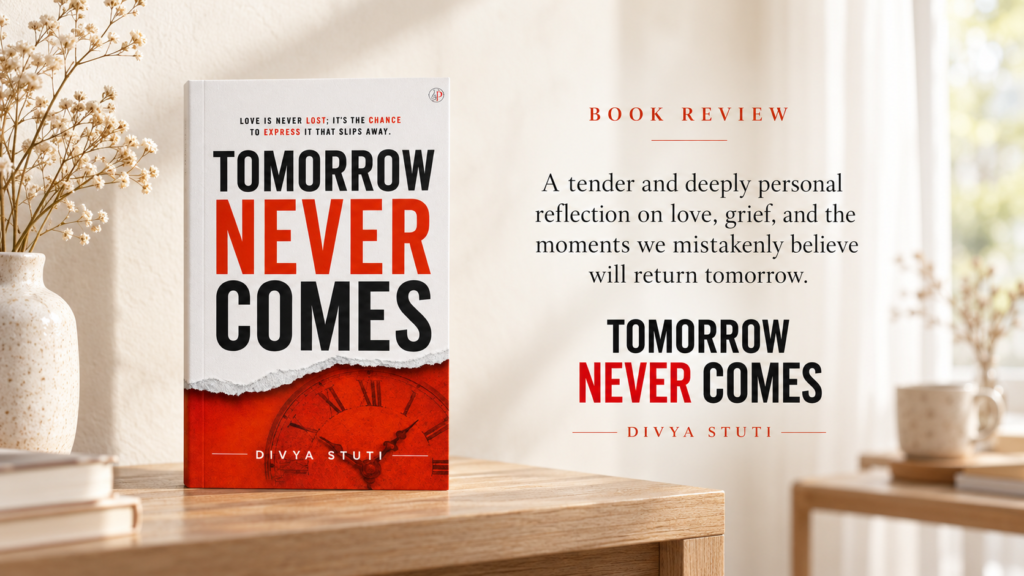
There are books about bereavement that explain grief, books that narrate its stages, and books that offer consoling methods for living after loss. Divya Stuti’s Tomorrow Never Comes belongs to a more intimate category. It is the record of a daughter speaking into the space her mother’s death has opened, trying to understand not only that she has lost someone indispensable but also how she lived when that person was still present. The result is less a conventional memoir of events than a sustained moral and emotional reckoning. Its central question is painfully simple: what happens when love was real, yet too much of it remained assumed, postponed, or unspoken?
This question gives the book unusual relevance. Many readers will recognize the pattern even if the particulars of their lives are different. The people who care for us most consistently can become almost invisible because their reliability feels like part of the world’s design. Meals appear, messages arrive, someone waits, someone remembers what we need, and someone quietly absorbs discomfort so the day can continue. Familiarity removes the sense of occasion. Stuti’s mother occupies precisely this foundational place. She is not represented through grand declarations but through innumerable acts that made home possible. Only after death does the daughter see how much intelligence, labor, endurance, and tenderness those acts contained.
The memoir’s opening movement is therefore an education in attention. Stuti revisits mornings, late nights, household tasks, minor disagreements, and small requests. These scenes matter because they demonstrate how regret is created incrementally. There is no single dramatic betrayal for which the narrator seeks forgiveness. Instead, there is a collection of hurried replies, distracted moments, insufficient questions, and affection saved for later. This makes the book emotionally persuasive. Most relationships are not defined only by decisive scenes; they are formed by repeated micro-choices about whether to listen, pause, notice, or turn away. Tomorrow Never Comes asks readers to measure love at this daily scale.
The portrayal of the mother also raises an important issue about care. She experiences weakness, low blood pressure, vomiting, and exhaustion, yet continues cooking and preparing for others. Her pain is folded so neatly into routine that the family accepts her assurance that it is “nothing.” Stuti’s hindsight is unsparing. She recognizes that calling a woman strong can sometimes become a way of allowing her to continue without help. The daughter trusted her mother’s endurance instead of questioning why endurance was required. This insight prevents the memoir from becoming simple idealization. It celebrates maternal devotion while exposing the unequal expectation that mothers will keep giving even when their own bodies ask them to stop.
When the narrative reaches the day of loss, its emotional world narrows to a few unforgettable coordinates: a father’s restrained voice, platform number eight at Patna Junction, a planned journey to Hazaribagh, and the desperate belief that the crisis must have a familiar explanation. The author’s mind cannot immediately imagine death because her mother’s previous illnesses belonged to a reassuring pattern: she became unwell, rested, and returned. The rupture is not merely the death itself but the collapse of that pattern. Stuti’s description of the station continuing around her makes public indifference part of the scene. One life has become divided into before and after, while timetables and conversations carry on unchanged.
Readers who have experienced sudden loss will recognize the disbelief that persists after factual knowledge has arrived. The body is gone, but expectation continues. The bereaved person listens for a voice, anticipates footsteps, and enters a room prepared for the old arrangement of reality. Stuti renders this through the transformed house. Her mother’s chair, sarees, jewelry, slippers, scent, and kitchen remain exactly where memory expects them, but their owner does not. The objects are both comfort and accusation. They prove that the life existed, yet they cannot restore it. In these passages, the book speaks particularly well to the strange materiality of grief: absence becomes most visible through what has been left behind.
The author’s candor about guilt may be the book’s greatest source of connection. Bereavement is often discussed publicly in softened language, with emphasis on cherished memories and gratitude. Stuti includes those emotions, but she does not suppress the harsher ones. She worries that she was not the daughter she should have been. She remembers moments when a phone, work, friends, fatigue, pride, or simple carelessness received attention that could have been given to her mother. She even fears that letting guilt diminish might feel like losing another part of the relationship. Such admissions may be difficult to read, but they can also release readers from shame. The memoir shows that love and regret are not opposites; they can inhabit the same bond.
At the same time, Tomorrow Never Comes should not be mistaken for an argument that grieving children must condemn themselves. Its later chapters slowly resist that conclusion. Stuti cannot revise the daughter she was, but she can decide what kind of person her mother’s memory will help her become. She recreates prayers, attempts recipes, notices the lessons embedded in her mother’s behavior, and carries those lessons into her choices. The shift is subtle but decisive. Regret looks backward and asks for an impossible correction; remembrance looks both backward and forward, preserving the person through action. The book’s deepest healing begins when the author allows love to become practice rather than punishment.
Indian cultural texture gives this transformation warmth and specificity. Food prepared by a mother’s hands is not merely food; it is care made sensory. Touching elders’ feet, a protective dot of kajal, prayers in the puja room, festival labor, sarees selected for an occasion, and a mother’s insistence that a child eat before leaving are recognizable forms of affection. Stuti revisits rituals she once considered unnecessary and understands that they were her mother’s effort to bless, protect, and accompany her. The memoir invites a similar rereading from its audience. What habitual gesture in one’s own home is actually a language of love? What seems like fussing because its emotional meaning has become too familiar to notice?
The book is written in a highly personal, lyrical-prose mode. Short declarations interrupt longer memories; phrases return; grief is addressed through images of choking, weight, echo, wounds, shadows, and silence. This creates the feeling of a mind circling what cannot be made reasonable. Some readers may wish for more variation or editorial distance, especially because the intensity remains high across many chapters. Yet the repeated language also serves a psychological truth: grief rarely moves in a clean line, and insight does not prevent the same ache from returning. The form mirrors recurrence. The author is not reporting from the far side of mourning; she is documenting the labor of surviving it.
The spiritual passages deepen that labor without making doctrinal claims the book cannot support. The Bhagavad Gita’s teaching that the soul is not destroyed allows Stuti to imagine that her mother has changed dwelling rather than vanished. Prayer becomes a bridge, and good deeds become offerings. Still, the narrator remains attached to the physical details of the woman she misses. She wants one more hug, one more conversation, one more chance to serve. The coexistence of belief and longing is one of the memoir’s most honest features. Spiritual hope does not erase human attachment; it accompanies it, sometimes unsteadily.
The epilogue converts the title from warning into a way of living. Stuti imagines the tomorrow she would spend differently if it were granted: she would wake first, cook, listen, document stories, ask about her mother’s dreams, photograph her, massage her feet, and express pride and love without embarrassment. Because that day cannot arrive, the author applies its lessons to the people still present. This is where the book reaches beyond testimony. Its call to action is neither complex nor abstract. Make the phone call. Stay in the room. Learn the recipe. Ask the parent about the person they were before parenthood. Do not assume that being loved absolves you from showing love.
Tomorrow Never Comes will resonate most strongly with readers who have lost a mother, who carry unresolved words, or who have begun to notice the aging and vulnerability of a parent once imagined as indestructible. It may also speak to caregivers who rarely see their labor acknowledged. The memoir offers companionship more than cure. It does not promise that grief ends, that guilt disappears, or that faith closes every wound. It suggests instead that pain can change shape, memory can become service, and a person can honor the dead by becoming more attentive to the living.
Divya Stuti has written a book of surrender in the fullest sense: surrender to the fact of death, to the imperfections of love, to the persistence of memory, and to the necessity of continuing. Its lasting effect is to make ordinary time feel newly visible. A mother’s call, a meal, a warning, a question, or a few minutes beside someone may seem repeatable until suddenly it is not. By turning her regret into language, Stuti gives readers an opportunity she no longer has in the same form. They can close the book and choose differently today. That is the memoir’s sorrowful gift and its quiet hope.