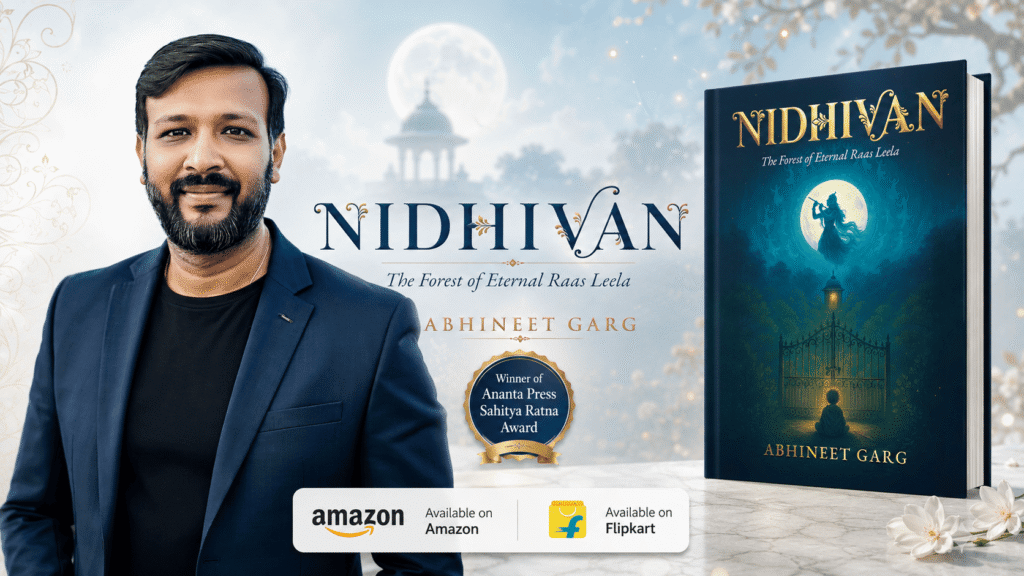
Indian mythological fiction has expanded enormously in recent years, yet much of it remains focused on retelling epic events, reimagining divine figures, or converting ancient narratives into large-scale adventures. Abhineet Garg’s Nidhivan: The Forest of Eternal Raas Leela distinguishes itself by choosing a more intimate and culturally immediate path. It does not travel into a distant mythic age. Instead, it asks what happens when a sacred legend remains alive in a real place, shaping rituals, warnings, memories, and human behaviour in the modern world.
The book is set around Nidhivan, the mysterious grove of Vrindavan associated with the belief that Radha and Krishna continue to perform their eternal Raas Leela after sunset. This belief gives the novel a uniquely Indian spiritual centre. The mystery is not imported from a generic haunted-house tradition. It emerges from bhakti, temple practice, sacred geography, oral testimony, and the reverence surrounding a place that devotees consider spiritually active. Garg’s choice of setting immediately gives the narrative authenticity and emotional depth.
Vrindavan in the novel is not simply a scenic background of temples and devotional music. It is a layered world in which landscape and faith are inseparable. Rang Mahal, Lalita Kund, Gopeshwar Bhagwan, the legacy of Swami Haridas, Radha temples, and the Ashta Sakhi tradition create a network of meanings. These references do not function merely as research details. They show that Nidhivan belongs to a larger sacred imagination in which places remember, rituals repeat, and stories remain present through collective practice.
This treatment of sacred geography is one of the novel’s strongest qualities. In many modern thrillers, location serves plot: a forest hides something, a temple contains a clue, a locked room creates suspense. In Nidhivan, the location carries its own authority. The grove is not waiting for the characters to give it meaning. It possesses meaning before they arrive. The three seekers must enter a tradition larger than themselves, and each is judged not only by what they discover but by how they approach it.
The first seeker, Anirudh Narayan, arrives in 1985 as an NRI journalist. His perspective reflects a familiar tension in modern Indian life: the conflict between inherited cultural memory and the rational language of professional modernity. He sees the legends as material for investigation, exposure, and publication. His instinct is understandable. India contains countless claims that deserve scrutiny, and journalism has a responsibility to question fear and superstition. Yet Anirudh’s error lies in assuming that skepticism automatically makes him superior to the people whose beliefs he examines.
His gradual descent from confidence into obsession gives the novel psychological force. The rituals of Rang Mahal, the seven locks, the offerings that appear touched by an unseen presence, and the warnings surrounding nightfall challenge not merely his theories but his identity. He is accustomed to controlling the narrative. Nidhivan refuses to remain within his frame. His storyline becomes a caution against the colonial habit of treating living traditions as curiosities that become legitimate only after an educated outsider interprets them.
Radha, the young student whose journey begins in 1988, offers a more emotionally rooted perspective. She does not stand outside the sacred world. She feels its pull. Her relationship to the mystery is shaped by devotion, longing, and a desire for meaning. Through her, the novel explores bhakti not as a simple emotional virtue but as a powerful inner force that can both elevate and consume. Her story recognizes a central paradox of devotion: love seeks closeness, yet the sacred may require distance.
This is where the novel becomes culturally sensitive rather than merely sensational. It does not exploit the legend of Raas Leela as a supernatural spectacle. It treats the belief with reverence. The central question is not, “Can the characters catch the gods in the act?” Such an approach would reduce the sacred to entertainment. The deeper question is whether human beings have the right to demand access to what tradition considers divine and private.
Meera, the historian who enters the narrative in 1990, embodies a mature relationship with heritage. She investigates, but she does not mock. She studies, but she does not assume that scholarship grants ownership. Her work helps the reader understand how temple practice, folklore, historical memory, and spiritual symbolism interact. Meera’s approach is particularly valuable in a contemporary context, where discussions of mythology often become polarized between unquestioning acceptance and aggressive dismissal.
Through Meera, the novel proposes a third possibility: respectful inquiry. Cultural traditions can be researched without being stripped of dignity. Oral accounts can be examined without being treated as worthless. Historical context can deepen faith rather than destroy it. At the same time, reverence does not require intellectual passivity. Meera’s balanced method makes her the bridge between Anirudh’s skepticism and Radha’s devotion.
The three timelines also allow the novel to portray India across a period of transition. The late 1980s and 1990 represent a time before digital saturation, when stories travelled through letters, personal testimony, newspapers, temple communities, and local memory. The absence of smartphones and social media makes the mystery more believable, but it also serves a larger theme. Sacred traditions survive through human transmission, not merely through recorded evidence.
The five-year-old boy who receives Meera’s account and later becomes the narrator at forty embodies this transmission. He inherits a mystery the way many people inherit culture: in fragments. A childhood warning, an unexplained absence, a document, a remembered voice, and a place-name can remain dormant for years before acquiring meaning. By making the narrator an inheritor rather than a detached investigator, Garg adds emotional continuity to the cultural dimension of the story.
The novel’s language and structure, as suggested by its premise, have a strongly cinematic quality. Nidhivan after sunset, the preparation of Rang Mahal, the locking of gates, the glow of lamps, the movement of shadows among intertwined trees, and the soundscape of Vrindavan create visual tension. Yet the spectacle remains controlled by silence. This restraint is important. The sacred is often most powerful when it is not fully displayed.
Another notable quality is the novel’s refusal to treat Indian spirituality as decorative exoticism. The symbols and traditions are not included simply to make the thriller look different. They determine the psychology of the characters and the ethical shape of the mystery. The Raas Leela is not only a legend around which clues are arranged. It represents divine love, cosmic play, longing, union, and the limits of ordinary perception. The forest’s prohibition after sunset therefore has symbolic depth. It marks the boundary between human spectatorship and sacred participation.
This gives the book a broad emotional appeal. Devotional readers may connect with its reverence for Radha-Krishna tradition. Thriller readers may enjoy the layered timelines, forbidden setting, incomplete investigations, and escalating suspense. Readers interested in history and folklore will appreciate the cultural network surrounding Nidhivan. Those drawn to psychological fiction will find the three seekers’ motives particularly engaging.
The book’s horror is also culturally specific. It does not depend on familiar Western images of possession, demons, or haunted mansions. Its fear arises from maryada, the crossing of a sacred boundary. This is a powerful Indian concept: danger emerges not necessarily because an evil force attacks, but because a human being enters a space without the required humility, readiness, or permission. The consequences are spiritual as much as physical.
Abhineet Garg’s background as a writer across psychological thrillers, mythology, spiritual fiction, romance, and emotionally driven drama appears well suited to this material. Nidhivan requires an author capable of balancing atmosphere with character and cultural research with suspense. Its premise depends on emotional credibility. The seekers cannot be mere instruments for uncovering clues. Their inner lives must explain why they continue when warning would persuade most people to stop.
What ultimately makes Nidhivan unique is its understanding that mythology is not dead material. It remains alive wherever people continue to organize their behaviour around it. A gate locked at sunset, an offering prepared for unseen visitors, a warning passed from priest to pilgrim, or a grove treated as private divine space can carry more narrative power than an elaborate fantasy world because these actions belong to lived faith.
Nidhivan: The Forest of Eternal Raas Leela is therefore a significant addition to contemporary Indian mythological fiction. It respects tradition without becoming static, uses suspense without cheapening the sacred, and explores belief without demanding a single interpretation. Its mystery grows from the cultural soil of Vrindavan, and its deepest message is one of humility. Some places do not need to reveal themselves fully in order to transform those who approach them.
PURCHASE THE BOOK