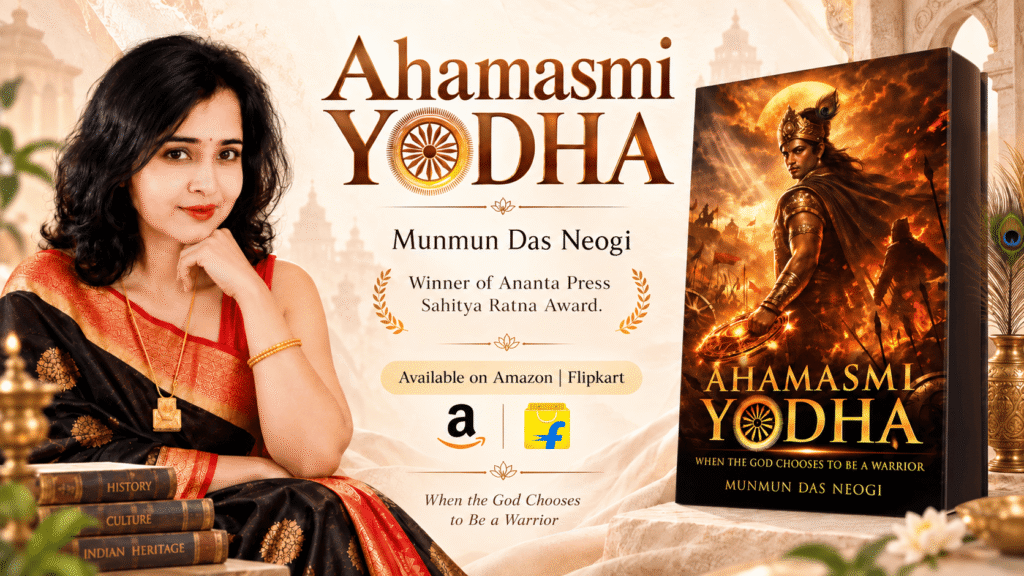
Ahamasmi Yodha: When the God Chooses to Be a Warrior begins by asking readers to hold two images of Krsna at once. One is familiar and tender: the flute, love, wisdom, playfulness, and compassion. The other is sterner: the strategist, protector of Dharma, counsellor to warriors, and guiding presence behind a war understood as a struggle over righteousness. Munmun Das Neogi does not ask the reader to reject the first image in favour of the second. The book’s interest lies in the tension between them. Its deeper argument is that compassion and strength are not opposites, and that spiritual maturity may require knowing when each must take form.
This duality gives the book its literary and cultural appeal. Mythological figures endure partly because they cannot be exhausted by a single interpretation. Krsna is one of the richest examples in Indian tradition: child, friend, lover, teacher, statesman, philosopher, strategist, and divine presence. By foregrounding the warrior dimension, Ahamasmi Yodha participates in a long tradition of returning to epic material in order to illuminate a present concern. The concern here is modern uncertainty about strength. What does it mean to be strong without becoming harsh? What does it mean to resist wrongdoing without becoming consumed by hatred? Can one act decisively and still remain spiritually grounded?
The book’s answer is built around Dharma. This is crucial because a warrior figure without an ethical centre can easily become a symbol of aggression. Munmun Das Neogi’s premise specifically resists that simplification. The divine warrior acts without ego, protects without attachment, and fights without hatred. These three conditions reshape the entire metaphor. They imply that the legitimacy of action depends not only on what is done but on the inner state from which it is done. The book therefore moves away from the spectacle of war and toward the consciousness of the person who must decide.
That emphasis also protects the work from glorifying conflict. The presence of diplomacy and peace efforts in the book’s framing makes clear that confrontation is not the first or preferred response. The warrior emerges when peace has failed and when continued inaction would represent an abandonment of Dharma. This distinction is culturally significant because it refuses both extremes: romanticising violence on one side and romanticising passivity on the other. The text instead explores the difficult middle ground in which moral life often occurs.
As a work rooted in mythological and spiritual material, Ahamasmi Yodha is also notable for its modern orientation. It is not presented merely as a retelling of episodes from Krsna’s life. The stated purpose is interpretive. Moments of diplomacy, silence, courage, and decisive action become opportunities to examine a philosophy of the “divine warrior.” This allows the reader to encounter familiar material as a set of living questions rather than as distant sacred history. The battlefield of Kurukshetra becomes portable; it enters the reader’s personal world.
That move from epic scale to personal scale is one of the book’s most effective structural ideas. Ancient epics are filled with kings, vows, wars, dynasties, and cosmic stakes. A modern reader may admire them while still wondering what they demand of ordinary life. Ahamasmi Yodha answers by translating the epic conflict into the language of choice. Every person has moments when fear and courage compete, when truth threatens comfort, when silence appears easier than responsibility, or when attachment clouds judgement. The inner battlefield is not grand, but it is real. By linking it to Kurukshetra, the book gives ordinary moral conflict a larger symbolic frame.
The title itself carries this fusion of epic and personal identity. “Ahamasmi Yodha” translates its central idea into a first-person declaration: I am the warrior. The importance of the phrase lies in how the book defines the word that follows “I am.” The reader is not invited to imagine themselves as a conqueror. They are invited to imagine themselves as someone capable of moral steadiness. This distinction transforms the title from dramatic branding into a philosophical proposition. If the reader is the warrior, then the relevant questions concern self-mastery, not enemy-making.
There is also something valuable in the book’s willingness to reframe a beloved spiritual image without attempting to make it unfamiliar for novelty’s sake. The Krsna of wisdom and compassion is not contradicted by the Krsna of strategy and protection. Instead, the latter dimension expands the former. Compassion may sometimes require protection. Wisdom may sometimes require difficult counsel. Love may sometimes refuse to cooperate with injustice. The book’s concept therefore encourages a more integrated view of spiritual virtue: gentleness is meaningful, but so are boundaries, courage, and responsible action.
Munmun Das Neogi’s author background helps explain why this integrative approach feels central to her project. She describes Indian epics, mythology, and spiritual literature as windows into human nature, leadership, courage, sacrifice, and moral dilemmas rather than as stories belonging only to the past. Her interests also extend to cosmology, Vedic philosophy, history, relationships, and emotions. Ahamasmi Yodha reflects that broad curiosity. It takes a culturally familiar figure and asks what philosophical work that figure can still perform for contemporary readers.
The book should appeal to several audiences for different reasons. Readers of Indian mythology may appreciate the focused exploration of Krsna’s strategic and warrior dimension. Spiritually inclined readers may find the emphasis on action without ego especially resonant. Self-help readers may value the transformation of epic symbolism into a language for courage and decision-making. Younger readers encountering these ideas for the first time may also find the book’s framing approachable because it begins with a recognisable contrast—the flute and the battlefield—and builds from there toward questions of identity and purpose.
Most importantly, Ahamasmi Yodha does not reduce spiritual philosophy to decorative inspiration. Its central metaphor has consequences. To say “I am the warrior” means that one must eventually decide what one stands for. It means examining whether peace is genuine or merely avoidance, whether courage is principled or ego-driven, whether protection is compassionate or possessive, and whether action is guided by clarity or anger. Those questions give the book substance beyond its dramatic theme.
In a literary landscape where mythological retellings often focus on plot revision, alternate viewpoints, or imaginative reconstruction, Ahamasmi Yodha takes a different route. It uses mythology as a philosophical mirror. The figure of Krsna is less an object of reinvention than a source of inquiry. Through him, the book asks how wisdom behaves under pressure. Its answer is neither passive nor violent. Wisdom negotiates, waits, guides, discerns, and, when necessary, acts. That is the quality that makes this book distinctive: it understands the warrior not as the opposite of the spiritual seeker, but as one possible expression of spiritual responsibility.
Amazon purchase link: https://www.amazon.in/dp/9376310659