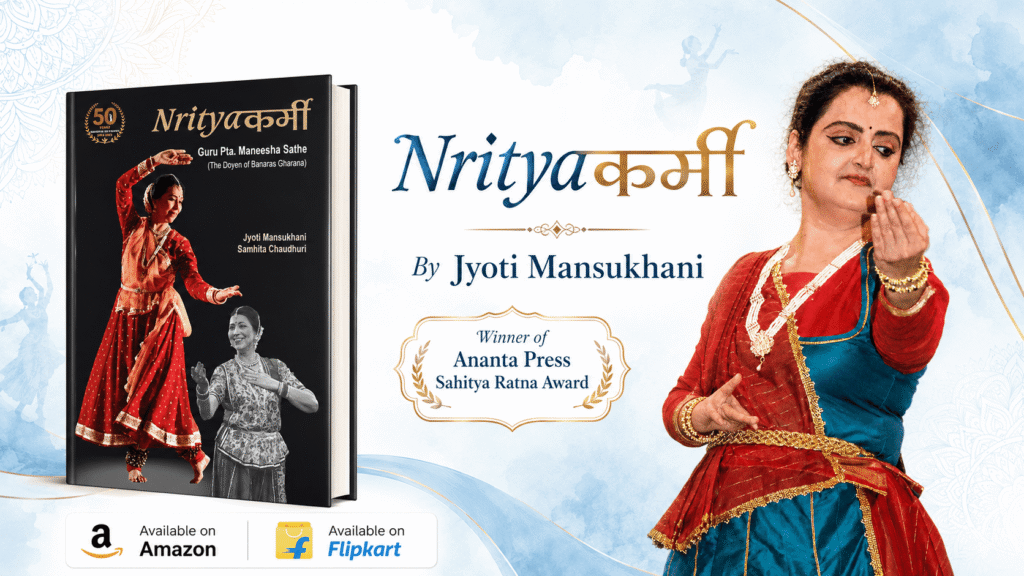
The most memorable biographies are not those that place their subjects on unreachable pedestals. They are the books that allow admiration to grow through understanding. Nrityaकर्मी, written by Jyoti Mansukhani with Samhita Chaudhury, promises precisely this kind of encounter with Guru Pta. Maneesha Sathe ji. It honours her stature as an outstanding Kathak artiste and Guru, yet it also seeks to reveal the sensitive human being whose values, relationships and inner discipline made that stature possible.
This balance is the book’s emotional strength. The language used to introduce the project – dedication, discipline, determination and deep devotion – could have produced a formal tribute centred only on greatness. Instead, the three-section structure brings the reader closer in stages. First, we encounter the long artistic journey. Then we hear from colleagues and associates. Finally, we listen to students whose lives were shaped through sustained contact. The biography therefore moves from public achievement towards personal intimacy.
The opening section covers an extraordinary span of more than six decades. A life this long in art contains many different selves: the child who begins training, the young performer discovering the stage, the mature artist refining an individual voice, the teacher learning how to guide others, the Guru carrying responsibility for a tradition, and the legend viewed through collective respect. By tracing these stages, Nrityaकर्मी resists the common tendency to see a celebrated person only in the finished form.
This is important because the word “legend” can conceal effort. It creates the illusion that excellence was inevitable. Childhood photographs, images of Gurus and parents, performance records and family pictures restore the missing process. They remind readers that artistic lives are built through support, correction, repetition, uncertainty and time. Even a confident stage presence has a history. Even a respected Guru was once a student attempting to understand and embody what she had been taught.
The family photographs are particularly meaningful within a biography of a classical dancer. Public narratives often separate art from ordinary life, as though an artiste exists only during performance. Yet family, health, responsibility, friendship and daily routines inevitably shape artistic practice. Including these dimensions makes the portrait more truthful. It suggests that devotion to dance did not erase Maneesha ji’s humanity; rather, her humanity gave emotional depth to her art.
The performance videos create another form of closeness. Readers can move from description to observation. They can see how expression travels through the face and body, how rhythm is inhabited, and how a performer commands attention without depending on verbal explanation. For those unfamiliar with Kathak, this is an invitation rather than a test of knowledge. The videos allow the art to introduce itself.
The second section humanises Maneesha ji through the memories of thirty-two contributors. Senior Gurus and artistes can speak about artistic excellence, but musicians and technicians may reveal equally important qualities. They may remember preparation, punctuality, responsiveness, respect, adaptability or the calm management of unforeseen difficulties. Such details show how a person carries herself when the audience is absent and the performance is still being built.
This is where anecdotes become powerful. A small incident can reveal character more effectively than a list of awards. Perhaps a contributor remembers a correction offered with unusual clarity, a gesture of support during a difficult moment or an uncompromising insistence on artistic integrity. The unique taglines associated with each contribution likely highlight these qualities and help the reader recognise that a person is composed of many relationships and impressions.
The distinguished list of contributors, including Taalyogi Pt. Suresh Talwalkar ji, Pt. Rajendra Gangani ji, Pt. Jai Kishan Maharaj ji, Shama Bhate ji, Dr. Sucheta Chapekar ji and Pt. Nandkishore Kapote ji, establishes the seriousness of the tribute. Their involvement indicates the breadth of Maneesha ji’s artistic associations. Yet the book’s tone, as described, seems to value emotional truth as much as professional recognition. This is not a ceremonial volume created only for an occasion; it is a collection of lived experiences.
The third section is likely to be the most moving for many readers. Senior students representing every decade speak about their Guru and the institution they helped build. A Guru often becomes part of a student’s inner voice. Years after formal training, students may still hear a correction, remember a demonstration or measure their own practice against a standard established in class. Such influence cannot be captured in certificates. It lives in memory, habit and artistic conscience.
The students are called the strong pillars of Maneesha Nrityalaya, a phrase that acknowledges reciprocity. A Guru shapes students, but dedicated students also sustain the Guru’s vision. They perform, teach, organise, assist younger learners and carry the institution into new spaces. By giving them a section of their own, the book recognises that legacy is collaborative.
The decision to include representatives from different decades also prevents the tribute from becoming nostalgic. The legacy is not only something that happened long ago. It continues in the present and changes as each generation interprets what it has received. This continuity gives the book hope. It shows that a life in art can extend beyond the individual through values transmitted to others.
The human quality of Nrityaकर्मी is also connected to Jyoti Mansukhani’s perspective as author. Her relationship with Maneesha ji is described as one of love, care and mutual respect – a bond that did not require a conventional name. Jyoti has watched many performances, attended workshops, listened to talks and observed Maneesha ji’s work closely. Her impulse to write emerged from sustained admiration and the realisation that such a vast contribution deserved careful documentation.
Jyoti’s own journey helps explain the sensitivity with which she approaches perseverance. She has lived with serious health challenges for decades, including Systemic Lupus Erythematosus and multiple complications and surgeries. Yet she continued teaching, choreographing, organising and serving the cultural community. This experience does not make the book autobiographical, but it may deepen her recognition of quiet courage. She understands that devotion is often most meaningful when maintained through difficulty.
Her career also demonstrates that she views art as a form of service. Through Prerana Foundation, she has encouraged young dancers, organised competitions, created awards and platforms, and used performances to support charitable institutions and communities. Students under her guidance have performed for special children, visually impaired people and underprivileged groups. This social understanding of art is relevant to Nrityaकर्मी because the book repeatedly places artistic excellence within relationships and responsibility.
The biography therefore has an ethical dimension. It asks readers to see that a great artiste is not great only because of technical command or applause. Greatness may also involve the ability to encourage others, maintain standards without losing compassion, respect collaborators and create a space in which students can grow. These qualities often remain invisible to audiences, but they are precisely what colleagues and disciples remember.
Nrityaकर्मी should appeal strongly to readers who enjoy character-driven non-fiction. Even without detailed knowledge of Kathak, one can appreciate a narrative about a person who dedicated her life to a demanding vocation. The emotional questions are universal: How does passion mature into responsibility? What sustains discipline across decades? How does a teacher influence lives? What does it mean to remain sensitive while carrying authority?
For readers within the classical arts, the book offers the added pleasure of recognition. They will understand the complexity of riyaaz, the seriousness of lineage, the importance of accompaniment and the emotional weight of the Guru-Shishya bond. The names and recollections will situate Maneesha ji within a vibrant artistic network. The photographs and videos will make that network visible.
The book’s uniqueness lies in its refusal to choose between celebration and intimacy. It celebrates a legend, but it also looks behind the title. It presents a public career without neglecting private relationships. It honours discipline while preserving tenderness. It acknowledges individual brilliance while showing the community that supported and extended it.
In an age when public images are often reduced to brief digital impressions, Nrityaकर्मी offers the opposite: patience, depth and accumulated memory. It invites readers to spend time with one life and discover how many lives are connected to it. The result is a tribute that should feel sincere rather than ornamental. Guru Pta. Maneesha Sathe ji emerges as an artiste worthy of admiration and a human being worthy of affection. That combination gives the book its lasting emotional power.