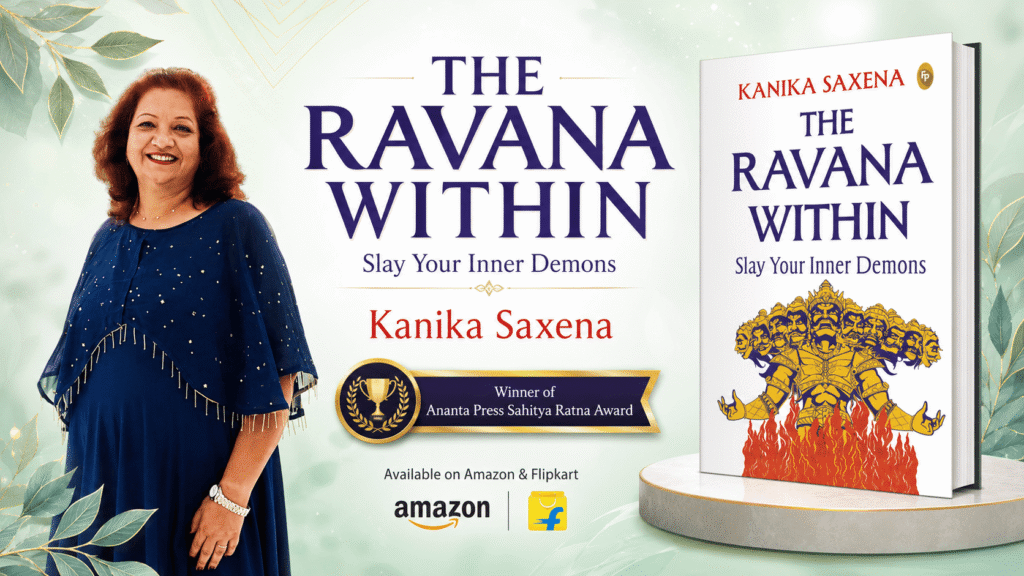
The Ravana Within: Slay Your Inner Demons is fundamentally a book about emotional responsibility. Its language is rooted in the Ramayana, but its concerns belong to everyday life: the argument we replay for hours, the apology we refuse to offer, the task we keep postponing, the success we secretly resent, the desire that becomes obsession, and the fear that persuades us not to try. Kanika Saxena gathers these experiences under the powerful image of Ravana within the self. By doing so, she presents personal growth not as a vague search for positivity but as a disciplined effort to recognise and regulate the forces that influence behaviour.
Emotional maturity is often mistaken for calmness. A person may appear calm while suppressing resentment, avoiding conflict, or disconnecting from feelings. True maturity involves awareness, expression, accountability, and choice. The book’s focus on ego, anger, greed, jealousy, procrastination, self-doubt, and attachment covers many of the points at which maturity is tested. Each trait asks a different question. Can I receive feedback without collapsing or attacking? Can I experience anger without becoming cruel? Can I pursue success without losing gratitude? Can I witness another person’s achievement without reducing my own worth? Can I act before motivation arrives? Can I separate caution from fear? Can I love without controlling?
These questions are more useful than generic commands to “be positive.” They acknowledge that personal development is built in difficult moments. A person does not discover patience when everything goes according to plan. Patience appears when plans fail. Humility is not proven when no one challenges us; it is proven when criticism arrives. Confidence is not the absence of self-doubt; it is the ability to move with self-doubt present. The Ravana Within seems designed to help readers recognise these testing points and respond with greater consciousness.
The book’s emphasis on taking responsibility for thoughts, choices, and actions is especially important in relationships. Many conflicts continue because both people are waiting for the other person to change first. Ego turns an issue into a contest. Anger enlarges the injury. Attachment creates fear of loss. Jealousy distorts interpretation. A person may believe that accepting responsibility means excusing another’s behaviour, but the two are not the same. We can hold someone accountable while still examining our own communication, boundaries, expectations, and reactions. Responsibility allows a reader to ask, “What part of this is mine to change?” That question can end cycles of helplessness.
At the same time, the book’s message can be applied without becoming self-punishing. There is a risk in self-help literature that readers may blame themselves for every difficulty. A healthier interpretation of the inner-demon framework recognises that awareness should lead to compassion as well as discipline. People develop defensive habits for reasons. Ego may protect an insecure sense of self. Anger may defend an unmet need. Procrastination may shield a person from the possibility of failure. Attachment may grow from loneliness. Understanding the origin of a pattern does not justify harmful behaviour, but it creates the conditions for wiser change. We are more likely to transform a habit when we understand what purpose it has been serving.
The book’s self-reflection exercises are therefore an essential feature. Reflection slows down the automatic cycle between trigger and reaction. Suppose a reader becomes angry when a colleague receives praise. Without reflection, the person may criticise the colleague, withdraw, or work from resentment. A reflective pause could reveal jealousy, fear of being overlooked, and an unmet need for recognition. The reader can then choose a constructive response: appreciate the colleague, seek feedback, communicate ambitions, or improve a skill. The external situation may remain the same, but the internal response becomes more intelligent.
This process can also build confidence. Confidence is often presented as a feeling that must arrive before action. In reality, confidence usually develops after repeated action. Kanika Saxena’s own professional journey illustrates this principle. Returning to work after years devoted to family, with limited computer knowledge and uncertainty about her options, she did not begin from a position of complete confidence. She practised typing, explored possibilities, faced rejection, entered a young workplace, learned, performed well, and became a team leader. Her later work as a freelancer, technology writer, life coach, speaker, YouTube creator, and author emerged from a series of actions rather than a sudden disappearance of fear.
This lived understanding can make the book meaningful for readers undergoing transition. A student choosing a direction, a parent returning to work, a professional changing careers, an entrepreneur facing uncertainty, or an older adult beginning a new chapter may all encounter an inner voice that says the opportunity has passed. Self-doubt becomes a Ravana head that speaks with authority despite lacking evidence. The book’s framework encourages the reader to question that authority. Is the thought true? Is it a prediction or a fact? What small action can be taken now? Such questions convert anxiety into movement.
The theme of attachment is equally significant for emotional maturity. Attachment is not simply love or commitment. It becomes problematic when personal peace depends entirely on a person, outcome, identity, possession, or plan. Life is unpredictable, and rigid attachment makes change feel like destruction. Learning to loosen attachment does not require indifference. It means caring deeply while accepting that we cannot control everything. This is one of the most difficult inner victories and one of the most liberating.
Greed and jealousy also receive fresh relevance in an age of constant comparison. Social media exposes people to carefully edited versions of other lives. Someone else appears more successful, attractive, productive, loved, or secure. The result can be dissatisfaction even when one’s own life contains much to appreciate. The book’s emphasis on inner demons helps readers treat comparison as a warning signal. Rather than allowing jealousy to become bitterness, the reader can ask what desire it reveals and whether that desire aligns with authentic values. Rather than pursuing more for the sake of display, the reader can define enough.
The Ravana Within is unique because it frames emotional regulation as heroism. The heroic act is not always dramatic. Sometimes it is remaining silent for ten seconds before speaking. Sometimes it is beginning a task for fifteen minutes. Sometimes it is admitting, “I was wrong.” Sometimes it is allowing another person to shine. Sometimes it is leaving a harmful pattern even when attachment resists. By connecting these choices with the epic language of inner battle, the book gives weight to the small decisions that build character.
Readers looking for a motivational book that also asks for honesty may find this work valuable. It does not place peace, confidence, or fulfilment at the end of external achievement. It places them within the practice of self-governance. The reader is invited to notice the inner reaction, understand its source, and choose a response aligned with the person they wish to become. That is emotional maturity in action.
Ultimately, The Ravana Within offers a hopeful message: our destructive tendencies are powerful, but they are not sovereign. Awareness can expose them, reflection can understand them, discipline can interrupt them, and repeated choices can weaken them. A person may not eliminate every inner conflict, but can become increasingly capable of leading the self rather than being led by impulse. That is a victory worth pursuing, and this book provides a culturally resonant language in which to begin.
Buy the book on Amazon: https://amzn.in/d/0cVDtzND