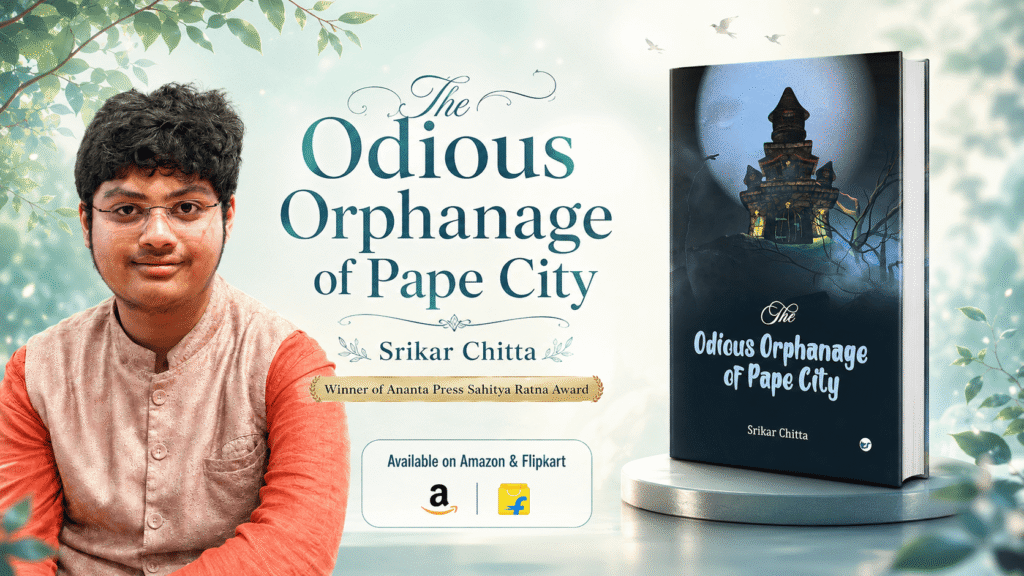
In conversations about children’s and middle-grade literature, one recurring question is how to find books that genuinely excite young readers without overwhelming them. Many children want stories with real tension, meaningful stakes, and imaginative settings, yet they may hesitate before long books with dense descriptions or slow openings. The Odious Orphanage of Pape City by Srikar Chitta answers that challenge remarkably well. It is a concise thriller packed with suspense, emotional clarity, and a memorable premise. The book’s brevity is not a weakness—it is one of its defining strengths, enabling it to offer an immediate and satisfying reading experience, especially for young or reluctant readers.
At the center of the novel is Chris, a boy who arrives at the ironically named “House of Victory” orphanage and quickly learns that it is anything but a place of hope. Instead of care and comfort, he finds an oppressive environment controlled by an evil warden. He is surrounded by unpleasant children, subjected to bizarre punishments, and forced to endure a miserable routine that includes unappetizing potato soup. As Chris begins to understand the institution’s true nature, the book becomes a tense struggle for survival, insight, and escape. The plot is clean and direct, which is part of what makes the story so effective.
One of the greatest achievements of the book is that it knows its audience. Young readers often respond strongly to narratives that begin with a clear disturbance and maintain strong forward movement. The Odious Orphanage of Pape City does exactly that. It establishes its conflict early, communicates the danger clearly, and then keeps raising the stakes. There is very little unnecessary delay. As a result, the reading experience feels active rather than passive. Readers are not waiting for the story to begin; they are inside it almost immediately.
This is particularly valuable for reluctant readers. A reluctant reader is not necessarily someone who dislikes stories. Often, such readers simply need books that reward attention quickly and keep them emotionally engaged. Srikar Chitta’s novel excels in this respect. It combines short-form readability with the intensity of a thriller. Each development matters. Each new revelation about the orphanage increases the tension. Each unpleasant encounter reminds Chris—and the reader—that he is trapped in an environment where comfort and fairness cannot be assumed.
The novel’s setting plays a major role in sustaining that engagement. The “House of Victory” is compelling because it embodies contradiction. The name suggests triumph, but the reality is misery. That ironic contrast is instantly understandable and emotionally powerful. Young readers are especially responsive to clear moral dissonance: a place that should help children instead harms them. The book uses that dissonance effectively, transforming the orphanage into a symbol of false promise. At the same time, the setting is filled with concrete details—the cruel warden, the mean children, the revolting soup, the harsh punishments—that make it feel vivid rather than abstract.
Chris is another reason the book works so well. He is easy to root for because his struggle is immediate and personal. Readers do not need a complicated psychological profile to care about him. They care because he is a child placed in a terrible situation and because his desire to survive is instinctively understandable. Yet he is not a flat protagonist. As the story unfolds, he comes to represent resilience and agency. He learns, observes, and endures. He does not possess magical power or unrealistic invulnerability. Instead, his strength lies in persistence. That makes him relatable and admirable at the same time.
The language and structure of the novel also deserve praise. Because the book is concise, the prose must work efficiently, and it does. The scenes move with purpose, the tone remains focused, and the suspense is sustained. For educators and parents trying to encourage reading, books like this are extremely useful because they demonstrate that literature can be both approachable and emotionally rich. A child who finishes a book like The Odious Orphanage of Pape City may come away with greater reading confidence, a stronger appetite for fiction, and a positive sense of accomplishment.
There is also educational value beneath the entertainment. Though the book is presented as a thrilling adventure, it raises important questions about authority, fairness, and courage. The evil warden is not just a villain for the sake of excitement. He represents the misuse of power. Chris’s experience invites readers to think about what happens when people in positions of responsibility become sources of fear instead of protection. The mean children, too, reflect the way hostile peer environments can intensify suffering. These elements can open meaningful discussions about bullying, empathy, institutional trust, and resistance to injustice.
What makes the book unique is the combination of its accessible form and its youthful authorship. Srikar Chitta wrote the novel while still very young, and that perspective gives the story an insider quality. The fears, humiliations, and hopes of childhood are not filtered through heavy adult distance. They feel immediate. For young readers, this can be particularly powerful. There is a sense that the book understands them from within. That authentic connection may help explain why the novel feels both energetic and emotionally convincing.
Another notable quality is the way the book balances darkness with readability. The atmosphere is certainly eerie and oppressive, but it never becomes so heavy that the story loses its sense of adventure. This balance matters in middle-grade fiction. Children often enjoy being scared in a contained, narrative way, especially when the story offers a strong protagonist and a meaningful path through danger. The Odious Orphanage of Pape City understands this perfectly. It gives readers a nightmare setting, but it also gives them momentum, suspense, and the possibility of triumph.
The brevity of the novel can also make it appealing in settings like classrooms, book clubs, or reading circles. Because it can be completed more easily than many longer books, it invites group discussion without becoming logistically difficult. Teachers might use it to discuss irony in the title, characterization through setting, or the concept of resilience under pressure. Young aspiring writers may also find inspiration in Srikar Chitta’s example. The very existence of this book sends an encouraging message: strong stories can come from young minds, and creativity deserves to be taken seriously.
If one were to summarize the book’s chief success, it would be this: it transforms a simple premise into a memorable reading experience through focused storytelling. The plot is easy to follow, but the emotions are not shallow. The characters are accessible, but the themes are not trivial. The book is short, but it leaves an impression. These are not easy balances to achieve, and Srikar Chitta handles them with surprising confidence.
Ultimately, The Odious Orphanage of Pape City is a valuable and enjoyable book for young readers, particularly those who want suspense without excessive length. It shows how a compact novel can still offer atmosphere, strong stakes, and meaningful emotional resonance. Chris’s story is frightening, engaging, and inspiring in equal measure. For parents seeking a gripping read, for educators encouraging reading fluency, and for children who enjoy dark adventures, this book is an excellent choice. It proves that a story does not need hundreds of pages to capture imagination. Sometimes, all it needs is a strong premise, a brave protagonist, and a writer who knows how to keep the pages turning.
Amazon Link: https://www.amazon.in/Odious-Orphanage-Pape-City/dp/9394437614/