Why another time-management book would miss the point
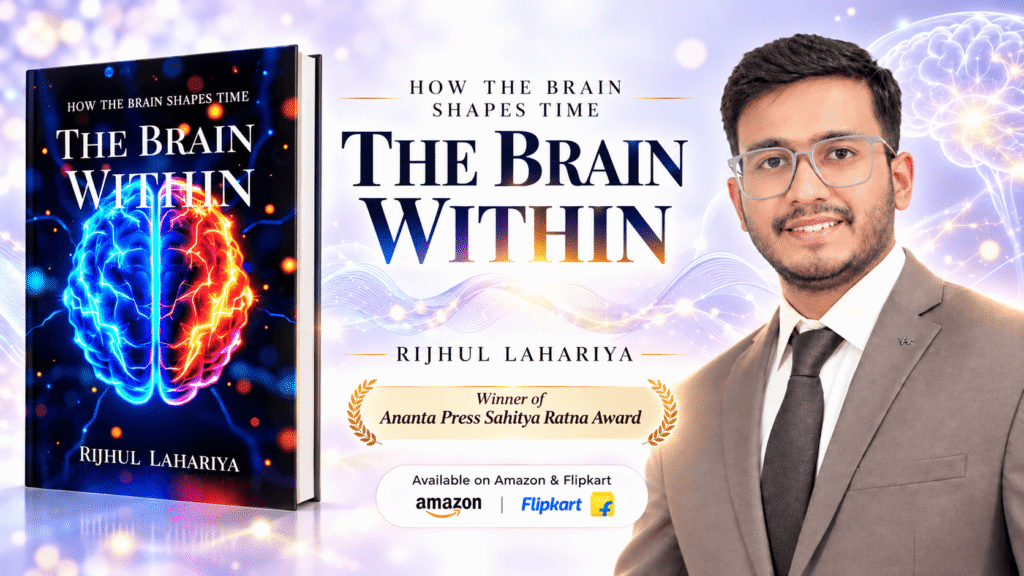
Modern culture offers an endless supply of advice on calendars, schedules, goals, and efficiency. The assumption behind much of it is simple: if we arrange our hours correctly, our relationship with time will improve. The Brain Within: How the Brain Shapes Time questions that assumption from the ground up. Dr. Rijhul Lahariya distinguishes the minutes recorded by devices from the minutes people actually live. This difference is not academic when someone ends a full day feeling as though nothing meaningful happened, or when a quiet hour of waiting becomes strangely exhausting. The book is therefore timely without needing to chase a trend. It speaks to an age of overflowing notifications and constant pressure by asking a deeper question than how to do more. What makes time feel hurried, shapeless, stretched, or usable in the first place? That shift is the work’s defining advantage over conventional productivity writing. It treats temporal dissatisfaction as a question about attention, memory, physiology, and meaning rather than merely faulty scheduling.
The difference between busyness and continuity
The chapter “Time Breaking into Fragments” offers a particularly sharp lens for contemporary working life. A person can respond to messages, switch between tasks, plan the next meeting, and monitor several concerns while never feeling that a single action has arrived at completion. Lahariya describes a rush of mental events without corresponding continuity. It is a helpful account of why acceleration and progress can feel so different. A high count of activities does not necessarily produce a coherent experience. This distinction applies well beyond offices. Students jump between learning materials and alerts; parents move between overlapping responsibilities; people at home live inside digital environments that rarely provide a natural end point. The chapter’s account of event segmentation turns a vague complaint—“I was busy all day but achieved nothing”—into a question about attention and closure. It does not offer a sweeping technological diagnosis, but its framework gives readers a more precise language for the fragmentation common in technology-saturated routines.
Why routine can erase the feeling of a year
At the other end of the spectrum is repetition. A predictable schedule may be efficient and even comforting, but long stretches of similarity can make remembered time feel abbreviated. In “Past Glooms, Future Blooms,” the book explores how repeated events are compressed in memory while unusual experiences leave more distinct markers. The difference between a routine week and a short journey full of new sights is an accessible illustration. The argument does not condemn routine, which can support health and stability; it simply distinguishes its practical benefits from its effect on retrospective richness. This tension is especially relevant for adults who ask where the last few months went. The clock has not secretly accelerated, but memory may have stored a relatively small number of distinctive landmarks. From this perspective, an interesting life is not necessarily one with the most obligations. It may be one with moments differentiated enough to be noticed, connected, and remembered. The book opens that reflection without prescribing a lifestyle or glamorizing novelty for its own sake.
Anticipation makes tomorrow feel near or impossibly far
The account of future-oriented time also has consequences for work and study. A deadline can be visible on a calendar yet emotionally distant, while an imminent appointment can dominate attention. Lahariya considers how anticipation and the felt reality of future outcomes influence effort. His discussion suggests why enormous goals often fail to guide the next small action: the person understands the goal in words but does not necessarily experience a usable path toward it. That insight is more subtle than telling readers to break tasks into smaller pieces. It supplies a reason that smaller, meaningful milestones may help a person feel forward movement. Equally important is the role of uncertainty. Waiting for an application result, a medical report, or a significant reply can stretch the present, even when no action is possible. A conventional schedule cannot resolve that felt duration. The book encourages readers to recognize anticipation as an active mental and bodily state, one that can shape how effort and patience are experienced.
Rhythm as a counterpoint to relentless intensity
In “Healing Through Re-Timing the Lived Moments,” the author discusses the value of predictable rhythms and experiences with recognizable beginnings and endings. There is an immediate everyday relevance to this perspective. A short period of focused study that concludes cleanly can feel more complete than hours of unfocused presence. A repeated daily structure can help make activity legible when life otherwise feels chaotic. Lahariya also explores music, movement, bodily rhythms, and simplified surroundings as forms of temporal support in relevant care settings. Those discussions should not be read as one-size-fits-all interventions; they are invitations to consider why pacing and structure matter. What stands out is the refusal to equate intensity with value. More hours do not automatically mean more learning, and constant effort does not guarantee the feeling of progress. The book’s language of completion and continuity supplies a welcome alternative to a culture that often celebrates exhaustion as proof of seriousness.
Not a manual of tricks, and better for it
Readers seeking an aggressive thirty-day program to transform their schedules may initially find this book unusual. It does not present a succession of checklists that promise control over every hour. Its closing message is almost the opposite: the goal is not to defeat time but to understand how it is lived. That choice gives the work a reflective quality. It allows difficult experiences to remain difficult while making them more intelligible. Even the discussion of healing is offered as a conceptual framework rather than an instruction to change treatment independently. The distinction matters because a human brain is not an underperforming machine waiting for a more efficient operating system. Emotional state, health, attention, and social circumstances affect the capacity to make use of an hour. The book is most useful when it changes the questions we ask about ordinary difficulties. Instead of “Why did I waste today?” it suggests asking whether the day had clear sequences, manageable demands, and a future to which effort could meaningfully connect.
The strengths and boundaries of the approach
Lahariya’s style is concise and conversational. The early chapters explain the neuroscience through simple scenes, while the later chapters extend the same framework to anxiety, trauma, diminished future orientation, and disrupted continuity. That makes the book approachable for general readers, although anyone wanting a research-heavy treatment of digital distraction or organizational psychology should recognize that these are applications of its central ideas rather than its main empirical subject. Its scientific explanations can be broad, and different people may experience the same routine very differently. A predictable day can be soothing to one person and stifling to another. Similarly, altered time perception cannot explain every source of workplace burnout or distress. These boundaries are worth keeping in view. The book’s value is not a universal theory of modern dissatisfaction. It is a way to notice how temporal texture contributes to experiences we too quickly label laziness, inefficiency, or lack of motivation.
A quieter definition of a well-used hour
The Brain Within succeeds when it leaves readers less eager to count the minutes and more interested in whether those minutes form a life they can recognize. It offers a conceptual bridge between the neuroscience of changing brain states and the pressures of contemporary routines. Attention, novelty, anticipation, closure, and rhythm become useful ways of talking about a day without reducing that day to a performance score. This makes the book relevant to professionals, students, educators, caregivers, and readers who simply feel chronically out of step with their calendars. A good hour, it suggests, may not be the hour packed with the most activity. It may be the hour in which an experience develops, matters, and reaches a natural conclusion. In a world that repeatedly asks people to accelerate, Lahariya’s central achievement is to make the quality of temporal experience worth examining. That is an important and surprisingly liberating difference from the usual productivity conversation.
AMAZON PURCHASE LINK https://amzn.in/d/01dDrqvA