A Beautiful Collection of Poems Filled with Hope, Courage, and Inspiration
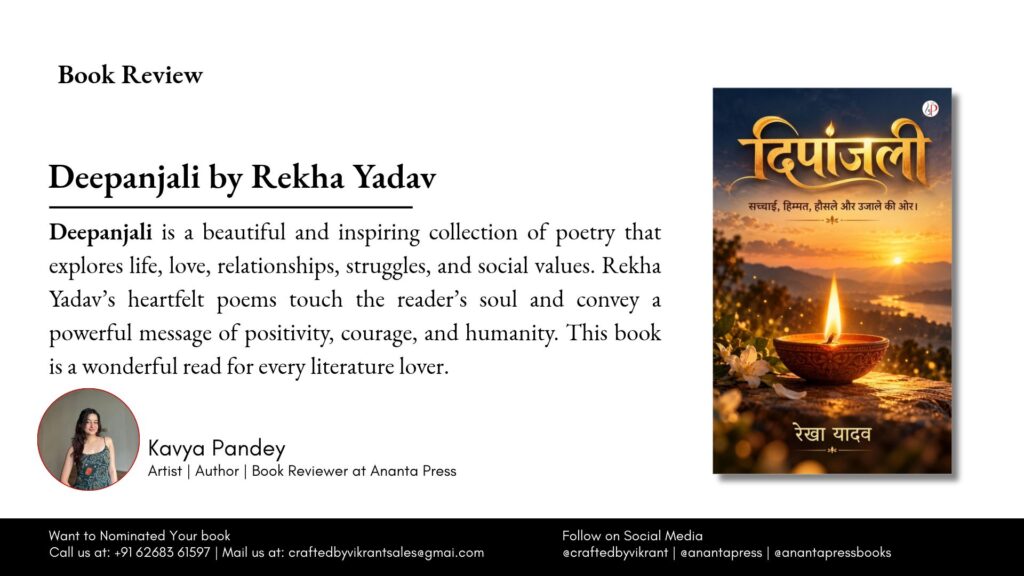
Deepanjali, written by Rekha Yadav, is an inspiring collection of Hindi poems that celebrates the beauty of life while encouraging readers to develop courage, kindness, responsibility, and a positive outlook. The title itself evokes the image of a lamp offering light, and this idea beautifully reflects the central spirit of the book. Through her poetry, the author encourages readers to move towards truth, confidence, hope, and a brighter future, even when life becomes difficult.
This collection is more than a gathering of verses. It offers reflections on everyday experiences, family relationships, social responsibilities, women’s strength, education, patriotism, nature, and the importance of good values. The poems explore subjects that are closely connected to ordinary life, making the book accessible to readers from different backgrounds. Its greatest strength lies in its effort to connect meaningful messages with familiar emotions and situations.
A Message of Hope in Everyday Life
One of the most appealing qualities of Deepanjali is its emphasis on hope and perseverance. Life is rarely a smooth journey, and every person encounters difficulties, disappointments, and moments of uncertainty. The collection encourages readers not to surrender when circumstances become challenging. Instead, it promotes courage, determination, and the willingness to keep moving forward.
The poems associated with courage and confidence remind readers that meaningful achievements require patience, hard work, and faith in one’s abilities. Dreams cannot become reality through wishes alone; they demand effort, discipline, and a readiness to overcome obstacles. This message is particularly valuable for young readers who are working towards personal, educational, or professional goals.
The book also presents a positive attitude as an important source of inner strength. A hopeful person does not necessarily have an easy life, but hope can help that person face difficulties with greater confidence. By emphasizing determination and constructive thinking, Rekha Yadav encourages readers to look beyond temporary setbacks and continue working towards a better tomorrow.
The Importance of Courage and Cooperation
Courage is another significant theme that runs through the collection. The poems suggest that success requires more than ambition. It also requires the willingness to act, the discipline to remain committed, and the strength to face difficulties without losing sight of one’s purpose.
The message becomes especially meaningful when the author connects personal development with social responsibility. Readers are encouraged not only to improve their own lives but also to contribute positively to their families, communities, and country. This perspective gives the poems a broader purpose: personal success becomes more valuable when it is accompanied by compassion and a willingness to help others.
Cooperation is presented as an essential part of a fulfilling life. Difficult situations often become easier when people support one another, share their responsibilities, and approach problems with understanding. The collection encourages readers to replace selfishness with consideration and to recognize the value of collective effort.
These ideas are relevant in a world where competition and personal achievement often receive considerable attention. Deepanjali reminds us that individual progress and the well-being of others do not have to be separate goals. Through mutual respect, helpfulness, and shared responsibility, people can build stronger relationships and more harmonious communities.
Family, Love, and Emotional Connections
Family relationships form another important part of the book’s emotional world. The poems explore the love, sacrifices, and responsibilities that connect parents and children. They encourage readers to recognize the value of family members and to appreciate the efforts that often go unnoticed in everyday life.
The poem dedicated to parents draws attention to the sacrifices parents make while raising their children. Their care, guidance, and affection continue over many years, often without expectations of material rewards. The poem invites readers to reflect on the importance of respecting parents and responding to their love with gratitude, care, and affection.
This theme carries a meaningful reminder for readers of all ages. As children grow older and become occupied with their own responsibilities, they may sometimes overlook the emotional needs of their parents. The book encourages readers to preserve these relationships through understanding, communication, and genuine concern.
The collection also celebrates the special place of a mother in a child’s life. The poem Meri Pyari Maa expresses the tenderness associated with a mother’s care, from feeding and teaching a child to offering comfort during illness and difficult moments. Such experiences are familiar to many readers, which gives the poem an intimate and heartfelt quality.
Rather than treating love as an abstract idea, these poems connect it with everyday acts of care. A parent’s sleepless night, a comforting word, patient guidance, or a helping hand can become powerful expressions of affection. This attention to ordinary moments makes the collection emotionally relatable.
Women’s Strength, Identity, and Self-Respect
A particularly meaningful aspect of Deepanjali is its attention to women’s experiences and achievements. The poem Sahasi Nari celebrates a woman who chooses struggle over comfort, self-respect over humiliation, and personal identity alongside her responsibilities. It recognizes the determination required to manage different aspects of life while continuing to pursue one’s goals.
The poem presents strength not simply as physical courage but also as emotional resilience, dignity, and the ability to make difficult decisions. It acknowledges that a woman’s journey may involve sacrifices and challenges, yet it also emphasizes her capacity to shape her identity and contribute meaningfully to her family and society.
Another noteworthy perspective appears in the poem Main Aisi Hi Hoon, which reflects the experiences of an ordinary woman whose happiness is closely connected with her family. She finds satisfaction in caring for loved ones, supporting her children’s progress, and creating a warm home. At the same time, she maintains personal interests, including gardening, sewing, and expressing her emotions through poetry.
This portrayal recognizes the value of domestic care without reducing a woman’s identity to a single role. It also highlights the quiet creativity and emotional richness that may exist within an ordinary routine. The poem invites readers to appreciate the work, affection, and dedication that often sustain family life.
Together, these poems encourage respect for women’s choices, contributions, and aspirations. They remind readers that strength can appear in many forms: pursuing a career, raising a family, protecting one’s dignity, developing personal talents, or continuing to move forward despite hardship.
Social Awareness and Responsibility
Beyond personal emotions and family relationships, Deepanjali addresses concerns that affect society as a whole. The collection encourages readers to think about the consequences of their choices and the responsibilities they share as members of a community.
One important example is the poem addressing substance abuse and the need for a drug-free society. It draws attention to the damage addiction can cause to individuals and families, while connecting the issue with the future of young people and the progress of the nation. Its message emphasizes the importance of awareness, collective responsibility, and preventive action.
The poem encourages families and communities to recognize that the well-being of young people is closely connected with the well-being of society. When addiction disrupts education, health, relationships, and opportunities, its effects extend beyond one individual. The call for awareness therefore becomes a call for a more responsible and caring social environment.
The collection also touches upon the importance of education. It expresses the hope that children should have access to educational facilities and that capable young people should receive fair opportunities for employment. The concern about examination paper leaks, corruption, and unequal opportunities reflects a desire for a system in which merit, learning, and hard work receive proper recognition.
These themes give the book a socially conscious dimension. The author does not restrict poetry to private feelings; she also uses it to express concerns about the institutions and values that influence people’s lives. Readers are encouraged to think about how honesty, fairness, education, and collective action can contribute to a stronger society.
Good Behaviour and Human Values
The poem Sadvyavahar highlights the importance of good conduct in everyday relationships. Its central message is straightforward: people who wish to receive kindness and respect should also treat others with consideration. Behaviour influences the quality of our relationships, and thoughtful communication can help prevent unnecessary conflict.
The poem also draws attention to the lasting impact of words. Harsh speech can hurt deeply, sometimes leaving emotional wounds long after a disagreement has ended. By encouraging readers to think before speaking, the collection promotes patience, respect, and sensitivity towards others.
This is a valuable lesson because good behaviour is not limited to formal manners. It includes listening carefully, understanding different perspectives, accepting responsibility, and recognizing the dignity of others. These qualities are essential within families, workplaces, schools, and communities.
The broader message of Deepanjali is that good values must be reflected in actions, not merely expressed in words. Honesty, kindness, cooperation, and respect become meaningful when people practise them in their daily lives. In this way, the collection encourages readers to consider how small personal choices can help create a more peaceful environment.
Nature, Beauty, and Appreciation of Life
The book also makes room for the beauty of the natural world. The poem Barish Ki Boonden celebrates the arrival of rain and its importance to the earth. Rain nourishes fields, supports crops, fills rivers and ponds, encourages greenery, and brings happiness to farmers and other people who depend on nature.
The poem invites readers to notice the many ways in which rain contributes to life. Its imagery connects natural beauty with human well-being, reminding us that the environment is not separate from our everyday experiences. The changing landscape, the movement of water, and the freshness associated with rainfall become sources of joy and reflection.
Importantly, the poem also recognizes the destructive potential of floods. It expresses the need for measures that can reduce flood-related damage and suggests that technology, science, and new ideas should be used to address such challenges. This balance between appreciating nature and acknowledging its risks gives the poem a practical dimension.
The treatment of rain reflects a wider message: gratitude for nature should be accompanied by responsibility towards it. Natural resources support agriculture, livelihoods, and countless forms of life. Appreciating them means understanding their value and working to protect the communities that depend on them.
Patriotism and the Desire for a Better Nation
Patriotism and service to the nation are also reflected in the collection’s emphasis on duty, education, hard work, and the responsibility to overcome social problems. The poems encourage readers to become constructive contributors to their country rather than remaining passive observers.
The idea of national progress is connected with the development of individuals. Young people are encouraged to cultivate good thoughts, work sincerely, and use their abilities for worthwhile purposes. The collection suggests that the future is shaped by the values and actions of the people who build it.
This form of patriotism focuses on responsibility as much as pride. Loving one’s country can mean supporting education, treating others fairly, resisting harmful social practices, and helping create opportunities for future generations. It can also mean recognizing that meaningful progress requires cooperation among people with shared goals.
Such messages are particularly relevant for younger readers, who are still developing their understanding of citizenship and personal responsibility. The poems encourage them to see their ambitions as part of a larger picture in which individual growth and social progress can reinforce each other.
Writing Style and Reader Appeal
The most accessible feature of Deepanjali is its choice of familiar subjects. Family affection, personal struggle, women’s experiences, education, social concerns, nature, and patriotism are themes that many readers can recognize from their own lives. This familiarity helps the collection communicate its messages without requiring specialized literary knowledge.
The poems generally work through clear ideas and emotionally recognizable situations. Rather than concentrating exclusively on abstract philosophical questions, they draw attention to the values and experiences that shape daily life. This makes the book suitable for readers who appreciate poetry with an inspirational and socially aware purpose.
The collection’s variety is another strength. Readers can move from reflections on courage and personal growth to the tenderness of a poem about a mother, the responsibilities associated with family relationships, or the natural beauty of rainfall. This range allows the book to appeal to different interests and emotional experiences.
Because many poems communicate direct moral or social messages, readers may find them particularly useful for personal reflection and discussion. Parents, teachers, and students can use the themes as starting points for conversations about respect, responsibility, education, environmental awareness, and the importance of treating people kindly.
The book’s emphasis on everyday values also makes it suitable for readers who want poetry that offers encouragement alongside emotional expression. Its purpose is not merely to entertain but to invite readers to think about their own choices and the kind of life they wish to build.
Overall Impression
Deepanjali by Rekha Yadav is a heartfelt collection that brings together personal emotions, inspirational ideas, and social concerns. Its poems encourage readers to face difficulties with courage, value the love of their families, respect women’s strength, support education, practise good behaviour, appreciate nature, and contribute to society.
One of the collection’s central strengths is its belief that meaningful change begins with individuals. A kinder word can improve a relationship. Gratitude can strengthen family bonds. Courage can help a person continue after disappointment. Education can create opportunities, while cooperation can help communities address shared challenges. These may seem like simple ideas, but they are important foundations for a thoughtful and responsible life.
The book also recognizes that inspiration is most useful when it encourages action. Hope should lead to perseverance, love should be expressed through care, respect should appear in behaviour, and concern for society should motivate people to contribute constructively. By returning to these ideas through different subjects, the collection offers readers several opportunities to reflect on their own experiences.
Readers who prefer poetry centred on human emotions, moral values, and positive social messages are likely to find the collection meaningful. Those interested in family relationships, women’s empowerment, personal development, and the relationship between individuals and society may especially appreciate its themes.
Ultimately, Deepanjali lives up to the image suggested by its title: a gathering of thoughts intended to bring light, warmth, and encouragement into the reader’s life. Rekha Yadav’s collection invites us to look beyond temporary difficulties, recognize the value of our relationships, and remember the importance of courage, compassion, and responsibility.
Final Verdict: Deepanjali is an encouraging and thought-provoking collection of Hindi poetry that celebrates life’s simple joys while addressing meaningful personal and social concerns. It is a worthwhile choice for readers who enjoy inspirational poetry and believe that literature can remind us of the values that make life more compassionate, purposeful, and hopeful.