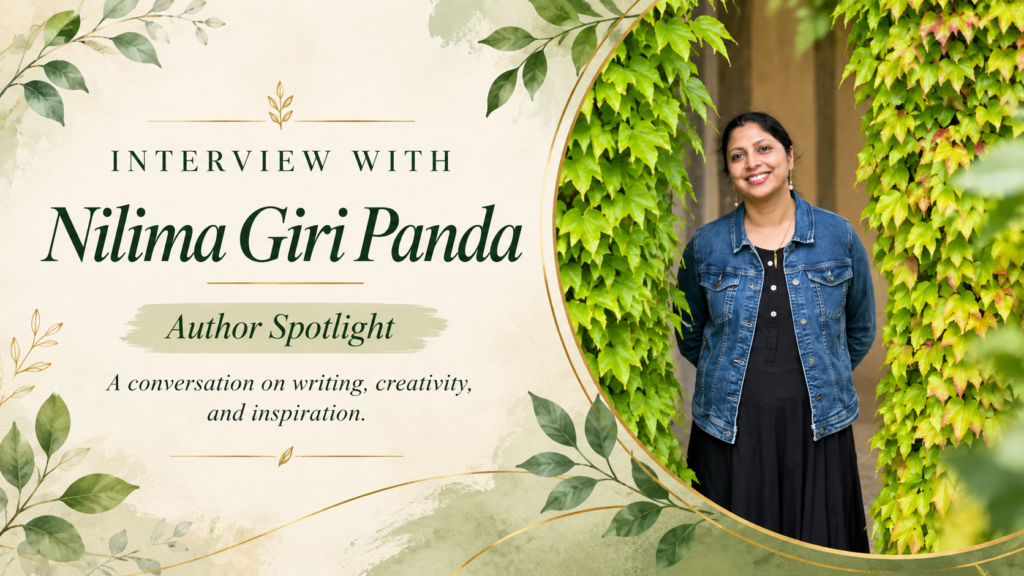
Rajat Kumar – The relationship between Manav and Chitralekha develops through years of familiarity, disagreements, shared responsibilities, and changing emotions. What do you believe distinguishes lasting love from temporary attraction?
Nilima Giri Panda – “Temporary Attraction is a spark that can ignite in an instant, but lasting love is the flame that is intentionally tended over time. Through years of familiarity, sharp disagreements, and heavy shared responsibilities, Manav and Chitralekha show us that real love isn’t just a feeling—it is a choice.
The true pillars that distinguish enduring love from temporary attraction are intentions and commitments. Attraction sees a person for what they give you in a moment; commitment sees a person for who they are and chooses to stand by them through every phase of life. When life brings grief, unexpected responsibilities, and changing circumstances, pure attraction fades under the weight—but honest intentions and steadfast commitment adapt, endure, and only grow stronger.”
Rajat Kumar – The story challenges the idea that family is defined only by biological relationships. What message would you like readers to take away about chosen families and the bonds created through care and responsibility?
Nilima Giri Panda – “If blood relationships were automatically strong and unbreakable, we wouldn’t see newborn babies abandoned on streets or elderly parents left alone in old age homes. Blood gives us a starting point, but it is not what holds us together when life gets hard.
The true bond of family isn’t written in DNA—it is forged in daily care, selfless responsibility, and the choice to stand by someone day after day. A chosen family, built on compassion and commitment, can be far stronger and more resilient than any biological tie. My message to readers is that love is an action, not an inheritance. Wherever there is genuine care, accountability, and shelter from the cold, that is where true family lives.”
Rajat Kumar – The novel moves between light-hearted humour and profoundly emotional moments of grief, separation, and loss. How did you balance these contrasting emotions without losing the story’s natural flow?
Nilima Giri Panda – “I didn’t design the balance between light-hearted humour and heavy emotional moments as a literary technique; I simply received the story as a reflection of any person’s daily life. Real life does not pause its small moments of laughter just because we are grieving, nor does grief vanish when we laugh.
When we lose people we love, we never forget them, nor do we stop missing them. We simply try to learn how to live without them. It is immensely difficult, but life places others in our path who still need us—our children, our aging parents, our friends, and our society. Even in the depths of our sorrow, we must wake up and fulfil our duties. The natural flow of the story comes from that exact reality: finding the courage to carry our grief gently in one hand while using the other to serve, love, and show up for those who are still here.”
Rajat Kumar – Characters such as Anupama and Dr. Chitranjan Shukla represent compassion, guidance, and the importance of community. How significant are older generations and parental figures in shaping the emotional foundations of your story?
Nilima Giri Panda – “Parental figures and older generations are exceptionally important—they are the very roots that keep a family grounded. I live with my in-laws and my father, and I know firsthand the quiet grace they bring into a household. Because of them, no matter how old we get or how many responsibilities we take on, we still get to be children in their presence.
Characters like Anupama and Dr. Chitranjan Shukla carry that exact warmth and wisdom. They aren’t just background figures; they represent compassion, guidance, and the vital strength of community. They give the younger generation a safe space to fall, learn, and grow. Having that loving canopy above us reminds us where we come from and gives us the courage to build a better world for those who come after.”
Rajat Kumar – The story is set in Vrindavan Baseera, surrounded by mountains, close-knit communities, an animal clinic, and a children’s home. How important was this setting to the atmosphere and emotional identity of the novel?
Nilima Giri Panda – “The setting was immensely important to the soul of this novel. For too long, our narrative of progress has suggested that growth and success only happen in bustling metro cities. But true development needs to reach our smaller communities, towns, and sanctuaries as well.
Vrindavan Baseera—nestled amid the quiet strength of the mountains, with its close-knit neighbourhood, animal clinic, and children’s home—is not just a backdrop; it is our emotional anchor. Our roots are our identity. That is why Chitralekha came back, Manav came back, Agastya returned after a full decade, and Samir did the same. They didn’t view returning home as a step backward; they brought their expertise, knowledge, and hearts back to nurture the soil that raised them. Vrindavan Baseera shows that when we choose to give back to our hometowns, we build communities where love, compassion, and true progress can thrive side by side.”
Rajat Kumar – Jay’s passion for painting becomes an important part of his personal growth. What inspired you to make art a form of expression, confidence, and emotional healing in his journey?
Nilima Giri Panda – “This aspect of the story is deeply personal to me. Both of my sons are wonderful artists, and they were fortunate to have an incredible teacher who mentored and groomed them through the years. Watching them grow through their art showed me firsthand that having a hobby or a genuine passion isn’t just an extra pastime—it is an absolute necessity in everyone’s journey of life. It grounds us, gives us a quiet sanctuary, and builds confidence from within.
Making painting Jay’s form of expression was my way of honouring that transformative power of art. For a young person, art becomes a language when words fall short, an anchor for emotional healing, and a source of quiet strength. In fact, that connection comes full circle in real life: the cover page of this book was designed by my younger son, and the boy on the cover painting ‘YES’ is Jay himself. It stands as a living tribute to how passion, mentorship, and creative expression can paint warmth and hope into our world.”
Rajat Kumar – Agastya Raj Singhania brings another dimension to the novel through his quiet devotion, sacrifices, and complicated emotional journey. What inspired you to create this character, and what does his story reveal about love that remains unspoken?
Nilima Giri Panda – “Agastya Raj Singhania represents a love that is selfless, deep, and silent—the kind of devotion that doesn’t demand ownership or recognition to be real. Not every profound love story is loud, and not every emotion needs to be spoken to carry immense weight.
I was inspired to create Agastya because in life, some of the most beautiful sacrifices are made in complete silence. His character reveals that true love isn’t about claiming someone for yourself; it is about genuinely caring for their happiness, protecting them from afar, and standing as a rock behind them, even when your own heart is breaking. Through his complicated emotional journey and quiet devotion, Agastya shows that unspoken love is not a failure of courage, but a supreme form of grace, patience, and honour.”
Rajat Kumar – Forgiveness, misunderstandings, hidden truths, and second chances play significant roles throughout the book. Do you believe genuine love can overcome the passage of time, emotional pain, and difficult circumstances?
Nilima Giri Panda – “Forgiveness, misunderstandings, hidden truths, and second chances—aren’t they an inevitable part of all our lives? They happen every single day to each one of us. But how do we overcome them? Why do we choose to forgive? It is simply because of love and trust.
Yes, I truly believe genuine love can overcome the passage of time, emotional pain, and the most difficult circumstances—but it is never easy. It requires a quiet strength that the world rarely sees: lots of unshed tears, incredible resilience, deep empathy, and immense personal sacrifice.
True love demands that we remain positive rather than bitter, even when life doesn’t turn out the way we hoped. The ultimate test of love is being able to continue wishing someone well, holding good thoughts for them in your heart, even if they are no longer in your life or if they chose a different path. Forgiveness and second chances aren’t about holding onto a person; they are about letting love transcend hurt, proving that genuine affection leaves no room for malice—only grace.”
Rajat Kumar – You have acknowledged your family’s contribution to your debut novel, including your son Archit, who designed the book cover. What was it like transforming a long-held personal dream into a published book with your family’s encouragement and involvement?
Nilima Giri Panda – “The feeling is completely surreal. When you carry a dream for so long, self-doubt naturally creeps in—I had so many doubts along the way. But my family became the gentle force that kept me moving forward.
My elder son read my very first rough draft and told me it was ‘too kind and good’—a feedback that gave me the initial push to believe in my own voice. When I hesitated, my father and my husband stepped in with unwavering support, encouraging me to finalize the manuscript and publish it. They told me, ‘Even if only one copy gets printed, it’s completely okay as long as you are happy.’
Having that kind of unconditional backing—along with my younger son, Archit, designing the book cover—turned writing from a solitary goal into a shared celebration. It proved to me that family encouragement isn’t just helpful, but it turns a quiet wish into a living reality.”
Rajat Kumar – Finally, when readers reach the last page of YES – Love Will Find a Way, what is the one emotion, realisation, or message you hope they will carry with them into their own lives?
Nilima Giri Panda – “When readers turn the final page and close the book, the one realization I hope stays rooted in their hearts above all else is empathy.
I hope they carry a deeper, gentler understanding for the people around them. In a world where it is so easy to judge, react, or walk away, empathy allows us to look past someone’s rough edges, silence, or mistakes and see the quiet struggles they might be carrying. If this story reminds readers to pause, listen with open hearts, and choose compassion over conflict in their daily lives, then the purpose of writing this book will be truly fulfilled. Because when we choose empathy, we choose love—and love will always find a way.”