Introduction
The media industry is changing at remarkable speed. Traditional newspapers, radio, and television now operate alongside digital platforms, social media, OTT services, artificial intelligence, and data-driven content ecosystems. Behind this transformation lies an equally important subject that is often less visible to audiences: the business and management of media.
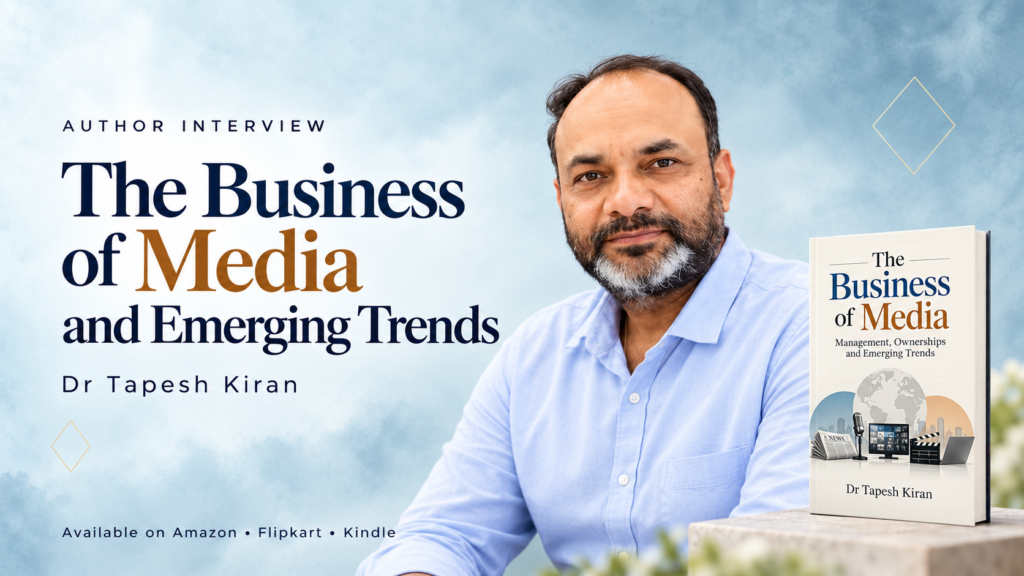
In his book, The Business of Media: Management, Ownerships and Emerging Trends, Dr Tapesh Kiran brings together academic concepts and professional experience to explain how modern media organisations are managed, how ownership influences their functioning, how technological change is reshaping business models, and what future media professionals need to understand.
The book has been designed as both an academic and practical resource, covering management fundamentals, media management, ownership structures, organisational operations, legal concerns, emerging trends, and different media business models.
In this detailed conversation, Dr Tapesh Kiran discusses the inspiration behind the book, the relationship between creativity and profitability, changing media ownership patterns, digital transformation, artificial intelligence, and the future of traditional and digital media.
About the Book
The Business of Media: Management, Ownerships and Emerging Trends
The Business of Media: Management, Ownerships and Emerging Trends presents a comprehensive understanding of media as both a creative industry and a complex business environment.
The book begins with the fundamentals of management and discusses concepts such as planning, organising, staffing, directing, coordinating, controlling, decision-making, and resource management. It then places these principles within the specific context of media organisations.
The discussion extends to media ownership and business structures, helping readers understand how ownership patterns can affect organisational objectives, investment decisions, management priorities, and business strategies. It also examines the operations and organisational structures of newspapers, radio stations, and television organisations.
Another significant part of the book focuses on legal concerns and emerging developments across radio, television, cinema, and digital media. It also examines family-owned, corporate-owned, and state-owned media while discussing the relationship between profitability, public responsibility, modernisation, and institutional interests.
The book ultimately encourages readers to understand how media organisations respond to change and how management decisions influence the media that audiences consume.
Q.1 What inspired you to write The Business of Media: Management, Ownerships and Emerging Trends?
Ans. 1 I was inspired to write this book because there is relatively limited student-oriented material specifically focused on media management, particularly from both academic and practical perspectives. The growing importance of media conglomerates, changing ownership patterns, competition, and the transformation of media into a complex business environment also motivated me.
With around 17 years of professional experience in media marketing and management, I wanted to bring my practical industry experience into an academic framework. Through this book, I have tried to provide students with clear, relevant, and practical knowledge of media management, while also helping them prepare for their examinations.
Q.2. How did your professional and academic experience influences the ideas and examples used in this book?
Ans.2 My professional experience of around 17 years in media marketing and management has strongly influenced the ideas presented in this book. It helped me understand the practical functioning of media organisations, including marketing, management, ownership, competition, and changing business models. My academic experience further helped me organise these practical observations into a structured and student-friendly format. I have therefore tried to combine practical industry experience with academic concepts, so that the examples and discussions are relevant, realistic, and useful for students as well as media professionals.
Q.3. Why is understanding management so important for students and professionals working in the media industry?
Ans.3. Management is important because media is not only a creative field but also a business and organisational environment. Professionals need to understand how to plan, organise, manage resources, lead teams, control costs, and respond to changing audience and market needs. For students, knowledge of management provides a better understanding of how media organisations actually function and prepares them for the practical challenges of the industry. In today’s competitive and rapidly changing media environment, management skills are therefore essential for both professional growth and organisational success.
Q.4. You describe media as both a creative field and a business environment. How can media organisations balance creativity with profitability?
Ans.4. Media organisations need to maintain a balance between creative freedom and sound business decisions. Creativity is essential for producing original and engaging content, while profitability is necessary for the organisation’s sustainability. This balance can be achieved through proper planning, understanding audience preferences, efficient use of resources, and effective marketing and revenue strategies. In my view, successful media organisations are those that encourage creativity while also keeping in mind audience demand, market realities, and financial sustainability.
Q.5. In your view, how does media ownership influence editorial decisions, organisational priorities, and business strategies?
Ans.5. Media ownership can have a significant influence on the overall direction of a media organisation. Ownership structures often shape organisational priorities, investment decisions, expansion plans, and business strategies. They may also influence editorial priorities, directly or indirectly, depending on the organisation’s management structure and policies. However, professional journalism also requires editorial independence and ethical standards. Therefore, a healthy media organisation needs to maintain an appropriate balance between business interests, ownership objectives, and editorial responsibility.
Q.6. What are the biggest differences between managing a newspaper, radio station, television channel, and digital media platform?
Ans.6 The basic principles of management remain similar, but each medium has different operational and audience requirements. A newspaper focuses on print production, distribution, circulation, and advertising; radio requires programme scheduling, audience engagement, and transmission management; television involves higher production costs, programming, technology, and distribution; while digital media requires continuous content updates, audience analytics, social media engagement, and technological adaptability. Therefore, media managers need to understand the specific characteristics, business models, and audience behaviour associated with each platform.
Q.7. Your book discusses planning, organising, staffing, directing, and controlling. Which of these management functions is most challenging in today’s media organisations, and why?
Ans.7. In today’s rapidly changing media environment, planning is perhaps the most challenging function. Audience preferences, technology, platforms, and revenue models are changing very quickly. Media organisations have to plan their content, resources, workforce, and investments while anticipating future trends. At the same time, effective planning must remain flexible enough to respond to unexpected changes in the market. Therefore, media managers need both strategic thinking and the ability to adapt quickly.
Q.8. How has digital technology changed the traditional business model of media companies?
Ans.8. Digital technology has fundamentally changed the way media companies create, distribute, and monetise content. Earlier, media organisations largely depended on circulation, subscriptions, advertising, and limited distribution channels. Today, content can reach audiences instantly through websites, apps, social media, OTT platforms, and other digital channels. At the same time, digital media has created new revenue opportunities through online advertising, subscriptions, memberships, and other models. It has also made audience data and analytics an important part of media management. As a result, media organisations now need to be more flexible, technology-driven, and audience-focused.
Q.9. What are some of the most important emerging trends that media students and professionals should prepare for?
Ans.9. Media students and professionals should prepare for the growing role of Artificial Intelligence, digital-first content, OTT platforms, data-driven media, social media, and personalised content. The use of automation and AI is changing content creation, distribution, and audience analysis. At the same time, audiences are increasingly consuming content across multiple digital platforms. Professionals therefore need to develop not only strong communication and creative skills but also digital, technological, analytical, and management skills to remain relevant in the changing media industry.
Q.10 Do you think traditional media such as newspapers, radio, and television can successfully compete with social media and digital-first platforms?
Ans.10 Yes, traditional media can remain relevant, but the approach has to evolve with changing audience habits. Newspapers, radio, and television have established strengths such as credibility, professional journalism, specialised content, and wider reach. At the same time, digital-first platforms offer speed, interactivity, and personalised content. Rather than treating digital media only as competition, traditional media organisations can integrate digital platforms, strengthen their online presence, use social media effectively, and develop multimedia content. The future is therefore likely to involve greater integration of traditional media with digital technologies and platforms.