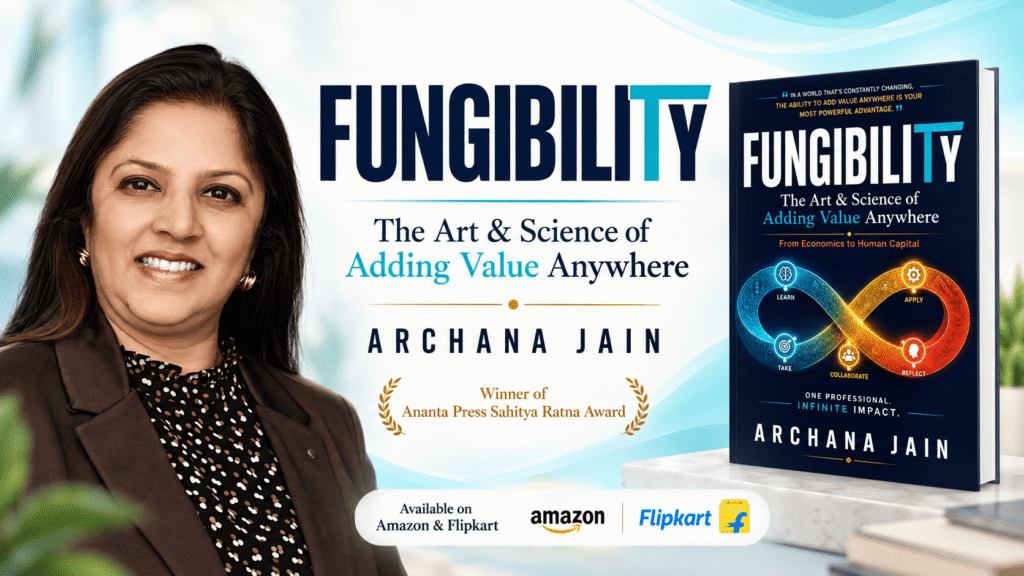
Self-help books about careers often fall into one of two patterns. Some are highly motivational but too general to guide action. Others are heavily technical and useful only to a narrow professional group. Fungibility: The Art & Science of Adding Value Anywhere aims for a more balanced space. Archana Jain takes a large, modern concern – how to remain relevant when AI, industries, roles, and skill requirements are changing rapidly – and turns it into a personal development framework built around transferability. The value of the book lies in the way it helps readers look at themselves not as fixed jobholders but as evolving collections of capabilities that can create impact in many settings.
The central proposition is easy to understand and difficult to practice: do not build your identity entirely around what you currently do. Build it around the value you know how to create. This distinction is the starting point for practical career resilience. A title describes where you are positioned today. A capability describes what you can carry into tomorrow. The book’s idea of fungibility asks readers to identify those portable assets and strengthen them deliberately. In a market where job descriptions change faster than traditional career plans, this is an unusually useful form of self-awareness.
The book description highlights several practical outcomes: building transferable skills, developing learning agility, future-proofing a career, expanding opportunities across functions and industries, and becoming known for capabilities rather than a title. Taken together, these goals form a coherent roadmap. Transferable skills provide the foundation. Learning agility keeps that foundation current. Cross-functional exposure expands the environments in which it can be used. Reflection helps a professional understand what is actually creating impact. Reputation then becomes attached to capability rather than to a narrow role. This sequence makes the concept actionable even before readers encounter the book’s specific frameworks.
One of the most useful exercises suggested by the philosophy is to separate tasks from underlying abilities. Consider a professional who says, “I prepare reports.” The task itself may be automated or changed. But beneath it may sit data interpretation, synthesis, storytelling, accuracy, stakeholder understanding, and decision support. Those abilities can be valuable in many forms. Someone who says, “I manage customer escalations” may possess conflict resolution, empathy, prioritization, risk judgment, communication, and service recovery skills. A person who says, “I run team meetings” may actually be facilitating alignment, surfacing blockers, making decisions visible, and creating accountability. Fungibility teaches readers to recognize this deeper layer.
That way of thinking can improve both resumes and real career decisions. Many people struggle during transitions because they describe their experience too literally. If moving from one industry to another, they focus on the parts of their past that do not match. A fungibility mindset asks them to identify the capabilities the new environment needs and then map prior evidence to those capabilities. This is not about exaggerating experience. It is about translating it. Translation is one of the most important career skills in a world where people may work across several functions over a lifetime.
The author’s own career offers an illustrative example. Jain has worked across a wide range of environments, including advertising, public relations, customer service, coaching, team management, business operations, and technology. Her early career even included designing children’s clothes. What connects these experiences is not a single industry. It is a pattern of learning, people understanding, communication, problem solving, and adaptation. That history gives the book an additional layer of authenticity. The framework is aligned with a career that has already required the author to become useful in multiple contexts.
The emphasis on learning agility is particularly practical. Traditional professional development often assumes that learning happens before performance: complete a course, earn a credential, and then apply it. In fast-moving workplaces, people often have to learn while contributing. They may join a new project, encounter a tool they have never used, or be asked to collaborate with a function they barely understand. Learning agility is the ability to make progress without waiting for perfect preparation. It involves curiosity, humility, experimentation, feedback, and the willingness to revise one’s assumptions. Those qualities can turn uncertainty into an environment for growth.
Fungibility also offers a healthier approach to “future-proofing.” No career can literally be protected from every future change. Promising absolute security would be unrealistic. The more useful goal is to reduce fragility. A fragile career depends on one narrow skill, one employer, one type of problem, or one professional identity. A resilient career has multiple sources of value. It includes technical knowledge, but also communication, judgment, relationship building, adaptability, and the ability to learn. It creates options. In this sense, future-proofing is not prediction; it is preparation for movement.
The book’s potential audience is impressively broad because the framework is not tied to a specific profession. Students can use it to think about capability-building before their first job. Early-career professionals can deliberately seek assignments that stretch them across teams. Mid-career professionals can audit which parts of their experience are portable and which have become too context-dependent. Leaders can use the ideas to build more flexible teams. Entrepreneurs naturally benefit from fungibility because they often shift between strategy, sales, customer understanding, operations, and people issues in the same day. Organizations can use the concept to rethink internal mobility and development.
For managers, the book may also encourage better coaching conversations. Instead of asking an employee only what role they want next, a manager can ask which capabilities they want to strengthen and where those capabilities can be practiced. Rather than treating a lateral move as a lack of progress, it can be seen as capability expansion. Rather than selecting people only because they have already done the exact job, leaders can look for evidence of adjacent strengths and learning speed. This can create more inclusive opportunity because it reduces overreliance on perfectly linear career histories.
Another practical strength is the connection between adaptability and reflection. Constant change without reflection can become exhausting. People can learn many tools and still feel directionless. Fungibility implies that professionals should periodically examine where they created value, what types of problems energize them, which strengths others repeatedly rely on, and what new contexts might benefit from those strengths. Reflection turns experience into reusable knowledge. Without it, people may repeat work for years without recognizing the capabilities they have actually developed.
The book is motivational in a mature way because it does not promise that confidence appears before action. Instead, confidence grows from evidence that a person can enter new situations and become capable. This is especially important for readers facing career shifts. The first move into a new function may feel uncomfortable precisely because it removes familiar signals of competence. A fungible professional learns to tolerate that temporary uncertainty. They trust not that they already know everything, but that they have learned before and can learn again.
The title’s phrase “The Art & Science of Adding Value Anywhere” captures the dual nature of the idea. The science side suggests frameworks, research, patterns, and deliberate skill development. The art side acknowledges context. What creates value in one environment may need to be adapted in another. Communication that works with one audience may fail with another. Leadership in a crisis differs from leadership during stability. Transferability therefore requires judgment, not simple repetition. Professionals must know what to carry forward and what to modify.
What sets Fungibility apart from generic career advice is this emphasis on mobility of value. It is not simply telling readers to work harder, network more, or become more productive. It is asking them to redesign the way they understand professional worth. That makes the book particularly relevant in a period when AI can perform more tasks but cannot determine the entire context in which human contribution matters. The professional who can combine tools, knowledge, human insight, and situational judgment has a wider field of opportunity.
For readers who prefer self-help that produces questions worth acting on, Fungibility offers fertile ground. What are my most transferable capabilities? Which of my strengths depend too heavily on one context? How quickly can I learn something unfamiliar? Where have I created value outside my formal responsibilities? What problems do people repeatedly trust me to solve? Which experiences have I dismissed because they do not fit a linear story? Answering those questions can change the way a person plans the next phase of a career.
Fungibility is therefore a strong contribution to motivational and professional-development literature. Its message is not that change will become easier. Its message is that people can become better equipped for change. By treating adaptability as a capability, learning as an ongoing professional advantage, and value creation as the center of identity, Archana Jain offers readers a practical way to become less dependent on any single role. In a world of shifting work, that may be one of the most useful forms of freedom a career book can offer.Amazon link: https://www.amazon.in/Fungibility-Science-Adding-Value-Anywhere-ebook/dp/B0HCL37QY5/ref=sr_1_1?crid=P0MZP65RWR8P&dib=eyJ2IjoiMSJ9.VV1teaHHjTpxtBX2RBvlLl74tqW9136U99KQyxpg4RDGjHj071QN20LucGBJIEps.OavO35Ak7j3XXH2IbLtnlXKLJlM8jVhvqECGUfVrE_g&dib_tag=se&keywords=fungibility&qid=1787137886&s=digital-text&sprefix=fungibilit%2Cdigital-text%2C313&sr=1-1