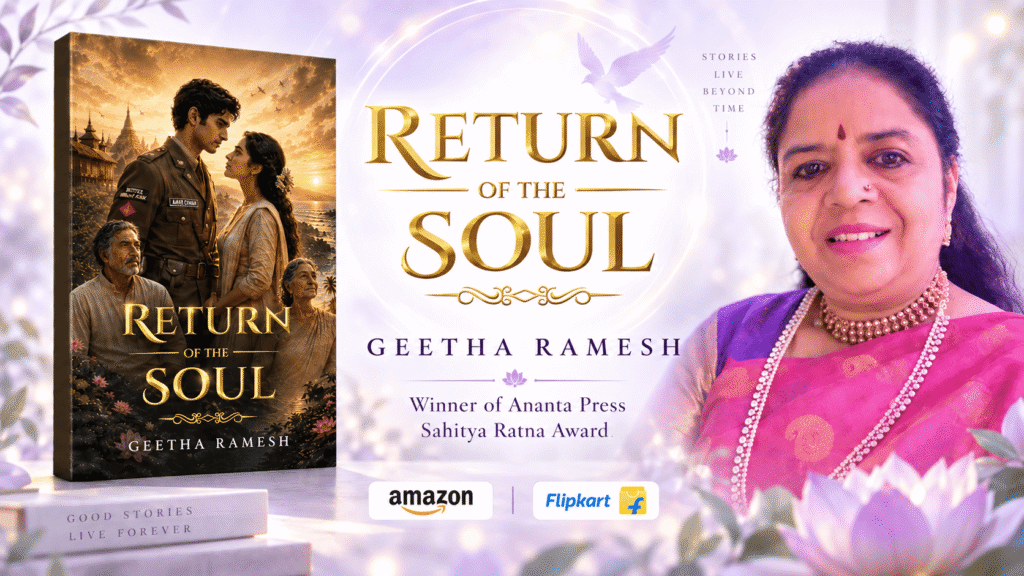
One of the most intriguing qualities of Geetha Ramesh’s Return of the Soul is its narrative design. The novel does not tell a romance within a single continuous life. Instead, it divides emotional experience across two incarnations, using war, death, rebirth, memory and delayed reunion to create a structure in which the past is always pressing against the present. The result is a story that can be appreciated not only for its romantic theme but also for the way its central idea is constructed.
The first life begins during the Second World War with an Indian family settled in Burma. This historical setting immediately establishes instability. War makes ordinary assumptions unreliable: homes may no longer be secure, businesses may be threatened, travel may become dangerous and relationships may be abruptly interrupted. Within this environment, Roopini, the family’s eldest daughter, helps her father with the business. Her introduction performs an important structural function. It gives the reader a heroine embedded in family life and responsibility before the romantic plot takes over.
Amudhan enters as a South Indian soldier and poet. His profession connects him directly to the war, while his poetic identity connects him to emotion and imagination. In narrative terms, he becomes a bridge between the external world of conflict and the internal world of love. The relationship between Roopini and Amudhan develops under the shadow of mortality, so the romance is never entirely separated from danger.
The first major turning point is Amudhan’s death in Roopini’s lap. He tells her that he will return to live with her. Structurally, this moment functions like a promise the narrative itself must eventually answer. Once the reader hears it, the story creates an expectation: either the promise will prove to be an expression of love with no literal fulfilment, or the novel will find a way to bring Amudhan back. Because the title is Return of the Soul, the reader understands that the second possibility will matter.
The cleverness lies in how the return is complicated. Roopini does not remain alive waiting for Amudhan’s rebirth. She herself is reborn as Sreeja, within the same extended family. This changes the shape of the story completely. Instead of one reincarnated lover returning to a surviving partner, both identities are displaced across time. The romance becomes a puzzle of recognition.
Sreeja’s childhood memories provide continuity between the two halves of the novel. She remembers her previous birth from an early age, but as she grows older she comes to regard those memories as fantasy. This is an effective narrative choice because it prevents the second-life plot from becoming too easy. If Sreeja had remained completely certain of being Roopini, she might spend the entire story waiting for Amudhan. By allowing doubt to enter, Ramesh creates distance between the past and the present. The reader knows the memories matter even while Sreeja learns to distrust them.
Her marriage to another person under family pressure and out of gratitude further increases the narrative stakes. The past-life promise now collides with a present-life commitment. From a storytelling perspective, this is the point at which reincarnation becomes conflict rather than novelty. The question is no longer simply “Will Amudhan return?” but “What happens if he returns after life has already moved on?”
Amudhan’s reincarnation as Sridhar intensifies this delayed structure. Sridhar is in his mid-forties and unmarried when the characters meet. At one stage, he too recalls his previous birth. The two lines of memory now converge. The story therefore moves from one-sided childhood remembrance to mutual recognition in adulthood. That progression creates a natural escalation: first there is a promise, then a memory, then doubt, then a new life, then reunion, and finally shared recollection.
This sequence is one of the novel’s strongest conceptual features. Ramesh understands that reincarnation stories depend heavily on timing. If recognition comes too soon, there may be little tension. If it comes too late, the story can feel arbitrary. Return of the Soul uses delayed recognition to generate emotional complications. The characters are not meeting in an empty space where destiny can operate without resistance. They meet after years of separate existence.
The structure also creates an interesting relationship between identity and time. Roopini and Sreeja are connected, but they are not identical in circumstance. Amudhan and Sridhar are connected, but Sridhar has lived a life that Amudhan never experienced. The narrative therefore asks the reader to hold two versions of each central figure in mind at once. That doubling gives the story an almost echo-like quality: one life reverberates inside another.
The Second World War setting strengthens this architecture because war itself is about rupture. Families are displaced, futures are interrupted and people disappear from one another’s lives. Reincarnation, by contrast, is a narrative of continuity. Putting the two together creates a meaningful opposition. War says that history can violently break a life. Reincarnation says that something essential may continue anyway. The book’s title sits exactly between these forces: a soul returns after history has seemingly ended the relationship.
The family connection across the two lives is another notable choice. Sreeja is born as the daughter of Roopini’s own sister, which keeps the new life close to the old one. This prevents the reincarnation from becoming geographically or culturally disconnected. The family becomes a vessel carrying both continuity and change. People who belonged to Roopini’s world remain, in another relational form, part of Sreeja’s world. That can create a distinctive emotional texture because past and present are not separated into entirely different universes.
The story also benefits from genre blending. It begins like historical fiction, develops as wartime romance, shifts into reincarnation drama and eventually becomes a mature relationship story shaped by memory and consequence. Readers who prefer fiction that crosses conventional categories may find this variety appealing. The novel does not ask them to choose between history, romance and spirituality; it combines all three.
Geetha Ramesh’s background supports this broad imaginative approach. She studied English literature, spent a long professional career in banking and returned seriously to writing after retirement. Her first book, Divine Will, was philosophical non-fiction; her second, Niranjana, drew on banking experience; her third enters romantic speculative territory through reincarnation. Such movement across genres suggests a writer interested in exploring different forms rather than staying within one established mode.
Return of the Soul stands out because its central love story is built around narrative delay. The original romance is cut short. The promise cannot be fulfilled immediately. The heroine is reborn and gradually doubts her memories. She enters another marriage. The hero is reborn later, reaches middle age and only then reconnects with her. Recognition arrives after circumstances have hardened around them. Every stage adds another layer between the original promise and its possible fulfilment.
For the reader, this structure creates curiosity. The crucial question is not merely whether Roopini and Amudhan loved each other. That is established early. The question is what that love means when both have become other people. The novel therefore converts a romantic certainty into an ethical and existential uncertainty. Two souls may return, but can an old relationship be resumed as though time has not passed?
That is where the book’s originality lies. Its reincarnation plot is not simply a device for extending romance beyond death. It is a device for testing love under radically changed conditions. By building the story across two identities and two eras, Geetha Ramesh gives the romance a wider scale and a more complex emotional geometry. Return of the Soul is ultimately a story about continuity, but it understands that continuity is meaningful only because so much else has changed.
Amazon Link