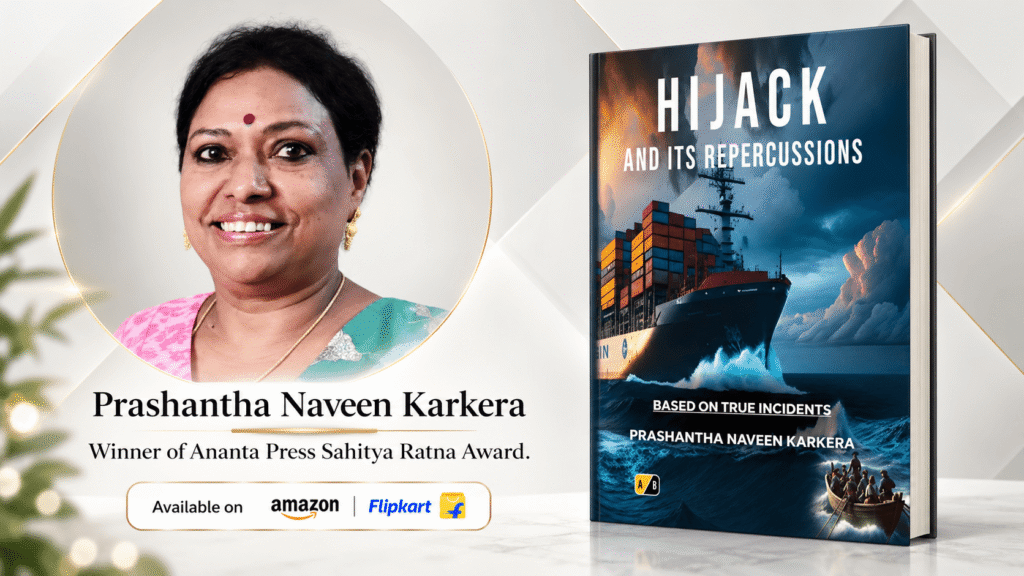
Book: Hijack: And Its Repercussions | Author: Prashantha Naveen Karkera | Category: Non-Fiction (General)
One of the most interesting ways to read Hijack: And Its Repercussions is as a non-fiction account of what happens when truth becomes difficult to establish. Prashantha Naveen Karkera’s book is built around a real maritime crisis, but beneath the drama of hijacking, bombing, captivity, and rescue lies another conflict: the struggle to understand what actually happened when multiple actors, incomplete information, wartime suspicion, media reports, and official decisions all converged around a single ship. This makes the book more intellectually engaging than a straightforward survival narrative.
The vessel at the centre of the story, Princess Kash, entered a highly charged environment. Sri Lanka was in the midst of a prolonged civil war, and the north-eastern coast associated with the incident was under LTTE influence. In such circumstances, ordinary commercial activity could easily be viewed through the lens of military strategy and supply lines. Shivshankar Menon’s preface is especially important because it acknowledges directly that reliable facts were hard to obtain. The Sri Lankan authorities suspected the vessel of carrying supplies that could benefit the LTTE. The Indian High Commission, meanwhile, was concerned first with the welfare of the Indians aboard and with establishing the facts as far as possible.
This distinction between suspicion and evidence runs through the emotional core of the author’s account. From her perspective, her husband was a merchant navy captain whose life, integrity, and professional reputation had suddenly become entangled in allegations generated by a conflict zone. Her fear was therefore not only that he might die. She also feared that he might survive only to be misrepresented. This is a powerful and often overlooked consequence of public crises. People can become symbols in narratives they did not create, and once suspicion enters public discourse, a family may feel that it has to fight for both a person’s safety and their name.
The book’s title is particularly effective when considered from this angle. The hijack is the central event, but the repercussions include suspicion, interrogation, media framing, family panic, diplomatic pressure, and long-term memory. A crisis does not end when immediate physical danger passes. It can continue in questions: Who was responsible? Why was the vessel there? What was known before the ship was destroyed? What can still be proven afterward? Menon’s preface notes that the destruction of the vessel made complete certainty about every aspect of the incident impossible. This recognition of ambiguity is one of the most valuable features of the material.
Many true-event books are tempted to offer readers absolute clarity. This story is stronger when it acknowledges the opposite. War is a setting in which facts can be obscured by urgency, competing interests, fear, propaganda, military necessity, and the destruction of evidence. A reader may naturally want a clean sequence of cause and effect, yet the book demonstrates why such neatness is often unavailable to the people living through the event. Families receive incomplete news. Governments make assessments. Military forces act. Armed groups control territory. Diplomats seek information. Humanitarian organisations try to protect lives. Each participant sees only part of the picture.
The author’s experience of media coverage is crucial to this theme. Her nightmare begins with a report that suggests the crew’s fate may be catastrophic. For a journalist or reader, such a report is information. For a spouse, it can feel like a verdict. The book therefore exposes a difficult tension in crisis reporting: the public needs timely information, but early information is often uncertain. The emotional consequences of error, speculation, or incomplete reporting can be enormous for families directly involved.
This dimension makes Hijack: And Its Repercussions relevant beyond the specific 1998 incident. Modern readers live in an even faster information environment, one in which rumours, partial images, official claims, and commentary can spread within minutes. The book’s older technological setting, where the author relies heavily on newspapers, telephone calls, and faxes, actually sharpens the theme. The mechanisms have changed, but the underlying problem remains: how does a person determine what is true when information arrives from sources that may not have the complete picture?
The book also encourages reflection on the ethical responsibilities of states during conflict. The destruction of the vessel, as described in the supporting materials, occurred amid fears that its cargo might be useful to the LTTE. The preface states that the Sri Lankan government did not want the cargo to become available to the rebels and chose to destroy the ship. For the author, however, the immediate moral issue was human life. Her narrative repeatedly returns to the fact that people were on board and that their families did not know whether they would survive. The contrast between strategic reasoning and human vulnerability gives the story much of its moral force.
Diplomacy becomes important precisely because the crisis exists between these different logics. Governments think about security, sovereignty, and armed conflict; families think about the person they love; diplomats must often operate between those scales. Menon’s preface offers a concise but meaningful record of the Indian mission’s efforts to secure the release of the crew and return them home. The author’s own account of repeated appeals shows how distant official systems can feel until one person within them responds. That response becomes a source of hope not because it guarantees the outcome, but because it tells the family that someone with access and authority is listening.
The humanitarian rescue component adds another ethical layer. When people are trapped in conflict, their status should not be reduced to the strategic value of the vessel they occupy. The book’s attention to rescue and release underscores the importance of preserving human life even when the political situation is deeply contested. In this sense, the book is ultimately less interested in winning an argument about conflict than in insisting on the value of the individuals caught inside it.
As a work of general non-fiction, the book’s greatest strength is its multi-dimensional perspective. It can be read as a family memoir, a maritime incident narrative, an example of diplomatic intervention, a reflection on war-zone uncertainty, and a meditation on public reputation. Few books manage to connect all these themes through one personal story. Its uniqueness lies in showing how quickly a private life can be absorbed into history and how difficult it can be to separate fact, accusation, perception, and memory once a crisis has begun.
The emotional writing also ensures that these themes never become abstract. The author’s anxiety, her determination to reach officials, her concern for her child and mother, and her eventual relief keep the reader grounded in what was at stake. Even when the book invites questions about state action or media reporting, it never loses sight of the people whose lives could have ended because of decisions made far from their control.
The aftermath matters just as much. The captain and crew had to answer questions and emerge from a cloud of suspicion. The family had to process the psychological shock. The author came away with a changed understanding of certainty and gratitude. These are precisely the repercussions that historical timelines often omit. Official accounts may tell us when a vessel was seized, when it was destroyed, and when people were released. A personal account tells us what happened inside a human being during those intervals.
For readers who appreciate true stories that raise difficult questions rather than merely offering spectacle, Hijack: And Its Repercussions is a rewarding book. It reminds us that in a crisis, facts matter enormously, but facts may also be the hardest thing to secure. Until certainty arrives, people must live inside fear, possibility, and competing narratives. By preserving that experience, Prashantha Naveen Karkera offers not only a record of what happened to her family but also a thoughtful case study in the moral and emotional complexity of conflict.Amazon: https://amzn.in/d/3x4P3nN