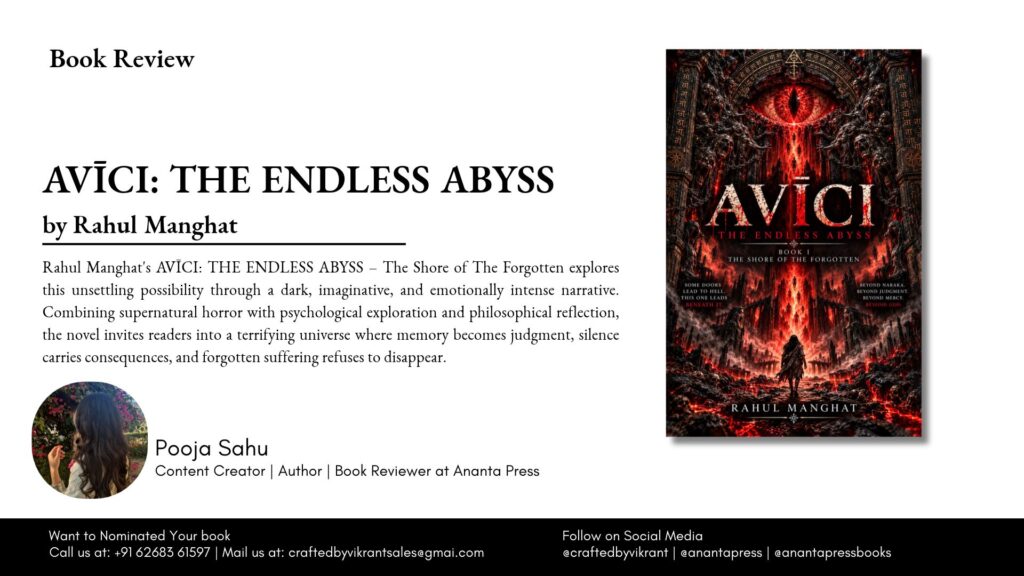
Book Review: A Philosophical Horror Novel That Explores the Darkest Corners of Human Conscience
Book Title: AVĪCI: THE ENDLESS ABYSS
Subtitle: The Shore of The Forgotten
Author: Rahul Manghat
Publisher: Ananta Press
Publication Year: 2026
Genre: Philosophical Horror, Psychological Fiction, Supernatural Thriller
ISBN: 978-93-7821-195-9
Rating: 5/5
Introduction: When Hell Becomes a Mirror of Humanity
What if the most terrifying place in existence were not a kingdom of monsters, flames, and endless punishment, but a world constructed from the suffering humanity has chosen to forget?
Rahul Manghat’s AVĪCI: THE ENDLESS ABYSS – The Shore of The Forgotten explores this unsettling possibility through a dark, imaginative, and emotionally intense narrative. Combining supernatural horror with psychological exploration and philosophical reflection, the novel invites readers into a terrifying universe where memory becomes judgment, silence carries consequences, and forgotten suffering refuses to disappear.
Unlike conventional horror stories that depend primarily on frightening creatures or violent encounters, AVĪCI locates much of its terror within human decisions. Its characters are haunted not simply by supernatural forces but by the consequences of their own actions, inaction, and moral compromises.
At its heart, this is a story about responsibility, abandonment, remembrance, and the possibility of redemption.
Spanning forty-three chapters and an epilogue, the novel creates an expansive fictional landscape in which every terrifying encounter contributes to a larger question: Can human beings truly escape the consequences of the suffering they cause?
Manghat’s answer emerges gradually through an atmospheric journey that is disturbing, thought-provoking, and surprisingly compassionate.
A Mysterious Beginning That Immediately Captures Attention
The novel opens with an unforgettable image: a seven-year-old girl standing alone outside a hospital in the rain, holding a stuffed rabbit with one missing eye.
Her father has promised to return, but he never does.
Around her, seemingly unrelated people make decisions that contribute to her suffering. A doctor signs a document, a journalist suppresses information, a politician destroys evidence, and others choose silence, indifference, or self-preservation.
Their decisions appear ordinary within their individual lives, but together they create a devastating chain of consequences.
Years later, ten people die under different circumstances. Their deaths become connected by a mysterious supernatural awakening, and they find themselves transported to a black shoreline beneath existence.
There, an impossible ocean appears to breathe, darkness seems conscious, and the mysterious little girl waits for them.
The question surrounding her identity and her connection to these souls creates an absorbing central mystery.
Manghat establishes suspense through carefully selected images and unanswered questions. Rather than immediately explaining the supernatural world, he allows readers to experience its strangeness alongside the characters.
The result is an opening that feels both cinematic and emotionally significant.
AVĪCI: A World Built From Forgotten Suffering
One of the novel’s greatest strengths is its extraordinary imaginative setting.
AVĪCI is not presented as an ordinary fictional underworld. It is a metaphysical landscape shaped by abandoned memories, ignored suffering, and humanity’s collective failures.
Its geography is surreal, disturbing, and rich in symbolism.
The breathing ocean contains the pain of forgotten lives. Roads preserve the footsteps of abandoned children. Mysterious gates lead toward increasingly unsettling revelations, while strange entities embody grief, remembrance, and neglected responsibility.
Among the memorable elements are the Lantern Keeper, the Mother of the Forgotten, the City of Lost Names, and the River That Drinks Screams.
These creations serve purposes beyond providing supernatural spectacle.
The Lantern Keeper, for example, possesses an extraordinary black flame capable of revealing memories and moral consequences. The figure becomes a powerful representation of truths that cannot be permanently hidden.
Similarly, the Mother of the Forgotten gives emotional form to the suffering of those who have been abandoned or erased from collective memory.
Manghat’s world-building is particularly effective because the landscape continually reflects the novel’s central ideas.
Every terrifying location seems to communicate something about human behavior. The supernatural environment becomes a physical manifestation of psychological and ethical realities.
This imaginative approach gives AVĪCI a distinctive identity within philosophical and supernatural horror fiction.
Ten Souls, Ten Burdens, and the Weight of Human Choices
The novel’s central group consists of individuals connected by decisions that have caused suffering.
They include professionals and ordinary people whose mistakes range from indifference to serious moral wrongdoing.
Rather than treating them as one-dimensional villains, Manghat explores the reasoning through which people justify their actions.
One particularly striking example involves Arjun, a photographer who has documented human suffering and received recognition for his work.
His experience raises an uncomfortable ethical question: What happens when another person’s tragedy becomes an opportunity for professional success without meaningful assistance being offered?
Elsewhere, characters such as Meera, Tara, and Veer confront different forms of guilt, emotional neglect, and destructive behavior.
Their experiences demonstrate that moral failure does not always emerge from deliberate cruelty.
Sometimes it develops through fear, convenience, anger, institutional loyalty, or the refusal to intervene.
The novel repeatedly challenges the tendency to separate personal choices from their consequences.
This is where its psychological dimension becomes especially compelling.
Readers may not identify with the characters’ most serious actions, but they may recognize the familiar human instinct to avoid uncomfortable responsibilities.
That recognition gives the supernatural horror an additional layer of unease.
The Little Girl: The Emotional Heart of the Narrative
Despite the enormous scale of its supernatural universe, AVĪCI remains emotionally anchored by the mysterious child.
Her rain-soaked appearance, quiet presence, and damaged stuffed rabbit create an image that is simultaneously vulnerable and haunting.
The child represents more than a conventional ghostly figure.
Throughout the narrative, her presence becomes connected with abandonment, longing, remembrance, and the emotional cost of being forgotten.
Her importance lies partly in the contrast between her apparent innocence and the terrifying forces associated with her existence.
While the surrounding world contains monstrous structures, ancient entities, and impossible landscapes, the image of a lonely child remains among the story’s most disturbing elements.
This contrast allows Manghat to explore horror through empathy.
The reader is encouraged not merely to fear what has happened to the child, but to consider the human decisions that made her suffering possible.
As the narrative develops, her significance expands beyond the initial mystery, connecting personal grief with the wider philosophical concerns of the novel.
The result is a character whose emotional presence helps unify an otherwise vast and complicated narrative.
A Literary Exploration of Guilt, Memory, and Redemption
Beneath its supernatural imagery, AVĪCI is fundamentally concerned with the relationship between memory and moral responsibility.
The novel suggests that forgetting can become a form of abandonment when individuals erase the suffering they have caused or witnessed.
Its characters repeatedly encounter memories that challenge their preferred versions of themselves.
Yet Manghat does not limit the story to punishment.
As the narrative progresses, the philosophical focus develops toward questions of forgiveness, accountability, and emotional liberation.
Can people acknowledge their wrongdoing without becoming permanently defined by it?
Can suffering be remembered without becoming an endless prison?
And can compassion offer a more meaningful response than perpetual condemnation?
These questions become especially important in the novel’s later developments, where the distinction between remembering pain and remaining trapped within it becomes increasingly significant.
The narrative ultimately suggests that acknowledging suffering is essential, but suffering need not become the entirety of human identity.
This philosophical evolution gives the novel emotional depth beyond its horror premise.
Rather than simply exposing humanity’s failures, Manghat also considers its capacity for change.
Writing Style: Cinematic, Intense, and Atmospheric
Rahul Manghat employs a distinctive narrative style characterized by short sentences, fragmented descriptions, repetition, and dramatic pauses.
This approach gives many passages the rhythm of a cinematic screenplay.
Scenes often unfold through successive visual impressions, allowing readers to imagine the setting as a sequence of carefully composed shots.
The descriptions of the breathing ocean, monumental gates, ancient entities, and shifting landscapes are especially vivid.
Manghat also uses recurring imagery effectively. Rain, darkness, eyes, doors, flames, and memories gradually acquire symbolic importance.
The repetition creates a sense of ritual and inevitability, reinforcing the impression that the characters are moving through a world governed by forces older than ordinary human understanding.
However, this stylistic approach may not appeal equally to every reader.
The frequent use of brief sentences and repeated dramatic phrases sometimes slows narrative progression. Certain revelations also revisit familiar ideas about memory, suffering, and responsibility.
Readers who prefer restrained prose or fast-moving, plot-centered horror may find sections repetitive.
Nevertheless, the style remains consistent with the novel’s ambition to create an overwhelming atmosphere of metaphysical dread.
Its strengths are most apparent when visual intensity and emotional meaning come together.
What Makes AVĪCI Stand Out?
The novel distinguishes itself through the combination of an ambitious supernatural setting and a sustained examination of human morality.
Its horror emerges not simply from monsters or unknown forces, but from familiar ethical failures presented on an extraordinary scale.
The symbolic environments are inventive, the central mystery is emotionally engaging, and the recurring themes create coherence across a lengthy narrative.
Another important strength is the book’s willingness to move beyond guilt toward questions of healing and choice.
This transformation prevents the story from becoming an uninterrupted exercise in despair.
At the same time, its philosophical density and recurring symbolism demand patience. The novel is best approached as an atmospheric literary experience rather than a conventional thriller driven exclusively by action.
Readers willing to engage with its ideas are likely to find its imaginative world particularly rewarding.
Who Should Read This Book?
AVĪCI: THE ENDLESS ABYSS will appeal strongly to readers interested in psychological horror, supernatural fiction, dark fantasy, and philosophical storytelling.
It is especially suitable for those who appreciate narratives exploring morality, existential questions, spiritual symbolism, and the complexities of human suffering.
Readers who enjoy imaginative fictional worlds with mysterious rules and emotionally layered characters may also appreciate Manghat’s approach.
Because the novel contains disturbing imagery and themes involving death, abandonment, grief, and psychological suffering, it is better suited to mature audiences comfortable with darker literary material.
It is not simply a book intended to frighten readers.
It is a story that asks them to reflect.
Final Verdict: A Dark and Thought-Provoking Literary Experience
Rahul Manghat’s AVĪCI: THE ENDLESS ABYSS – The Shore of The Forgotten is an ambitious work of philosophical horror that combines unsettling supernatural imagery with meaningful questions about human responsibility.
Its greatest achievement lies in transforming abstract concepts such as guilt, memory, abandonment, and moral accountability into an elaborate and emotionally resonant fictional universe.
The novel’s extensive world-building, striking symbolism, and haunting central mystery make it a memorable reading experience.
Although its repetitive stylistic patterns and philosophical complexity occasionally affect the pacing, these limitations do not overshadow its creative ambition.
What remains most compelling is the humanity beneath the darkness.
AVĪCI reminds readers that the consequences of our decisions may extend far beyond what we immediately recognize, and that remembrance becomes meaningful when accompanied by compassion and responsibility.
Ultimately, the novel leaves behind a powerful idea: true freedom may depend not on forgetting the past, but on learning how to remember it without surrendering the future.
Overall Rating: 5/5
Recommended for: Readers of philosophical horror, psychological fiction, supernatural mysteries, and emotionally intense literary thrillers.
Book Details and Availability
AVĪCI: THE ENDLESS ABYSS – The Shore of The Forgotten
Author: Rahul Manghat
Published by: Ananta Press
ISBN: 978-93-7821-195-9
Listed MRP: ₹785
Availability: Amazon, Flipkart, and Kindle, as stated in the book.
Publisher Website: https://www.anantapress.com