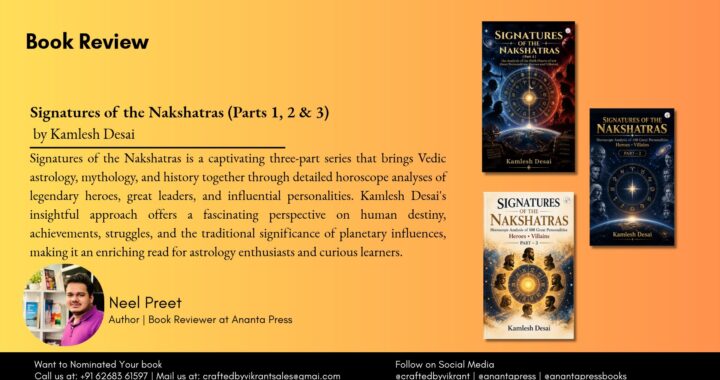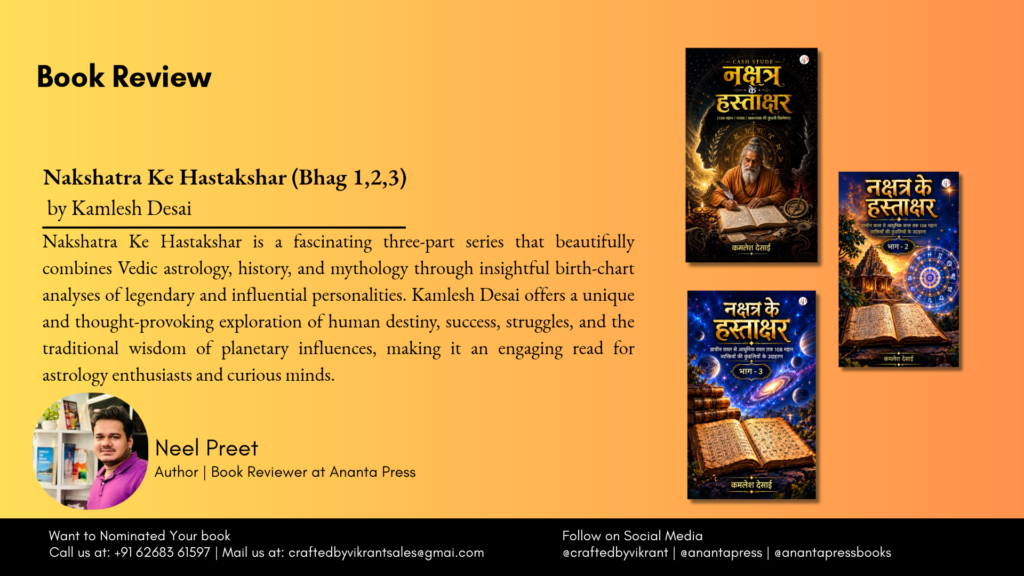
Book Title: Nakshatra Ke Hastakshar (नक्षत्र के हस्ताक्षर)
Volumes: Part 1, Part 2 & Part 3
Author: Kamlesh Desai
Genre: Vedic Astrology, Historical Studies, Mythology, Spirituality and Biographical Analysis
Publisher: Ananta Press
Introduction: When the Stars Meet the Stories of Humanity
Throughout human civilization, one question has continued to fascinate philosophers, scholars, spiritual thinkers, and ordinary individuals: What shapes human destiny? Why do some people achieve extraordinary greatness while others experience unimaginable struggles and unexpected failures? What lies behind the remarkable lives of kings, warriors, spiritual leaders, scientists, revolutionaries, and influential personalities?
Kamlesh Desai’s three-volume series, Nakshatra Ke Hastakshar, approaches these timeless questions through the traditional wisdom of Vedic astrology.
This ambitious collection brings together astrological interpretations of 108 celebrated, influential, and controversial personalities drawn from mythology, history, and modern society. Through their birth charts, the author explores traditional beliefs about planetary influences, personality, leadership, success, difficulties, and human behaviour.
What makes this series particularly interesting is its distinctive combination of biography, Indian cultural traditions, astrological interpretation, and historical reflection.
Rather than presenting astrology only as a method of predicting future events, Desai approaches it as a traditional interpretive framework through which readers can examine human lives.
Across three volumes, the series moves from ancient mythological narratives to historical civilizations and eventually to influential personalities of the modern world.
The result is an extensive and thought-provoking literary journey that encourages readers to reflect on the relationship between circumstances, choices, traditional astrological symbolism, and personal achievement.
Part One: The Foundations of Astrology and the Wisdom of Ancient Civilizations
The first volume establishes the intellectual and cultural foundation of the entire series.
It introduces readers to important principles of Vedic astrology, including zodiac signs, planetary positions, astrological houses, yogas, and the traditional interpretation of birth charts.
The author explains how astrologers study the ascendant, the influence of different planets, and their relationships within a horoscope.
These introductory discussions help readers understand the terminology used throughout the collection.
One of the most engaging elements of Part One is its exploration of mythological and ancient personalities.
Figures such as Lord Rama, Mata Sita, Lord Krishna, Arjuna, Karna, Ravana, Hanuman, and other characters from the Ramayana and Mahabharata introduce readers to familiar narratives through an unconventional astrological perspective.
These personalities represent enduring themes of bravery, sacrifice, devotion, ambition, wisdom, moral conflict, and responsibility.
By connecting these stories with traditional astrological concepts, Desai encourages readers to examine familiar characters from another interpretive angle.
The volume also turns toward ancient historical personalities, including Lord Mahavira, Confucius, King Porus, Alexander the Great, Chanakya, Emperor Ashoka, and Julius Caesar.
Their contrasting achievements provide opportunities to explore traditional astrological associations with courage, intelligence, authority, spirituality, and leadership.
The first volume’s greatest strength is its ability to introduce complex concepts through recognizable personalities.
It provides an accessible starting point for readers interested in learning how traditional astrological interpretations are constructed.
Part Two: Exploring Leadership, Power, Knowledge, and Historical Transformation
The second volume expands the scope of the series by examining personalities associated with medieval history and the transition into the modern world.
This section is particularly interesting because it focuses on individuals whose decisions, achievements, intellectual contributions, and struggles left lasting impressions on society.
Historical figures such as Raja Bhoj, Prithviraj Chauhan, Genghis Khan, Goswami Tulsidas, Emperor Akbar, Chhatrapati Shivaji Maharaj, George Washington, Tipu Sultan, Ahilyabai Holkar, and Napoleon Bonaparte appear in this volume.
Their lives offer contrasting examples of political authority, military strategy, intellectual brilliance, artistic contributions, and social responsibility.
One notable discussion concerns Raja Bhoj, remembered for his scholarship, leadership, and patronage of learning and architecture.
The author examines an estimated astrological chart associated with him, interpreting planetary combinations in relation to his intellectual achievements and experiences as a ruler.
The book acknowledges that a verified birth chart is unavailable for Raja Bhoj, making the example an illustrative astrological reconstruction rather than a documented historical horoscope.
Similarly, the discussion of Prithviraj Chauhan examines traditional astrological interpretations associated with courage, leadership, determination, conflict, and adversity.
These examples demonstrate the author’s broader objective: to explore how astrologers might interpret the lives of influential personalities through the symbolism of planetary combinations.
The volume also includes modern intellectuals, political leaders, spiritual figures, scientists, and revolutionaries.
Personalities such as Swami Vivekananda, Mahatma Gandhi, Abraham Lincoln, Albert Einstein, Dr. B. R. Ambedkar, Subhas Chandra Bose, and Dr. C. V. Raman contribute significant diversity to the collection.
Through these contrasting lives, readers encounter questions about achievement, personal character, decision-making, public influence, and historical legacy.
This makes Part Two especially engaging for those interested in the intersection of history and traditional astrological thought.
Part Three: The Influence of Astrology in the Modern World
The third volume continues the journey into the twentieth century and contemporary society.
Its subject matter becomes particularly relatable because many of the personalities discussed are familiar through history books, newspapers, films, sports, business, and public life.
The collection includes leaders such as Indira Gandhi, Nelson Mandela, Martin Luther King Jr., Rajiv Gandhi, and other prominent political figures.
It also includes influential personalities from business, technology, science, entertainment, and sports.
Figures such as Ratan Tata, Dhirubhai Ambani, Steve Jobs, Lata Mangeshkar, Dr. A. P. J. Abdul Kalam, Kalpana Chawla, Sachin Tendulkar, Shah Rukh Khan, Mahendra Singh Dhoni, and Virat Kohli bring the series closer to contemporary readers.
Their lives represent different kinds of achievement.
Some became influential through innovation and entrepreneurship. Others earned recognition through artistic excellence, athletic discipline, scientific contributions, or public service.
The author examines these personalities using traditional astrological principles, exploring symbolic associations with ambition, creativity, recognition, perseverance, and responsibility.
The inclusion of controversial personalities also broadens the series beyond celebratory biographies.
Through these examples, the author considers traditional interpretations of adversity, power, conflict, and downfall.
Part Three demonstrates that the central themes of human ambition, struggle, success, and reputation remain relevant across different historical periods.
It creates an interesting connection between ancient astrological traditions and the lives of people whose achievements continue to shape modern conversations.
A Distinctive Case-Study Approach to Vedic Astrology
Perhaps the most impressive quality of the complete series is its emphasis on learning through examples.
Astrology contains extensive terminology and interpretive rules that can appear intimidating to beginners.
Instead of relying entirely on theoretical explanations, Desai places individual personalities at the centre of the learning process.
Readers are encouraged to observe each horoscope, identify significant planetary positions, understand traditional yogas, and compare the interpretations with the individual’s life story.
This method gives the collection an educational character.
The series introduces traditional associations involving the Sun and authority, the Moon and emotions, Mars and courage, Jupiter and wisdom, Mercury and intellect, Venus and artistic interests, and Saturn and discipline.
The roles of Rahu and Ketu are also discussed within the traditional astrological framework.
Importantly, the author emphasizes that birth charts should be examined comprehensively rather than reaching conclusions from one planetary placement alone.
This principle encourages students to consider relationships among different astrological elements.
The case-study structure also allows readers to compare personalities from different fields and time periods.
For astrology enthusiasts, this approach may make the subject more engaging than studying definitions without practical illustrations.
The Philosophical Message: Destiny, Personal Effort, and Human Responsibility
Beyond birth-chart interpretation, the series contains a broader philosophical message.
Its discussions repeatedly return to questions of personal effort, ethical conduct, responsibility, and the importance of individual decisions.
The author does not present every life outcome as the consequence of one isolated planet.
Part Two particularly emphasizes the relationship between traditional astrological indications and factors such as upbringing, circumstances, personal decisions, and determination.
This gives the series a reflective dimension.
A person’s achievements cannot be understood only through fame or wealth.
Courage, compassion, intelligence, responsibility, sacrifice, and perseverance are equally meaningful aspects of human character.
The discussions also encourage readers to consider how people respond differently to challenges.
Some individuals overcome adversity through patience and discipline, while others allow ambition or poor decisions to create destructive consequences.
The series invites readers to examine these contrasting life experiences and consider the lessons they might offer.
This emphasis on reflection makes the books relevant even for readers who approach astrology primarily as a cultural or philosophical tradition.
Celebrating Indian Knowledge and Cultural Heritage
Another important strength of Nakshatra Ke Hastakshar is its appreciation of India’s traditional intellectual heritage.
Vedic astrology has occupied a significant place within Indian cultural and spiritual traditions for centuries.
Kamlesh Desai’s work reflects a desire to preserve interest in this field and introduce its terminology and methods to new generations.
The series connects traditional astrological thinking with mythology, spiritual philosophy, historical narratives, and biographical material.
Its references to Indian scriptures and celebrated personalities create a strong cultural foundation.
The author’s educational background is also reflected in his desire to encourage observation, comparison, and continued study.
This gives the collection a character that extends beyond entertainment.
It becomes an invitation to explore how traditional systems of thought have sought to understand personality, experience, and human destiny.
At the same time, the books are best appreciated with an important distinction in mind: astrological claims about planetary influences on personality or life events are traditional interpretations, not scientifically established causal relationships.
The author also acknowledges that some historical birth charts are estimated or compiled from secondary sources.
Recognizing this limitation allows readers to appreciate the cultural value of the work while maintaining a thoughtful and critical perspective.
What Makes the Three-Volume Collection Special?
The three books work particularly well as a connected series because each volume contributes a different historical dimension.
Part One introduces foundational astrological concepts through mythological and ancient personalities.
Part Two expands the discussion into historical leadership, scholarship, spiritual thought, political movements, and the achievements and conflicts of earlier civilizations.
Part Three connects the same traditional interpretive framework with influential personalities of the modern world.
Together, these volumes provide a broad view of how astrological symbolism can be applied to contrasting human experiences.
The variety of subjects is a major attraction.
Readers interested in Indian mythology may appreciate the early discussions, while history enthusiasts may find the medieval and modern personalities especially engaging.
Those interested in contemporary achievements may connect more readily with the discussions of scientists, industrialists, artists, and athletes.
The series also invites readers to continue exploring its themes instead of treating each volume as an isolated collection.
Its breadth, structured case studies, and educational ambition distinguish it from a conventional introductory astrology book.
Final Verdict: A Remarkable Exploration of Astrology, History, and Human Experience
Nakshatra Ke Hastakshar (Parts 1, 2 and 3) is an ambitious, informative, and thought-provoking exploration of Vedic astrology through the lives of legendary, historical, and contemporary personalities.
Kamlesh Desai brings together a wide variety of biographical narratives and traditional astrological interpretations in a format designed to stimulate curiosity and encourage deeper study.
The series’ strongest achievement lies in its ability to make complex astrological concepts more approachable through recognizable personalities and their contrasting life experiences.
From ancient mythological figures and historical rulers to modern scientists, social reformers, business leaders, and celebrated artists, the collection explores different expressions of ambition, responsibility, courage, wisdom, and achievement.
Although its astrological interpretations should be approached as traditional perspectives rather than scientifically verified explanations, the series offers an engaging introduction to the symbolism and methods associated with Vedic astrology.
Overall, Nakshatra Ke Hastakshar is a compelling three-volume collection that connects India’s astrological heritage with the fascinating stories of influential personalities across the ages. It is a rewarding read for astrology students, history enthusiasts, and curious readers interested in exploring the traditional relationship between celestial symbolism, human choices, and the enduring mysteries of destiny.