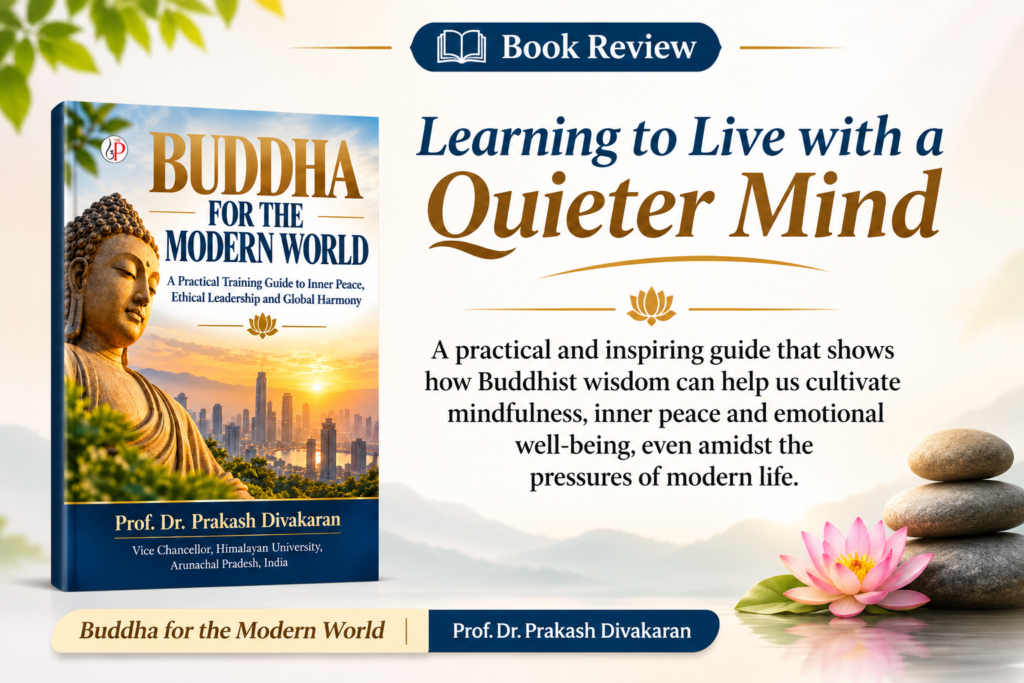
Buddha for the Modern World | Prof. Dr. Prakash Divakaran
A deadline changes without warning. A conversation ends with an uncomfortable remark. An important message receives no reply, and the mind spends the remainder of the afternoon inventing explanations. Experiences like these are familiar, yet they are rarely considered opportunities to learn about the nature of attention and emotional reaction. Buddha for the Modern World, by Prof. Dr. Prakash Divakaran, takes precisely that approach. Viewed as a companion for personal well-being, the book is especially valuable for its ability to make inner experience understandable without making it seem mysterious. It introduces Buddhist ideas through the ordinary challenges of work, family, uncertainty and daily habits. Its appeal is less the prospect of achieving uninterrupted happiness than the possibility of becoming more aware of what happens when happiness is interrupted. That distinction gives the work an unusually grounded quality within the broad field of personal development.
Imagine trying to relax after a difficult day, only to discover that a disagreement continues to occupy the mind long after the other person has gone home. A reader in this position may find the chapter on the nature of suffering particularly relevant. The author describes the traditional distinction between pain and the additional struggle that can arise through our responses to it. This is illustrated through the image of two arrows. The first represents an event or pain that may be unavoidable; the second represents additional distress that can emerge through resistance, interpretation or repeated mental storytelling. The usefulness of the image lies in its simplicity. It gives readers a way to examine difficult experiences without demanding that they pretend those experiences are pleasant. The original pain matters, and some circumstances require external help, but the mental processes surrounding them also deserve compassionate attention.
The book’s practical exercises make this distinction easier to explore. One method asks readers to describe a stressful event factually, notice bodily sensations and record the thought that followed. An altered deadline might be the event, tight shoulders the sensation and a fear of being unable to cope the interpretation. Separating these elements is a helpful alternative to experiencing them as one indistinguishable feeling. It encourages curiosity about what is taking place and can reveal where a response might be adjusted. A reader might discover that clearer communication is needed, that a boundary has been neglected, or that an unverified assumption has intensified a worry. The book does not treat written observation as a clinical test. Rather, it uses the notebook as a space in which personal patterns can become visible. That modest aim is one of the work’s most convincing features.
As the chapters progress into Right Mindfulness and Right Concentration, the author builds a vocabulary for understanding attention. Mindfulness is presented as awareness of present experience rather than a demand to empty the mind of thoughts. Concentration involves developing the ability to sustain attention. Both receive a practical treatment suitable for beginners who may be uncertain about meditation. The opening five-minute exercise establishes the essential pattern: sit comfortably, attend to ordinary breathing, notice when attention has moved and return without criticism. The simplicity of the procedure is reassuring. It requires neither impressive equipment nor a special identity. More importantly, it changes the interpretation of distraction. The moment a person notices that the mind has wandered can become part of learning rather than evidence that the exercise has gone wrong. Readers who are inclined to judge themselves harshly may appreciate this emphasis.
The distinction between having an emotion and acting upon it becomes clearer in the chapters dealing with thoughts, emotions, anger and resentment. Anger often appears to arrive fully formed, with its preferred explanation and its preferred response. Yet an irritated thought may have developed from fatigue, fear, a misunderstanding or a perceived threat to dignity. The book encourages observation of these conditions before responding. This does not mean that anger must be concealed or that genuine injustice should be ignored. It means that the existence of a strong emotion does not settle the question of what ought to be done next. In a family setting, this may create room for an honest conversation rather than a harsh remark. In the workplace, it may support a direct but respectful correction. The underlying lesson is that feeling intensely and behaving wisely are not incompatible.
The discussion of craving and attachment offers another rewarding aspect of the book. Contemporary environments continually suggest that satisfaction is just beyond the next purchase, achievement or sign of approval. The author connects this recurring movement of wanting with Buddhist explanations of dissatisfaction. He does not insist that ordinary preferences or responsible goals must disappear. Instead, the reader is encouraged to examine the difference between pursuing something and becoming unable to tolerate its absence. This distinction is essential for professionals and students who need motivation but may also attach their entire sense of worth to a result. Wanting to perform well in an examination is different from believing that one disappointing mark defines an entire future. The book’s framework can illuminate such patterns and invites readers to develop a relationship with ambition in which effort matters without every outcome becoming a verdict on identity.
Impermanence is explored as a fact of changing circumstances rather than simply as a sad observation about loss. Friendships evolve, organizations restructure, moods change and achievements become ordinary. Remembering change can make it easier to appreciate favorable conditions without assuming they will remain fixed. It can also support flexibility when plans fail. The associated chapter on non-self and ego introduces a more demanding philosophical theme: the identities people defend are not necessarily as stable or independent as they imagine. For a general reader, the practical significance becomes apparent in moments of criticism. If a person regards every criticism of a decision as an attack upon an unchangeable self, learning from feedback becomes difficult. The book offers a framework for examining such defenses. This section is worth reading slowly, because the Buddhist teaching has deeper implications than ordinary advice about confidence or humility.
The emotional range of the work is not limited to uncomfortable feelings. Chapters on compassion, loving-kindness, sympathetic joy and equanimity introduce constructive ways of relating to oneself and others. Sympathetic joy is particularly interesting in a world of constant comparison. Another person’s success need not automatically become evidence of one’s own inadequacy. The invitation to develop goodwill for people outside one’s immediate circle similarly challenges habitual judgments. Equanimity, meanwhile, offers a way to understand steadiness without confusing it with indifference. These ideas give the book a warmer and more relational dimension. A quiet mind is not presented as an isolated private achievement. The quality of attention that helps a person understand personal distress may also help that person notice the concerns of someone else. Emotional maturity thus includes both balance and the capacity to care.
An important strength is the attention paid to responsible practice. The book explicitly states that it is educational and is not a substitute for appropriate medical or psychological support. The later discussion of misconceptions includes circumstances in which distress during meditation requires professional advice, and it discourages forcing oneself through severe discomfort. These cautions are relevant because enthusiastic accounts of self-help sometimes imply that one technique is appropriate for every person. Divakaran’s more measured stance respects the differences between individual needs. It also reinforces the idea that seeking assistance can be consistent with compassionate and wise conduct. Readers should therefore approach the exercises as invitations to observe and learn, adapting or discontinuing them where necessary, rather than interpreting the routines as guaranteed treatments. The text’s honesty in this regard makes its personal-development message more credible.
Not every reader will respond equally well to the organized training format. The many tables and repeated checklists may feel more like coursework than the gentle prose associated with some spiritual books. Readers seeking personal stories might also desire a greater number of extended narratives. For others, however, the orderly format will be a real advantage, particularly when returning to a specific topic after difficult circumstances arise. The language generally makes several demanding concepts approachable without depending on dramatic assurances. The best way to use this volume may be to read a section carefully, try a suitable exercise and allow sufficient time before proceeding. Its breadth rewards patient engagement rather than hurried completion.
Ultimately, Buddha for the Modern World offers a humane perspective on the relationship between peace and ordinary experience. It reminds readers that the mind can become an object of patient inquiry and that a difficult day does not need to produce a series of further difficulties through automatic responses. Its strongest contribution to personal well-being is the way it connects awareness with kindness, balance with effort, and acceptance with constructive action. It will appeal to people who are curious about meditation, interested in improving relationships or searching for a thoughtful introduction to Buddhist approaches to emotion. Rather than placing peace at some distant destination, Divakaran directs attention toward the small decisions through which a steadier life may gradually take shape. That is a useful and compassionate message, especially for readers navigating the relentless demands of contemporary living.