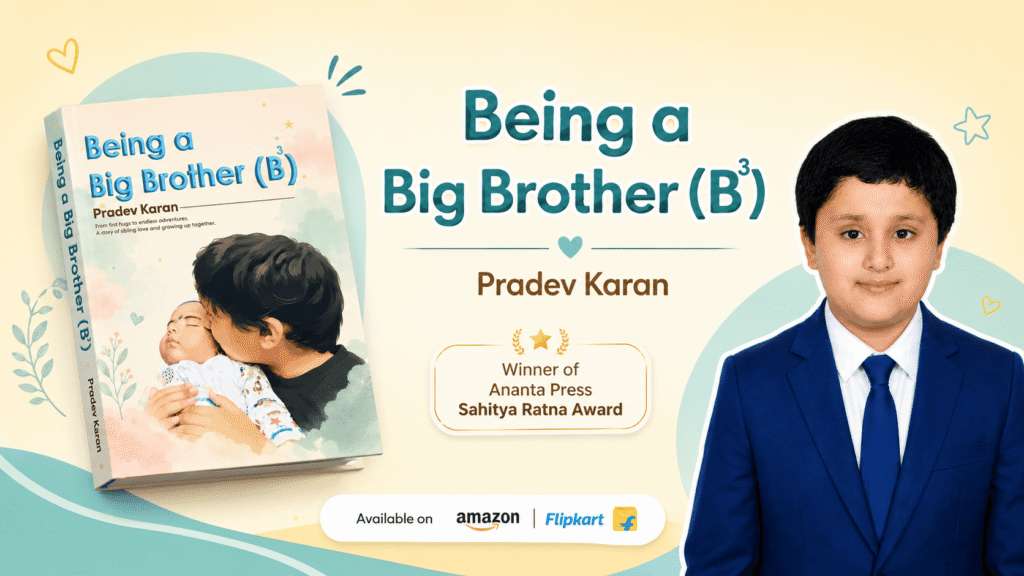
Many books search for importance in exceptional events. Being a Big Brother by Pradev Karan discovers it in ordinary life. Its world is made of family adventures, sibling disagreements, funny moments, conversations, affection, and daily learning. These may appear modest beside dramatic fiction, yet they are the experiences through which most people actually become themselves. Pradev’s ability to recognise their value is one of the most appealing features of his debut.
The book begins from a familiar life change: a child becomes an elder sibling. This transformation does not happen only when a younger sister is born. It unfolds gradually as the older child learns to share a home, adapt to new responsibilities, interpret new emotions, and understand that love can involve both joy and effort. By presenting this process through personal stories, Pradev allows readers to see growth as it occurs in daily life rather than in a single heroic moment.
The ordinary setting gives the book broad relatability. Families differ in language, culture, routine, and circumstance, but many share similar emotional patterns. Siblings laugh together, compete, misunderstand one another, seek attention, offer help, and create private memories. Parents try to balance needs and guide children through conflict. Trips and celebrations bring excitement, while small disruptions become stories retold for years. Being a Big Brother draws strength from this recognisable rhythm.
Pradev’s perspective prevents the familiar material from feeling predictable. Adults often forget how large small events can feel to children. A change in a routine may be deeply significant. A disagreement may seem to threaten the whole relationship. A moment of praise may be remembered for years. A younger sibling’s trust may create a new sense of pride. Because Pradev writes at eleven, he preserves the scale of childhood emotion. He does not look down on these moments from adulthood; he stands within them.
The book’s warmth appears to come from its refusal to separate love from imperfection. Family affection is not shown as constant agreement. It survives irritation, misunderstanding, and competing wishes. This is a healthy and reassuring representation for young readers. It teaches that conflict does not cancel love. Relationships can bend, recover, and become stronger when people communicate honestly.
The theme of memory is particularly important. Childhood passes quickly, even for the child experiencing it. Family photographs preserve appearances, but stories preserve meaning. They explain why everyone laughed, what someone feared, how a quarrel ended, or when a child first felt responsible for another person. By writing his memories, Pradev creates a family archive. Years later, the book may allow him and his sister to revisit not only what happened but how their relationship felt at this stage of life.
This archival quality gives the book emotional depth. It is easy to imagine readers thinking about their own collections of family stories. Which memories are repeated at gatherings? Which small acts revealed love? Which disagreements now seem funny? Which ordinary day became unforgettable? A book that awakens such questions remains with the reader beyond its pages.
The storytelling also celebrates observation. Pradev enjoys noticing people and learning through everyday experiences, and that habit is central to nonfiction writing. A good observer sees patterns in ordinary behaviour. He notices tone, reaction, and change. He recognises that a funny event may contain a truth about personality, or that a difficult moment may reveal a family value. Being a Big Brother demonstrates how attention can turn life into narrative.
The simplicity of the book’s language supports this focus. The value of a memory does not depend on elaborate description. In family storytelling, clarity can be more powerful than ornament. A direct voice feels intimate, as though the author is sharing an experience across a table. For children, this accessibility makes reading inviting. For adults, it allows the sincerity of the young narrator to remain central.
The book also has a gentle philosophical dimension. It suggests that growth happens continuously and often unnoticed. Children do not wake one morning with complete empathy or responsibility. These qualities form through repetition: helping again, listening again, apologising again, trying again. A sibling relationship provides countless opportunities for such learning. Each small encounter adds to the person a child is becoming.
This idea gives the book a quiet resilience. Resilience is sometimes represented through extreme challenges, but everyday resilience matters too. It is the ability to recover after hurt feelings, adjust to a changed plan, accept that another person has different needs, or remain connected after conflict. Pradev’s family-centred stories help readers recognise these forms of strength in themselves.
The role of humour should not be underestimated. Family memories often survive because they are funny. Humour makes difficulty bearable and gives relatives a shared language. A playful tone also protects the book from becoming a catalogue of moral lessons. Readers are allowed to enjoy the incidents before analysing them. This is particularly important for children, who deserve books that entertain as well as guide.
Being a Big Brother can therefore appeal to a wide range of readers. Children with younger siblings may recognise their own mixture of pride and frustration. Children without siblings can gain insight into another kind of family experience. Parents may understand more clearly how children interpret changes at home. Grandparents may appreciate the preservation of family memory. Teachers can use the book to encourage autobiographical writing and discussions about relationships.
The author’s achievement adds another layer of meaning. Writing and publishing at eleven requires sustained attention, confidence, and perseverance. Pradev balances his academic life with creative work and community engagement, demonstrating that young people can contribute seriously without losing the playfulness of childhood. His example may encourage children who believe their lives are too ordinary to write about. His book proves that significance comes not only from what happens, but from how carefully one sees it.
The connection between personal and social responsibility is also noteworthy. Pradev’s involvement with Positive Alliance Trust has introduced him to community wellbeing and service. His book focuses on home, but the values it explores—empathy, kindness, patience, protection, and respect—are the same values required in a wider community. Family becomes the first place where a child practises citizenship.
What makes Being a Big Brother unique is its confidence in the emotional richness of everyday life. It does not need a grand adventure to show courage or an extraordinary crisis to show love. It finds both in the ongoing work of being a sibling. The result is a sincere piece of nonfiction that honours family, childhood, and memory.
Pradev Karan’s debut invites readers to slow down and value the moments that are easiest to overlook. A child helping a sister, a family laughing after confusion, a disagreement that leads to understanding—these are not minor events when viewed from the inside. They are the building blocks of character and belonging. Being a Big Brother transforms them into stories and, in doing so, reminds us that an ordinary family life is filled with extraordinary meaning.
Purchase the book on Amazon: https://amzn.in/d/0bT3hytF