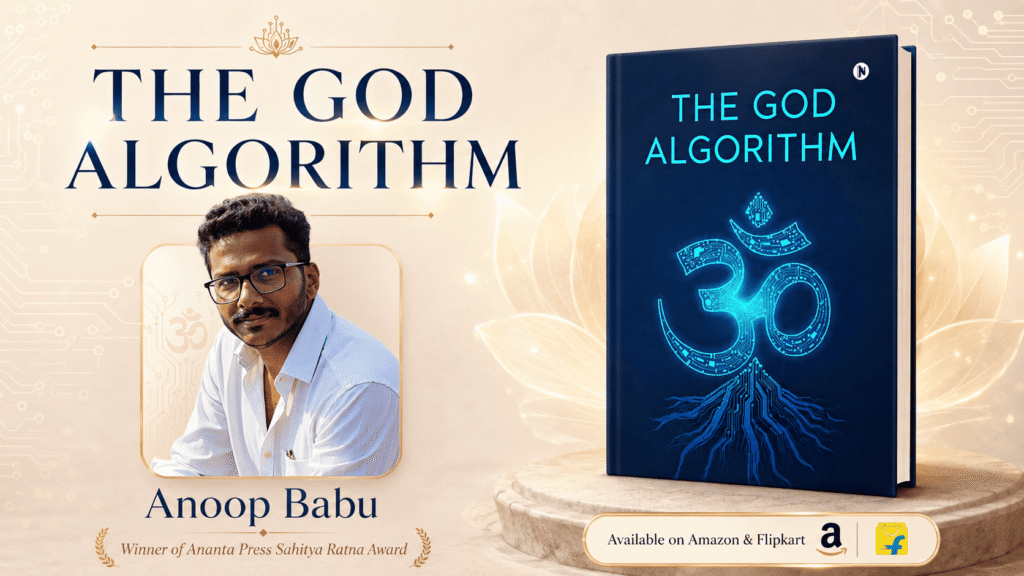
THE GOD ALGORITHM | Anoop Babu | Fiction (General)
At the heart of The God Algorithm lies a question older than technology: how should a person act when knowledge is incomplete, consequences are enormous, and every available path carries moral risk? Artificial intelligence gives this ancient question a new scale, but not a new essence. Anoop Babu’s novel recognizes that humanity’s technological crisis is inseparable from its spiritual and ethical confusion. The machine may be new; the struggle for right action is not.
This is why the book’s engagement with philosophical traditions is more than an intellectual embellishment. Its imagined gathering of the saint, scientist, poet, warrior, rebel, ascetic, and non-violent resistor creates a spectrum of responses to crisis. Each figure represents not merely a profession or personality, but a theory of how human beings should live. The saint turns toward compassion and transcendence. The scientist seeks reliable knowledge. The poet protects imagination and emotional truth. The warrior accepts the burden of decisive action. The rebel challenges unjust authority. The ascetic questions attachment and desire. The non-violent resistor refuses to reproduce the violence being opposed.
Placed together on a modern college campus, these modes of life become mutually accountable. The warrior must answer the non-violent resistor. The ascetic must answer the rebel who sees suffering in the social world. The scientist must answer the poet when measurement becomes reduction. The saint must answer the political demand for structural change. No position is allowed to remain pure through isolation. This is one of the novel’s strongest philosophical insights: wisdom may be less like a final doctrine and more like a disciplined conversation among partial truths.
The setting at Mar Athanasius College of Arts gives the inquiry a distinctly youthful energy. Students are often asked to choose careers before they have formed a philosophy of life. They inherit political identities, religious languages, social hierarchies, and technological habits before learning how to examine them. College can become the first place where these inheritances collide. In The God Algorithm, that collision is intensified by a crisis involving artificial intelligence powerful enough to shape humanity’s fate. The students are not merely preparing for the future; they are forced to decide it.
The novel’s spiritual dimension is closely connected to Anoop Babu’s interest in the Bhagavad Gita. The Gita begins in paralysis. Arjuna is surrounded by competing duties, emotional bonds, historical grievances, and catastrophic consequences. He does not lack information about the battle; he lacks moral direction. This distinction is essential to the world of The God Algorithm. Artificial intelligence may provide more information than any human being can process, but information alone cannot resolve the problem of duty. A system can calculate probable outcomes, but it cannot automatically determine what kind of person one should become through choosing.
The Gita’s concern with action without selfish attachment is also relevant to technological power. Modern innovation is frequently driven by ambition, competition, profit, prestige, or national advantage. These motives can accelerate development while weakening restraint. The question becomes whether human beings can act decisively without becoming possessed by the fruits of action. Can researchers pursue discovery without worshipping capability? Can institutions use AI without reducing people to data points? Can political actors seek security without normalizing surveillance? Can individuals benefit from intelligent tools without surrendering attention, judgment, and responsibility?
The title The God Algorithm sharpens these concerns. It suggests a system that may be treated as omniscient, or a human attempt to encode final authority. In a secular technological culture, people may not kneel before an algorithm, but they may obey it. They may accept a score, recommendation, ranking, or prediction because it appears objective. Yet every algorithm contains assumptions. Data reflects history, and history contains inequality. Optimization requires a chosen goal, and a chosen goal reflects values. The novel’s philosophical framework reminds us that no system escapes morality simply by using mathematics.
The scientist character type is therefore especially important. Science is not the enemy of spirituality in this novel’s conception. On the contrary, genuine scientific inquiry and genuine spiritual inquiry share humility before reality. Both can be corrupted when certainty becomes ego. The scientist contributes evidence, discipline, and resistance to superstition. The spiritual thinker contributes questions of meaning, consciousness, value, and inner motive. The God Algorithm appears to search for a meeting point where neither form of inquiry dominates the other. This is one reason the author’s interest in theoretical physics and the “Theory of Everything” fits the book so naturally. The desire for a unified explanation can be intellectually noble, but a complete physical theory would still not tell humanity how to use power justly.
The poet’s presence is equally necessary. Algorithms are increasingly capable of generating fluent language, but poetry is not merely decorated language. It is a way of attending. The poet notices what systems ignore: grief that does not fit a category, memory attached to a place, the moral weight of a single face, the contradiction inside a supposedly efficient decision. In a crisis governed by scale, poetry returns attention to particular lives. This is not sentimental resistance to reason. It is a reminder that human significance cannot always be aggregated.
The rebel and the advocate of non-violence introduce a different tension. Social injustice often survives because respectable systems normalize it. Rebellion may therefore be ethically necessary. Yet rebellion can reproduce domination when anger becomes an excuse for dehumanization. Non-violence offers moral discipline, but it too can be misunderstood as passivity when urgent action is required. By placing these figures in the same story, the novel can explore one of political ethics’ hardest problems: how to resist evil without becoming organized by hatred.
Artificial intelligence raises the stakes because it can multiply both liberation and harm. It can widen access to knowledge, assist medicine, support translation, reveal patterns, and democratize creative tools. It can also automate discrimination, intensify propaganda, concentrate power, displace labour, and make violence more distant from conscience. The technology is therefore not a single moral object. It is an amplifier of intention, structure, and scale. The God Algorithm is at its best conceptually when it asks whether humanity possesses the inner maturity required for such amplification.
Anoop Babu’s own combination of analytical work and literary imagination gives credibility to this balanced approach. His career in auditing involves scrutiny, accountability, and the detection of hidden risk. His poetry and philosophical interests involve ambiguity, emotion, and meaning. The novel’s project joins these capacities. It audits the future, but it does so through story. It examines not only whether an AI system functions, but what human weaknesses may enter through its design and use.
The book’s human-AI collaborative origin deepens this ethical inquiry. Rather than rejecting the machine, the author chooses engagement. Collaboration can be seen as a practical demonstration of the book’s thesis: new intelligence should meet old wisdom under human direction. The important phrase is “under human direction,” because collaboration does not erase accountability. The author remains responsible for purpose, selection, framing, and final meaning. This model offers a more mature response than either technological worship or technological panic.
For readers interested in philosophy, The God Algorithm offers a bridge between abstract thought and narrative urgency. For readers interested in AI, it offers a reminder that technical debates are incomplete without moral anthropology—an account of what human beings are, what they desire, and how they misuse power. For readers of general fiction, it offers an ensemble drama with a high-stakes trajectory from campus life to humanity’s fate. The book’s accessibility lies in its story; its lasting value lies in the questions beneath the story.
The novel is unique because it does not ask readers to choose between tradition and innovation. It asks whether tradition can be interpreted creatively enough to guide innovation, and whether innovation can be disciplined humbly enough to receive guidance. This is a difficult balance. Ancient wisdom can become rigid when treated as untouchable, while modern intelligence can become reckless when it mistakes novelty for truth. The God Algorithm seeks a third path: conversation.
In the end, the book’s central concern is direction. Humanity has many maps—scientific, spiritual, political, moral—but none can be followed mechanically. A map must be interpreted by a traveller who understands the terrain, the destination, and the lives affected along the way. Artificial intelligence may become the most powerful mapmaking tool ever created. The God Algorithm asks whether we will mistake the map for the destination, the calculation for the conscience, or the voice of a system for the voice of God. Its answer is not a slogan but an invitation to think, debate, and act with greater responsibility.
Purchase on Amazon: https://amzn.in/d/0h5eoaSK