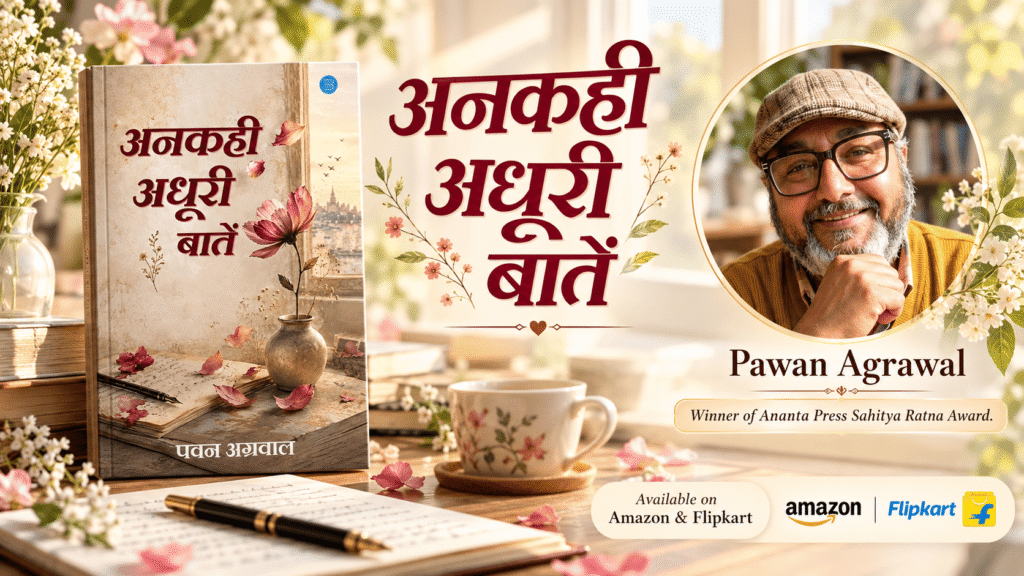
At first glance, “अनकही अधूरी बातें” by Pawan Agrawal is a personal collection of Hindi poems drawn from the author’s life. Yet within that personal framework lies a broader concern that gives the book social relevance: the tension between human relationships and a money-driven way of seeing the world. Agrawal identifies an anti-money-centred mindset as one of the recurring currents behind his writing, alongside marital concerns, sibling relationships, adversity, and personal emotional experiences. These themes make the collection more than a private diary in verse. They allow it to ask what people value, what they neglect, and what becomes difficult to say when material priorities begin to dominate emotional life.
The strongest feature of the collection is that it approaches these questions through poetry rather than through preaching. A poem does not need to present a financial philosophy or a social theory. It can show the emotional consequence of a value system through one memory, one relationship, one moment of hurt, or one private contradiction. This approach can be far more persuasive than direct moral instruction because it leaves room for the reader’s own experience. Instead of telling readers that money should not matter too much, the poems can invite them to consider what happens when it does.
This is a particularly contemporary concern. Economic aspiration is a major part of modern life, and rightly so: people seek stability, comfort, education, security, and opportunity. The problem arises when financial measurement begins to colonise every other measure of worth. Relationships can become transactional. Success can become a competition. People may begin to evaluate themselves through possessions, salary, or status rather than through character, contentment, creativity, or the quality of their connections. A poetry collection that questions this mentality participates in an important cultural conversation while remaining grounded in individual feeling.
The inclusion of marital and sibling relationships makes that critique more concrete. Money rarely exists separately from family life. It influences expectations, responsibilities, decisions, power dynamics, and sometimes conflict. But the emotional meaning of family cannot be reduced to economics. A marriage survives through trust, communication, patience, affection, and mutual recognition. A sibling bond is built from shared history, memory, rivalry, care, and obligation. When financial considerations become the dominant language within such relationships, something intangible may be lost. Poetry is well suited to noticing that loss.
Agrawal’s stated approach is notable for its simplicity. He does not claim that the poems offer profound wisdom. He describes them as personal observations shaped into words. This restraint gives the collection credibility. The most effective reflections on values often come not from someone announcing universal truths but from someone describing what they have noticed in their own life. A reader can disagree with an observation and still find it meaningful. That openness is essential to personal poetry.
The title “अनकही अधूरी बातें” deepens this emotional framework. Relationships are full of incomplete conversations. People may avoid speaking about money, resentment, disappointment, expectation, sacrifice, or unequal treatment because these subjects are sensitive. Silence can protect a relationship temporarily while also allowing tension to accumulate. The collection’s title suggests that poetry becomes the place where such suspended conversations continue. What was not said in the moment can later be examined in verse.
This gives the book a confessional quality, but it need not be understood as confession in a dramatic or sensational sense. Rather, it is confession as honesty: the willingness to acknowledge feelings that are often edited out of social interaction. People are trained to maintain appearances, especially within families. They may say “everything is fine” while carrying frustration or sadness. They may avoid criticising a loved one openly. They may suppress disappointment because they fear being misunderstood. Writing allows those emotions to exist without immediately demanding a confrontation.
This function of poetry—as a safe space for difficult feeling—is one of the collection’s most relatable elements. The author himself describes writing as a kind of venting, a way of expressing what one may not say aloud. For readers, this can make the book feel companionable. Even when the exact circumstances differ, the emotional mechanism is familiar. Many people know what it is like to replay a conversation mentally, imagine a different response, or recognise too late what they wanted to say. The poems emerge from that recognisable human experience.
The collection’s focus on adverse circumstances also prevents its social critique from becoming abstract. Values become clearest when tested. It is easy to speak about relationships, loyalty, or simplicity when life is comfortable; difficult periods reveal what people actually prioritise. Adversity may expose dependence, selfishness, generosity, resilience, or unexpected support. Personal poetry can capture these discoveries without turning them into slogans. It can record the emotional texture of hardship—the frustration, fatigue, vulnerability, gratitude, or disillusionment that accompany it.
Agrawal’s professional background as an advocate adds another perspective to this theme. Legal practice often deals directly with conflict, property, obligation, rights, and competing interests. While the poems are presented as personal rather than professional reflections, the author’s daily familiarity with human disagreement may sharpen his awareness of how values operate in real life. His literary inclination offers a counterbalance: a space where human complexity is not reduced to a case, position, or outcome, but explored as feeling.
The choice of Hindi reinforces the collection’s closeness to everyday relationships. Hindi allows the poems to speak within the cultural atmosphere of family life, social expectations, and personal conversation. Emotional words carry associations formed through childhood and community. When poetry is rooted in experience, writing in the language nearest to that experience can preserve a natural intimacy. This is especially important in poems about home, relatives, marriage, and values, where tone can be as meaningful as literal content.
Another strength is the collection’s likely accessibility to readers beyond the regular poetry audience. Because its themes arise from ordinary life, readers do not need theoretical knowledge to appreciate them. Someone who has faced family expectations, financial pressure, relationship strain, or the difficulty of being emotionally honest may immediately understand the territory. The poems can therefore serve as an entry point into poetry for people who usually think the genre is too abstract or distant from daily concerns.
What makes “अनकही अधूरी बातें” unique is the combination of private feeling and ethical observation. The book is not only asking, “What did I feel?” It is also implicitly asking, “Why did this situation feel this way? What values were at work? What mattered more than it should have? What was neglected?” These questions allow personal poetry to expand toward social reflection without losing intimacy.
The collection may also encourage readers to examine their own relationship with success. A book cannot resolve the tension between material needs and emotional values, nor should it try. But literature can make us more conscious of the assumptions guiding our choices. If a poem makes a reader reconsider how they speak to a sibling, how they measure a partner’s contribution, or how they define a successful life, it has already done meaningful work.
In the end, “अनकही अधूरी बातें” is valuable because it preserves the emotional side of experiences that modern life often treats too quickly. It gives space to relationships, disappointments, values, and unresolved thoughts. Its critique of money-driven thinking is not separated from its concern with family; the two belong together because values reveal themselves through relationships. Pawan Agrawal’s collection offers readers a reflective pause—a chance to look beyond visible achievement and listen to the quieter, unfinished conversations that shape a life.
Amazon Purchase Link: https://www.amazon.in/dp/8169956668