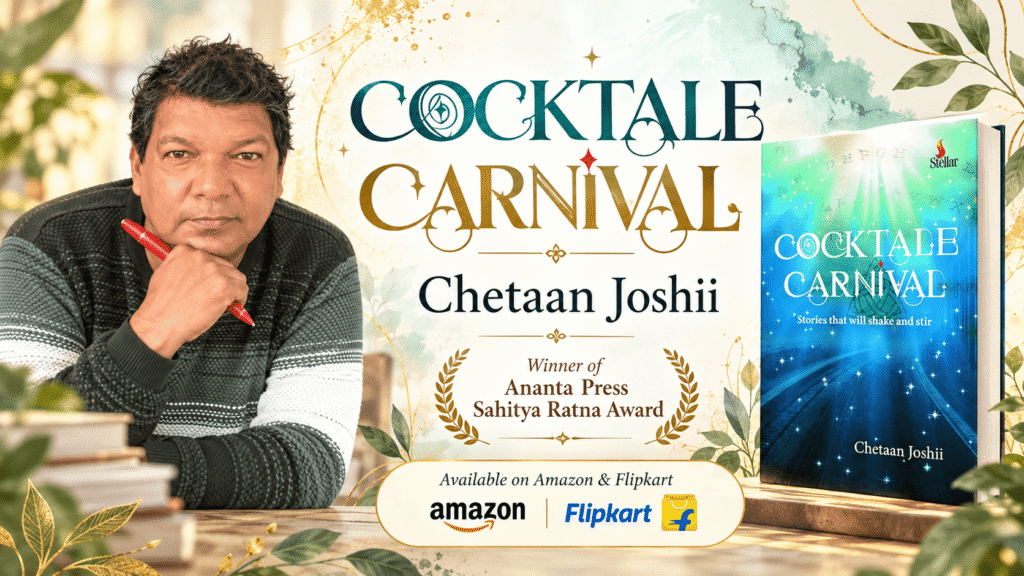
There are books that satisfy familiar expectations, and there are books that stand out because they challenge the reader’s expectations in pleasurable ways. CockTale Carnival by Chetaan Joshii belongs firmly to the latter group. What distinguishes this collection most powerfully is its originality. In fact, originality is not simply one feature among many here—it appears to be the governing principle of the book. From its title to its story premises to its blending of genres, CockTale Carnival presents itself as a work determined to avoid the ordinary. That determination gives the book a distinct literary identity and makes it particularly valuable in a time when much fiction risks becoming formulaic.
The short story collection as a genre can sometimes suffer from unevenness or thematic predictability. Writers may remain confined to one mood, one social concern, or one stylistic pattern. Chetaan Joshii resists that limitation. He brings together fantasy, surrealism, horror, humour, sci-fi, realism, satire, and modern fable within a single volume. This is not merely variety for its own sake. Rather, it reflects a larger artistic philosophy: that stories should be allowed to find their own best form. That freedom is visible in the array of ideas presented in the book’s description. Each story seems built around a premise that is both surprising and suggestive. Such imaginative boldness is a significant achievement.
Originality in literature is often misunderstood. It does not necessarily mean inventing something so obscure that no one can connect with it. True originality lies in presenting human concerns through fresh narrative angles. A love triangle between two people, a writer battling writer’s block by stepping into his own story, a detective looking for a stolen heart, or a scientist discovering love as a radioactive element—these ideas are original because they transform familiar themes like love, ambition, creativity, and longing into new imaginative structures. That is the kind of originality that matters, because it refreshes the reader’s perception without losing emotional relevance.
One of the most admirable aspects of CockTale Carnival is that its originality appears anchored in readability. Experimental literature sometimes prides itself on difficulty, but Joshii’s work seems to pursue a different path. The stories are imaginative, but they are also designed to entertain, engage, and surprise. This combination is precious. It means the collection can appeal to a wide readership without sacrificing intelligence. The book does not ask readers to choose between accessibility and literary creativity. It offers both.
The title story space of a “carnival” is also metaphorically apt. A carnival is a place where the unusual becomes normal for a while, where disparate attractions coexist, and where delight comes from movement between different experiences. That seems to be the exact spirit of the collection. Each story is like a different stall, performance, or attraction in a literary fair. Some may provoke laughter, some awe, some suspense, some reflection. Yet they all belong within one imaginative world shaped by the author’s signature confidence in unusual ideas. This makes the collection coherent not through sameness, but through creative abundance.
Chetaan Joshii’s authorial profile further strengthens the significance of this originality. He has written across forms and genres, including graphic books, short story collections, a novella, tribal novels, and works that blend self-help with fantasy. Such a body of work already indicates a refusal to be boxed in. CockTale Carnival can thus be seen as part of a larger literary project: exploring the full flexibility of storytelling. This is where the book becomes especially inspiring. It reminds readers and aspiring writers alike that one need not remain imprisoned by a single genre identity. Imagination thrives when given permission to roam.
The presence of modern fables in the collection is especially noteworthy in this context. Fables carry an ancient tradition, but in modern hands they can become sharp, witty, and psychologically revealing. By including stories like the duckling who does not believe he is ugly, the peacock who learns the meaning of display, or the mouse redefining the mousetrap, Joshii extends the idea of originality into the symbolic realm. These tales suggest that the collection can be playful while also subtly reflective. They demonstrate that creativity in literature is not only about novelty of setting, but also about novelty of perspective.
The book also deserves praise for honouring multiplicity. In a polarized reading culture, there is something refreshing about a collection that does not insist on one literary texture. CockTale Carnival allows absurdity and emotion, humour and pathos, fantasy and realism, literary play and readerly pleasure to coexist. This coexistence is important because it mirrors the complexity of imaginative life. Human beings do not experience existence in one fixed genre. We move through comedy, dread, longing, irony, tenderness, and wonder. A collection that embraces many genres therefore feels, paradoxically, more complete in its engagement with life.
Another reason the book stands out is its likely effect on the reader’s memory. Stories grounded in unusual concepts linger. They create narrative fingerprints. Even after one finishes the collection, one is likely to remember the vanished music note, the same train ride, the stolen heart, or the radioactive love. This memorability is one of the clearest markers of successful fiction. It means the stories have crossed from the page into the imagination of the reader. They continue living there. That is a profound achievement for any short story writer.
Joshii’s own philosophy, especially his belief in the power of Human Imagination, finds beautiful embodiment here. The collection seems to argue that originality is not a luxury—it is the lifeblood of meaningful fiction. In an era shaped increasingly by repetition, templates, and algorithmic sameness, CockTale Carnival insists on the uniqueness of the imaginative leap. Its stories seem to say that literature remains powerful when it surprises, unsettles, amuses, and invents. The book is therefore not only a reading experience, but a subtle defense of creative freedom.
This collection will likely appeal strongly to readers who are tired of predictable plots and standard emotional arcs. It is for readers who enjoy asking, “What if?” and who delight in seeing that question answered with wit and inventiveness. It is also highly suitable for young writers or literature students, because it models how far one can go when one trusts an unusual idea. It shows that genre boundaries are not cages, but tools—available to be blended, inverted, and refreshed.
In conclusion, CockTale Carnival stands out because it is unapologetically original. It embraces multiplicity, delights in invention, and brings together a wide range of literary moods without losing coherence. Chetaan Joshii has crafted a collection that celebrates the freedom of storytelling and demonstrates how originality can remain both reader-friendly and artistically meaningful. For anyone seeking fiction that is fresh, unconventional, and imaginatively alive, this book offers an experience well worth having. It is a reminder that the impossible, the bizarre, and the unexpected often make for the most memorable literature of all.
Amazon Link:
https://www.amazon.in/dp/9382035176