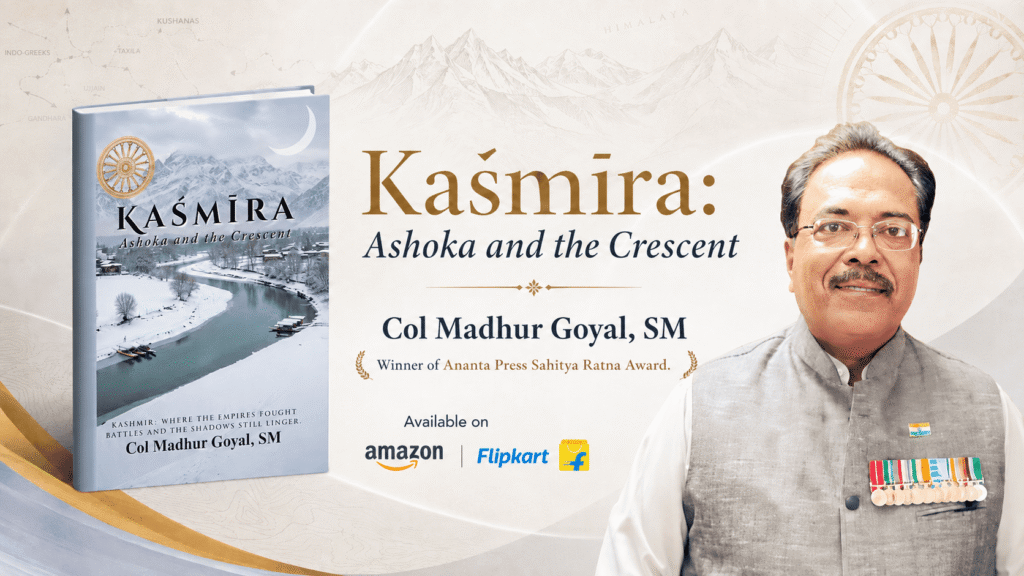
Book: Kaśmīra: Ashoka and the Crescent | Author: Col Madhur Goyal, SM
The most powerful way to read Kaśmīra: Ashoka and the Crescent may be to look beyond the borders, armies and diplomatic positions and ask a more difficult question: what does a century of unresolved history do to the people who must live inside it? Col Madhur Goyal, SM’s book is broad in scope, moving from ancient kingdoms to contemporary geopolitical rivalry, but its underlying emotional force comes from the fact that Kashmir is never merely territory. It is home, memory, sacred space, battlefield and inherited argument at the same time.
The book begins with geography, and that choice carries a human meaning as well as a strategic one. Rivers, valleys and mountains are not only physical features; they become places around which communities organise their lives and memories. A mountain range can be a frontier to a state, but to someone born beneath it, it is part of childhood. A river can mark geography in a history book, yet for a family it may be connected to pilgrimage, farming, neighbourhood life or stories carried through generations. Kaśmīra’s movement from landscape into history therefore establishes the central emotional truth of the book: when conflict changes control over land, it also changes relationships between people and place.
This becomes particularly important when the narrative enters Kashmir’s religious and civilisational history. Buddhism, Hinduism, Sikhism, Islam and Sufism all form part of the book’s account of the valley. Such diversity makes any simple story of “one Kashmir” inadequate. The region has been shaped by multiple communities and traditions, and its identity has often been created through coexistence, succession, influence and friction among them. The spiritual richness of the valley makes later violence more painful because shrines and sacred landscapes exist beside military positions and memories of loss.
The book’s treatment of the twentieth century deepens this sense of historical rupture. Maharaja Hari Singh’s dilemma during Partition represents more than a ruler’s decision; it is the moment when competing national projects collide with a princely state’s uncertain future. The violence surrounding Partition and the conflict of 1947 create new borders and new fears. Subsequent wars in 1965 and 1971 reinforce the idea that Kashmir is not simply disputed but repeatedly fought over. Every military episode leaves behind not only strategic consequences but civilian memories.
The rise of militancy in 1989 and the exodus of Kashmiri Pandits are among the most painful components of this modern history. The word “exodus” can sound clinical until one considers what it means at the level of ordinary life: leaving homes, localities, neighbours, schools, temples, workplaces, family possessions and familiar landscapes under fear and uncertainty. Displacement rearranges identity. A person may continue to belong emotionally to a place while being physically separated from it for decades. By including this trauma within a larger history, Kaśmīra acknowledges that political conflict is also a crisis of belonging.
Yet the book’s stated ambition to include diverse Kashmiri voices is equally important. One community’s suffering does not cancel another’s. Kashmir contains multiple experiences of grief, aspiration, alienation and attachment. The challenge for any writer is to acknowledge this plurality without dissolving moral seriousness into vague equivalence. Kaśmīra’s conceptual strength lies in presenting competing dreams: India’s vision of unity, Pakistan’s call for self-determination, China’s strategic calculations and the varied voices of Kashmiris. This framework makes disagreement visible rather than pretending a single narrative can absorb everyone.
Col Goyal’s military background adds another layer of human complexity. Soldiers are often represented either as abstract instruments of the state or as simplified heroic symbols. His own career, which included service in Siachen and Kashmir and a Sena Medal for Gallantry, gives him reason to understand the physical and emotional cost of deployment. The “Frozen Battlefield” of Siachen is therefore important not only as a strategic story but as an account of endurance. Soldiers face frostbite, avalanches, isolation and severe cold. Families wait at home. The distance between the beauty of the mountains and the hardship of living in them becomes one of the book’s most striking contrasts.
Kargil extends that contrast. Mountain peaks that appear magnificent in photographs become sites where every movement can be exposed and every ridge can determine survival. War turns geography into memory. For those who fight, a location may forever remain associated with comrades, fear, duty and loss. For civilians, the same conflict may mean displacement, disrupted livelihoods or anxiety about what happens next. Kaśmīra’s broad structure enables these layers to sit beside one another.
The expansion to China through Aksai Chin, the legacy of the 1962 war and the China-Pakistan Economic Corridor could easily make the book feel more distant from ordinary people, but in fact it reinforces the central theme. Great-power strategies are executed across inhabited or historically meaningful spaces. Roads, corridors, borders and military infrastructure may be described in strategic language, yet they affect how secure communities feel and how states imagine their future. Kashmir becomes part of a triangular tension among India, Pakistan and China, while its inhabitants continue to live beneath the weight of decisions made at multiple levels of power.
One of the book’s most effective ideas is its use of symbols. “Ashoka,” “Crescent” and “Dragon” represent broad strategic and ideological visions. But the book’s real question appears in the space between those symbols: where are the human beings? The answer is that they are everywhere – in the valley, in displaced communities, at military posts, in shrines, in villages, in political movements and in families that carry stories of what was lost. The symbolism works because it simplifies the actors without simplifying the human consequences.
This is also why the closing question is so haunting: can a land of faith and fire find peace beyond the shadows of history? “Beyond” is the most important word. History cannot be erased, and a demand to forget suffering would itself be unjust. The challenge is whether memory can be preserved without becoming a permanent instruction for future conflict. Can communities acknowledge different wounds? Can states protect their interests without reducing people to strategic assets? Can identity survive without requiring permanent antagonism? The book does not promise easy answers, but it asks the right kind of question.
For a general non-fiction reader, Kaśmīra is valuable because it connects major historical events to the emotional reality of place. It does not require the reader to see Kashmir only through military strategy, nor only through religious history, nor only through diplomacy. It creates a broad canvas where all of these dimensions interact. This breadth helps readers understand why discussions about Kashmir can become so intensely personal: they involve not only policy but memory, ancestry, security, faith and belonging.
The author’s relationship to Kashmir makes this more than a distant intellectual exercise. The region was part of his service life, and he returns to it in writing after a long military career. That background gives the project an atmosphere of reckoning. It feels like an attempt to understand a landscape that has been both professionally defining and historically troubled. His position will naturally bring a particular perspective, as every serious work on a contested subject does, but the book’s value lies in the scale of the conversation it opens.
Kaśmīra: Ashoka and the Crescent stands out because it recognises that the hardest conflicts are not sustained by strategy alone. They are sustained by memories, identities, fears and stories transmitted across generations. To read the book only as military history would miss its civilisational ambition; to read it only as political analysis would miss its emotional core. It is ultimately a book about a place that has been asked to carry too many meanings at once.
Its most enduring contribution may therefore be its insistence that peace must be imagined historically and humanly, not only strategically. Borders matter. Security matters. Sovereignty matters. But so do homes, shrines, memories, families and the dignity of people whose lives unfold beneath competing national narratives. Kaśmīra invites the reader to hold all of these truths together. That is an uncomfortable task, but for a subject as complex as Kashmir, discomfort may be the beginning of understanding.
Amazon: https://amzn.in/d/2VeZbFr