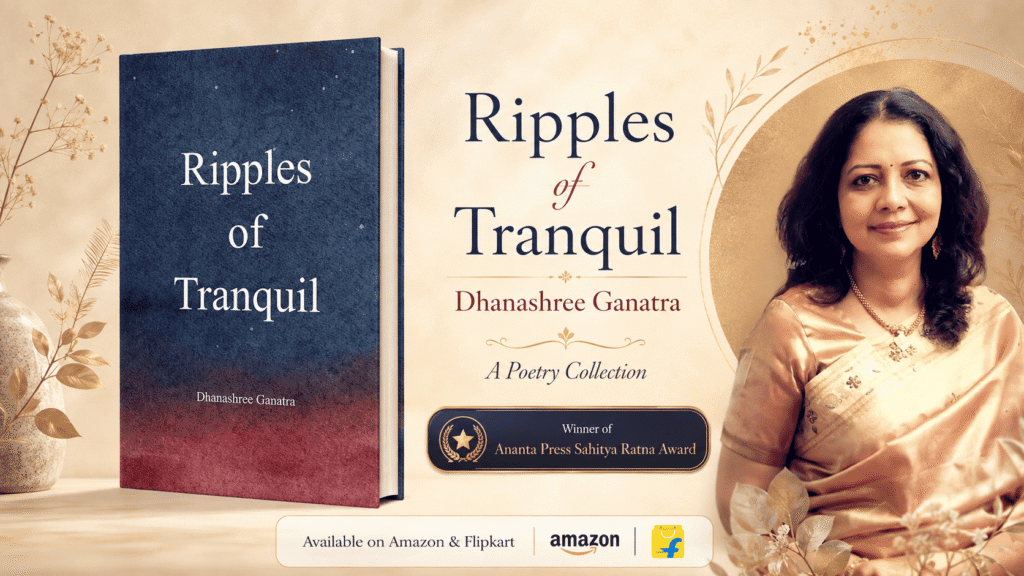
The contemporary world has developed extraordinary tools for communication, yet genuine quiet has become increasingly rare. Messages arrive instantly, screens compete for attention, work follows people into private hours, and public conversation often rewards speed over reflection. In such an environment, a poetry collection called Ripples of Tranquil carries immediate relevance. Dhanashree Ganatra’s book is not presented as a manual for digital wellbeing or a program for stress management. Its contribution is more literary and, in some ways, more enduring: it gives the reader a reason to slow down through the act of reading itself.
This is why the collection’s gentleness should not be mistaken for escapism. The desire for tranquility is not necessarily a desire to avoid the world. It can be a desire to meet the world with greater clarity. Ganatra’s poems explore love, dreams, silence, self-realisation, hope, and the subtle colours of the mind. These are inward subjects, but they shape outward life. A person’s internal dialogue affects relationships, decisions, resilience, and the ability to respond rather than react. By focusing on the inner world, the collection addresses the source from which much everyday action begins.
The phrase “when the world grows loud, these words guide you home” captures the book’s emotional purpose. Home, in this context, is not simply a physical location. It is an inner point of return. Many readers know the experience of feeling mentally scattered: attention divided among responsibilities, anxieties, unfinished conversations, and future plans. Poetry can interrupt that fragmentation because it asks for a different kind of reading. A poem often cannot be skimmed in the same way as informational prose. Its images and silences require presence. The reader must slow down enough to notice what is happening between words.
Ripples of Tranquil therefore offers a valuable reading practice as well as literary content. Its short reflective form is likely to encourage pauses. One does not need to finish the entire collection in a single sitting to benefit from it. In fact, the book’s themes suggest the opposite approach. A poem read in the morning and carried mentally through the day may have more impact than many poems consumed quickly. This makes the collection suitable for rereading, journaling, quiet evenings, travel, or any moment when the reader wants to step briefly outside the pace of routine.
A notable strength of the collection is that it seeks peace without converting poetry into simplified motivational language. There is a major difference between a slogan and a poem. A slogan removes ambiguity; a poem can deepen it. A slogan tells the reader what to believe; a poem may create an image that continues unfolding. Ganatra’s description of her work as “soft reflections,” “fragments of feeling,” and “shadows of thought” suggests respect for this distinction. Human consciousness is fragmentary. We do not always understand ourselves in complete sentences. Sometimes a mood comes before an explanation. Sometimes a memory is present only as an image. Poetry is particularly well suited to such states.
The theme of self-realisation gives the collection added depth. In an age dominated by public identity—profiles, professional roles, visible achievements—self-realisation asks a different question: who are we when external definitions become quiet? Ganatra’s contemplative approach makes room for that question without turning it into an abstract intellectual exercise. The route inward passes through recognisable experiences such as love, dreams, silence, and hope. This makes the spiritual dimension of the work inclusive. Readers do not need specialised knowledge to enter it.
The author’s own creative life strengthens the book’s message about inner continuity. Ganatra is a poet, singer, songwriter, composer, and filmmaker. These roles suggest an artist who allows one form of reflection to flow into another. The opening poem, “Life is Beautiful,” later became a song written, composed, and sung by her. That fact is especially fitting for a collection built around ripples. The poem itself created a ripple beyond the page, moving into music and then into international film-festival spaces. The journey of the work becomes an example of the book’s metaphor: a small creative source can spread across forms and audiences.
The song’s focus on optimism, resilience, and gratitude also makes the collection relevant to modern emotional life. These qualities are often discussed in the language of productivity or personal development, but poetry approaches them differently. Resilience in a poem is not a metric. Gratitude is not a task to complete. They can be felt as states of consciousness, questioned, lost, and rediscovered. That complexity protects the book from becoming merely inspirational. It can comfort without insisting that every difficult feeling be immediately replaced by positivity.
The international honours associated with Ripples of Tranquil—the 21st Century Emily Dickinson Award and the Tagore International Cultural Award, as described in the author information—suggest that its appeal has been recognised beyond a narrow readership. The international film-festival response to “Life is Beautiful” further supports the universality of its emotional language. In a global literary environment, this matters. A book rooted in an Indian author’s sensibility can speak across cultural lines not by erasing its origin but by reaching toward experiences common to many lives.
For readers who are exhausted by the pressure to constantly improve themselves, the collection may offer something particularly refreshing. It does not seem to begin from the premise that the reader is inadequate. Instead, it invites attention. There is a difference between being told to become calmer and being given an artistic space in which calm becomes possible. Poetry can create that space because it does not need to produce immediate practical results. Its usefulness may be indirect: a line changes the rhythm of thought, a metaphor opens perspective, a pause prevents an automatic reaction.
This is where the book’s title becomes increasingly meaningful. A ripple does not transform water by force. It moves through contact. Similarly, the most effective reflective writing often changes readers subtly. They may not close the book with a dramatic conclusion, but a thought may return hours later. A line may become associated with a personal memory. A poem may be revisited during a difficult period and suddenly feel different. Literary influence is often cumulative in this way.
Ripples of Tranquil is also a good reminder that poetry can serve readers who are not seeking academic complexity. Literary value does not depend on obscurity. A collection can be accessible while still dealing seriously with consciousness, emotional life, and spiritual reflection. Ganatra’s emphasis on universal themes gives the book a broad potential audience: regular poetry readers, newcomers to the genre, music lovers, spiritually curious readers, and anyone who values introspection.
The collection’s greatest quality, then, is its alignment between subject and form. It speaks about tranquility in a tranquil manner. It considers silence without filling every silence. It explores inner truth through images and reflections rather than through argument. This aesthetic consistency makes the book convincing. Readers are not simply told that stillness matters; they are invited into a reading experience shaped by stillness.
In a noisy age, that invitation is more significant than it may initially appear. Attention is one of the most valuable resources modern life demands, and where attention goes, emotional life often follows. Ripples of Tranquil asks the reader to reclaim a portion of that attention and direct it inward, not in self-absorption but in self-understanding. Dhanashree Ganatra’s poetry offers a gentle counterweight to hurry. It reminds us that peace may not be found by adding another activity to an already crowded life. It may begin by noticing one thought, one feeling, one breath, or one line of poetry with complete presence. That small act is a ripple, and the collection’s quiet wisdom lies in trusting how far such a ripple can travel.
Buy / View on Amazon: https://amzn.in/d/0doJNpxh