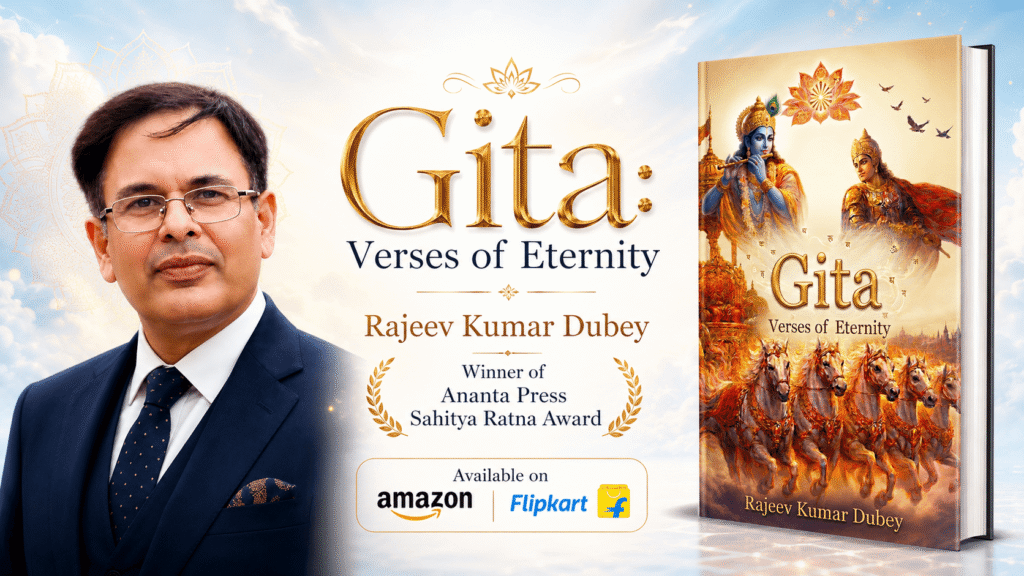
For many people, the desire to explore spiritual wisdom begins long before they know where to start. They may hear a famous quotation, encounter a reference to the Bhagavad Gita in a speech, or feel drawn toward questions about purpose, inner peace, and the meaning of action. Yet the first step can be intimidating. Classical texts often arrive surrounded by reverence, scholarship, unfamiliar vocabulary, and the fear that one must already possess considerable background knowledge to understand them. Gita: Verses of Eternity by Rajeev Kumar Dubey is valuable precisely because it seeks to soften that threshold. Written as poetry inspired by the Gita, it offers newcomers an approachable way to enter a timeless field of reflection.
The book’s accessibility is not a minor feature; it is its central contribution. It recognises a genuine gap between the continued cultural importance of the Gita and the experience of many contemporary readers. The Sanskrit verses may feel distant to those who have not studied the language, while conventional commentaries can sometimes feel demanding to a first-time reader. Dubey’s poetic approach creates an alternative entry point. It does not ask readers to become scholars before they can begin asking meaningful questions. Instead, it invites them to encounter the essence of a spiritual conversation through a form that is emotionally immediate.
This makes the book especially appealing for younger readers. Young adulthood is a period in which inherited answers are often questioned at the same time that new responsibilities are forming. Questions about identity, career, relationships, ambition, failure, comparison, and meaning can become intense. The modern environment adds another layer: constant digital stimulation, public comparison, rapidly changing expectations, and pressure to define success early. In such a context, ancient wisdom may seem remote, yet its underlying questions can be remarkably relevant. The challenge is one of language and access. Gita: Verses of Eternity responds by offering poetry as a meeting place between old insight and contemporary sensibility.
Poetry is particularly effective for readers who resist heavy instruction. It does not have to lecture. It can suggest, pause, and allow the reader to complete the meaning through personal experience. That is important in spiritual writing because the deepest questions cannot be answered entirely from outside. A poet can point toward self-examination, but each reader has to recognise their own fear, attachment, confusion, aspiration, or sense of duty. The verse form encourages this inward participation.
The book’s intended inclusiveness is another strong quality. It is described as suitable for spiritual seekers from any background, thoughtful readers everywhere, professionals navigating ethical choices, and newcomers to the Gita. Such breadth reflects the fact that the questions explored through Gita-inspired thought are not restricted to one narrow category of reader. A person may approach the book from faith, philosophy, literary curiosity, or personal uncertainty. The common ground is the human search for a way to act with greater understanding.
A particularly attractive aspect of the book is its emphasis on participation in life. Spirituality is sometimes presented in ways that seem to oppose worldly activity: one imagines peace as something found only by escaping conflict, responsibility, or ambition. The Gita offers a more demanding vision in which inner understanding must accompany action. Dubey’s book carries forward this orientation. The reader is encouraged not to abandon life, but to engage with it more consciously. For young readers, this is a powerful message. The point is not to eliminate challenge, but to develop a wiser relationship with challenge.
This orientation makes the book relevant beyond explicitly spiritual moments. A student deciding between paths, a professional under pressure, a young person facing disappointment, or someone trying to understand the difference between healthy ambition and restless attachment can all find value in reflective ideas about purpose and action. Because the work is poetry rather than a prescriptive guide, it can accompany rather than command. That tone can make spiritual inquiry feel personal rather than imposed.
Rajeev Kumar Dubey’s own life adds credibility to this balance between contemplation and engagement. He is a Professor of Anaesthesiology at the Institute of Medical Sciences, Banaras Hindu University, with expertise that includes critical care and hospital administration. This is a profession rooted in responsibility, knowledge, discipline, and service. Alongside his medical and academic career, he has cultivated deep interests in Indian culture, literature, history, the Gita, spirituality, meditation, and yoga. He is also an established poet whose work has appeared in literary journals, been presented on literary platforms, and broadcast on All India Radio.
For a young reader, this combination is quietly important. It demonstrates that intellectual, professional, scientific, literary, and spiritual interests do not have to cancel one another. Modern education can sometimes encourage people to place themselves into narrow categories: scientific or artistic, practical or spiritual, ambitious or reflective. Dubey’s profile offers another model, one in which these dimensions can coexist. The author’s medical career does not prevent him from writing poetry; his poetic sensitivity does not make his professional life less rigorous. That integration mirrors the book’s wider message that inward reflection and outward responsibility can belong together.
The values associated with Dubey’s poetry—truth, social harmony, universal brotherhood, and human values—also make the book suitable for readers who are interested in spirituality without sectarian boundaries. In a diverse world, spiritual literature becomes more meaningful when it encourages deeper humanity rather than sharper division. A book that helps readers consider discipline, purpose, compassion, and responsibility can contribute to ethical maturity regardless of the reader’s specific background.
Another reason the work stands out is its potential function as a beginning rather than an endpoint. Not every reader will move immediately from this volume to detailed Sanskrit study or philosophical commentary, and they do not need to. Yet a welcoming poetic introduction can awaken curiosity. It may lead someone to read a translation of the Bhagavad Gita, attend a discussion, explore meditation, or simply think more carefully about the motives behind everyday choices. Literature often matters because it opens doors that the reader did not know were available.
The title Gita: Verses of Eternity carries a sense of continuity. The original dialogue occurred in an epic setting, but each generation re-encounters its questions under new conditions. Today’s battlefield may be internal: anxiety about the future, conflict between expectation and conviction, or confusion about achievement and meaning. The names and circumstances change, but the search for a steadier basis for action remains. Dubey’s poetry is an attempt to keep that conversation alive in a form that feels hospitable to present-day readers.
Readers should approach this book not as a substitute for every possible reading of the Gita, but as an accessible companion. Its value lies in invitation, reflection, and emotional connection. It acknowledges that many people are curious about spiritual wisdom yet uncertain about how to begin. By meeting them through poetry, it lowers the barrier without trivialising the search.
Gita: Verses of Eternity is therefore a meaningful choice for first-time readers, young seekers, and anyone who wants philosophical depth presented in an approachable literary form. Its uniqueness comes from its ability to connect tradition with openness, action with contemplation, and spiritual inquiry with ordinary life. Rajeev Kumar Dubey has created a work that encourages the reader to enter an ancient conversation not as an outsider looking at history, but as a participant asking the same enduring question in a new age: how can I live and act with greater understanding?
Amazon purchase link: https://amzn.in/d/0e2udQ4o