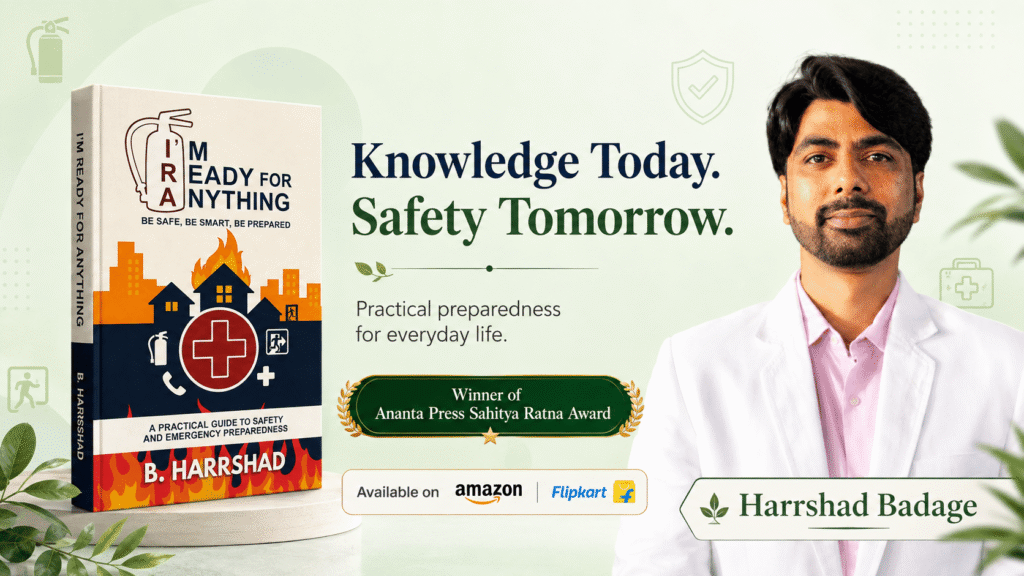
How professional safety education becomes clear, memorable guidance for ordinary readers
Some nonfiction books begin with research and later search for a practical application. I’m Ready for Anything (IRA) seems to have developed in the opposite direction: it begins with years of practical experience and turns those lessons into a book. That origin is one of its most persuasive strengths. Harrshad Badage is presented not simply as an author interested in safety, but as a safety educator, trainer, and speaker with more than a decade of experience in fire safety, first aid, emergency response, workplace safety, and disaster preparedness. He has reportedly trained thousands of participants across industries, schools, residential communities, hospitals, and corporate organizations. As a result, the book carries the perspective of someone who has repeatedly had to answer the most important question in practical education: will people actually remember and use this information when it matters?
That question influences the book’s style. IRA is described as conversational rather than technical, with relatable stories, Indian case studies, simple checklists, first-aid techniques, and step-by-step emergency planning. This is not a superficial choice. Teaching adults in real training rooms quickly reveals the difference between information that sounds impressive and information that sticks. A complicated explanation may be accurate but unusable. A clear sequence, memorable example, or simple demonstration can survive long after a session ends. Badage’s background as a soft-skills trainer before entering the safety field is therefore particularly relevant. He learned to teach communication, presentation, customer service, and workplace effectiveness before applying his teaching ability to emergency preparedness. The combination of communication skill and safety knowledge appears to shape the book’s reader-friendly approach.
The author’s career transition also gives the project an interesting human dimension. His profile explains that he entered a fire safety organization after beginning his career in soft-skills training. What might have been a professional change gradually became a mission as he noticed a recurring problem: organizations could invest in equipment and compliance, yet people still did not always know how to react during an actual emergency. This observation is crucial because safety cannot be reduced to infrastructure. An extinguisher helps only if people know where it is and what to do. An evacuation plan helps only if occupants understand it. A first-aid kit helps only if someone has enough knowledge to use its contents appropriately. IRA therefore directs attention to the human side of safety – awareness, behavior, memory, judgment, and preparation.
The book’s subject range reflects the variety of questions a field trainer is likely to encounter. It addresses fires, floods, earthquakes, road accidents, gas leaks, blackouts, workplace emergencies, civil unrest, and cyber scams. These situations span homes, public spaces, workplaces, transport, natural hazards, infrastructure failures, and digital environments. The breadth could have made the book feel scattered, but the unifying idea is preparedness itself. Across all these situations, the reader is asked to recognize hazards, think ahead, make early decisions, protect others, and avoid preventable mistakes.
One of the most convincing pieces of evidence for Badage’s teaching philosophy comes from a real incident described in his profile. At a first-aid workshop in Pune, he showed participants how to improvise a collar bandage with newspaper and cloth. Almost five years later, a participant contacted him to say that he had used the remembered technique to help stabilize a road-accident victim until professional assistance arrived. This anecdote explains the practical ambition behind the book better than any slogan could. Effective emergency education does not require a reader to remember everything. It requires certain useful ideas to be simple, relevant, and memorable enough to return at the right moment.
That principle also explains the importance of checklists. In ordinary reading, lists can sometimes feel simplistic. In safety, they are a strength. During stress, working memory becomes limited. People may overlook obvious steps or repeat ineffective actions. Checklists externalize memory and reduce dependence on perfect recall. A household emergency list can organize contacts, supplies, meeting points, and responsibilities. A workplace checklist can reinforce procedures. A first-aid sequence can help someone pause and act more systematically. By including practical checklists, IRA aligns with a broader truth about high-stakes environments: simple structures often support better decisions.
The author’s field experience also helps the book avoid the fantasy of the perfectly controlled emergency. Real incidents are messy. Roads are crowded, communication can fail, weather can disrupt access, bystanders may gather, families may be separated, electricity may go out, and professional responders may need time to arrive. An India-first guide has to acknowledge these realities. The book was reportedly inspired by the lack of a single resource addressing common local concerns such as LPG leaks, monsoon floods, road accidents, cyber fraud, building fires, stampedes, and prolonged blackouts. That direct relationship between training-room questions and book content makes the guide feel responsive rather than generic.
Another important quality is the avoidance of unnecessary fear. Trainers know that frightening people does not necessarily improve performance. Excessive fear can cause denial, panic, or disengagement. IRA’s message is that preparedness should produce confidence. Readers are encouraged to become proactive rather than reactive, which is a more sustainable foundation for safety habits. The book is not asking people to expect catastrophe every day. It is asking them to reduce avoidable uncertainty by learning a few essential skills and making a few sensible plans.
The pedagogical value of the book extends beyond individual readers. Because the material is practical and accessible, it can support families, schools, workplaces, residential societies, and community groups. A teacher can use a checklist as a discussion prompt. A parent can turn a section into a family conversation. A manager can connect key principles to a safety drill. A housing society can use the ideas to review communication and evacuation procedures. In this sense, the book can function as an extension of training: a resource that keeps important conversations alive after a workshop or awareness session has ended.
Its treatment of cyber scams is another sign of a trainer responding to contemporary reality. Safety education that ignores digital threats would now be incomplete. Fraud often succeeds because attackers create urgency and exploit emotional reactions. That means cyber safety and emergency preparedness share an important lesson: pause, verify, and act deliberately. By including digital risks with physical emergencies, IRA updates the concept of personal safety for modern life.
What makes this book unique, then, is not only what it covers but how its content appears to have been shaped. The material comes from repeated contact with ordinary people asking practical questions. The author has seen the gap between owning equipment and knowing how to use it, between attending a training session and remembering the lesson years later, and between reading international survival advice and dealing with Indian realities. IRA turns those observations into a reader’s toolkit.
For anyone who values nonfiction that can produce a visible change in behavior, this is the book’s strongest appeal. It is meant to be acted on. A reader can review a checklist, update emergency numbers, prepare family members, strengthen first-aid awareness, examine household hazards, or become more cautious about digital scams. These are modest actions individually, but together they build resilience.
I’m Ready for Anything succeeds as a practical translation of field experience into everyday guidance. It demonstrates that expert knowledge is most powerful when it becomes understandable, memorable, and usable by non-experts. Rather than treating safety as a specialist subject kept inside training rooms, Badage brings it into homes, schools, offices, and communities. That is a valuable achievement – and it makes the book not only informative, but potentially life-changing in the most literal sense.
Amazon Purchase Link: https://amzn.in/d/01LeypC9