Book Review: An Emotionally Rich Collection of 42 Stories That Brings Back the Forgotten Beauty of Handwritten Communication
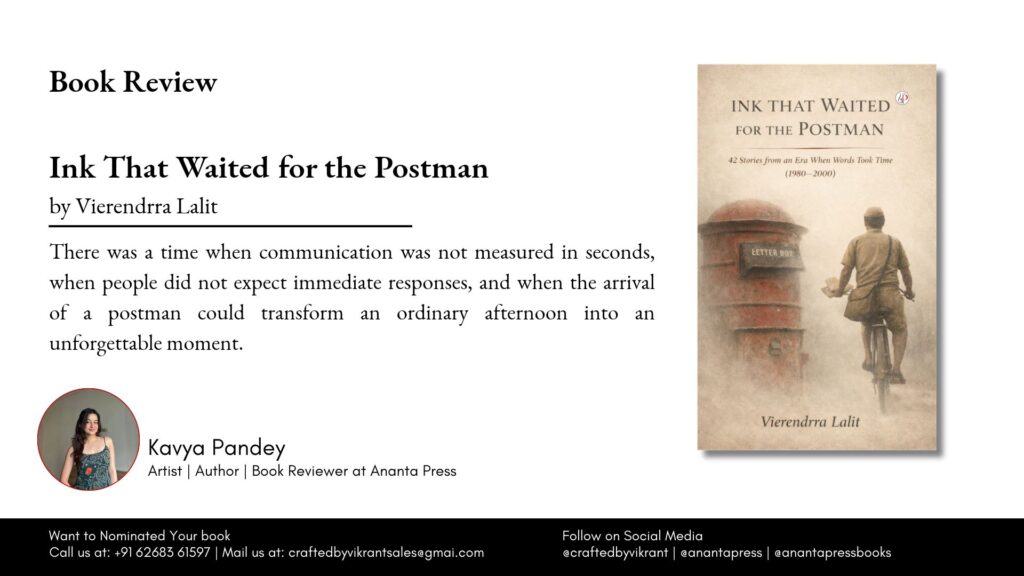
Book Title: Ink That Waited for the Postman
Subtitle: When Words Took Time, They Carried Lives
Author: Vierendrra Lalit
Publisher: Ananta Press
Publication Year: 2026
Genre: Literary Fiction, Short Stories, Nostalgia, Human Relationships
ISBN: 978-93-7821-139-3
Editorial Rating: 4.5/5
Introduction: Remembering an Era When Every Letter Had a Heartbeat
There was a time when communication was not measured in seconds, when people did not expect immediate responses, and when the arrival of a postman could transform an ordinary afternoon into an unforgettable moment.
In those days, letters were more than pieces of paper. They were expressions of love, forgiveness, longing, uncertainty, and hope. Every envelope carried a possibility, every handwritten sentence reflected someone’s emotions, and every delay could deepen anticipation.
Vierendrra Lalit’s Ink That Waited for the Postman takes readers back to this emotionally significant world through a captivating collection of forty-two stories set between 1980 and 2000.
The book beautifully captures the period when handwritten correspondence served as an essential connection between people separated by geographical distance, family circumstances, unexpressed feelings, or unexpected tragedies.
However, this collection is much more than a nostalgic celebration of traditional communication. It is a thoughtful exploration of relationships, human vulnerability, emotional courage, regret, and the extraordinary importance of words that sometimes arrive too late.
Through carefully constructed narratives, Lalit reminds readers that communication is not simply about sending information. It is about creating connections, preserving feelings, and expressing truths that might otherwise remain hidden forever.
The result is a deeply reflective literary experience that encourages readers to reconsider the emotional value of patience in an increasingly hurried world.
A Collection That Preserves the Emotional History of an Era
One of the most impressive aspects of Ink That Waited for the Postman is its carefully chosen historical setting.
The stories unfold across India during the final two decades of the twentieth century, when inland letters, postcards, stamps, postboxes, and handwritten envelopes formed an important part of everyday life.
The author recreates this environment through familiar details: old wooden writing desks, military school hostels, railway journeys, neighbourhood post offices, fading ink, and families waiting anxiously for news from loved ones.
These details create a sense of authenticity and transport readers into a world where communication required deliberate effort.
The collection is divided into seven thematic sections: The Wait, The Distance, The Silence, The Vanishing, The Unsent, The Misplaced, and The Revelations.
This arrangement gives the book an emotional progression rather than simply presenting forty-two unrelated stories.
Each section explores a different dimension of correspondence, from anticipation and separation to missed opportunities, hidden truths, and unexpected discoveries.
Interestingly, the stories are not arranged in a strictly chronological sequence. This allows their emotional themes to take precedence over historical order.
The structure successfully reinforces the central idea that letters do not merely travel across geographical distances; they also move through memory, relationships, and time.
The Letter That Arrived After the Funeral: A Powerful Beginning
The opening story, The Letter That Arrived After the Funeral, immediately demonstrates the author’s ability to create emotional intensity through an ordinary situation.
Set in Allahabad in 1980, the narrative follows Arvind Sharma, who receives a letter written by his father after the latter’s death.
The simple arrival of an inland letter becomes an emotionally overwhelming experience.
Arvind recognizes his father’s handwriting but hesitates to open the envelope. The letter represents one final conversation with someone he can never speak to again.
When he eventually reads it, he discovers a message of understanding and forgiveness concerning an old incident that had burdened him with guilt for years.
The story is particularly moving because its emotional impact emerges without exaggerated drama.
Instead, Lalit relies on domestic details, restrained dialogue, and the quiet weight of unresolved feelings.
The narrative beautifully explores the complicated relationship between parents and children, especially the emotions that families often struggle to express openly.
It also introduces one of the collection’s most important themes: sometimes the words we need most arrive only after we believe the opportunity to hear them has disappeared.
The Letter That Was Never Opened: The Tragedy of Unspoken Love
Another memorable narrative is The Letter That Was Never Opened, which follows Raghav Malhotra and his unresolved connection with Meera Sethi.
For eleven years, Raghav preserves a letter from Meera without opening it.
His decision reflects an emotional conflict that many readers may recognize: the desire to preserve a comforting possibility rather than confront an uncomfortable truth.
The unopened envelope becomes a symbol of hesitation, regret, and emotional self-protection.
When Raghav finally reads the letter, he discovers feelings that had remained unspoken throughout their relationship.
What makes this story effective is its understanding of how silence can shape a person’s life.
The narrative suggests that avoiding a difficult conversation does not necessarily protect us from emotional pain. Sometimes, it merely postpones the moment when we must confront it.
Through Raghav’s experience, Lalit explores the difference between remembering the past and allowing it to control the present.
The story is intimate, psychologically convincing, and quietly heartbreaking.
Inland Letter No. 14: A Moving Portrait of Waiting
Among the collection’s most affecting stories is Inland Letter No. 14, set around the Rashtriya Military School in Ajmer.
The story revolves around Kavita Mishra, who continues writing letters to her pen friend, Aniket Sharma, without knowing that he has died during training.
Her letters repeatedly return, but she initially believes the lack of response is the result of postal delays or unforeseen circumstances.
When the truth finally becomes known, the emotional meaning of her correspondence changes completely.
The story highlights the fragile relationship between hope and uncertainty.
Kavita’s continued writing illustrates how communication can become an emotional necessity even when the possibility of receiving an answer disappears.
The military school setting also adds a distinctive layer of realism, emphasizing the isolation experienced by young people living away from home.
Through this narrative, the author captures the profound loneliness of waiting for a response that will never arrive.
The story succeeds because it allows grief to emerge gradually rather than forcing an immediate emotional climax.
The Postman Who Read Everything: An Unexpected Moral Dilemma
The collection also explores unusual perspectives, particularly in The Postman Who Read Everything.
Set in Chunar, the story follows Shyamlal Mishra, a postman who secretly reads letters addressed to others.
His behavior begins through curiosity but gradually becomes a means of escaping his own loneliness.
Through the correspondence of strangers, he experiences fragments of relationships and emotions absent from his personal life.
However, an unexpected discovery in one letter forces him to confront a truth connected to his own past.
This narrative introduces a fascinating ethical dimension.
Letters represent deeply private forms of communication, and Shyamlal’s actions violate the trust placed in him as a postal worker.
Yet the author portrays him as a complicated individual rather than a simple villain.
His loneliness makes his motivations understandable without excusing his behavior.
The story demonstrates Lalit’s interest in moral ambiguity and the unexpected consequences of entering another person’s private emotional world.
The Beauty of Ordinary Human Experiences
The greatest strength of Ink That Waited for the Postman is its ability to discover emotional significance within ordinary lives.
The characters include students, soldiers, parents, postmen, workers, lovers, and individuals struggling with family relationships.
They are not extraordinary people performing heroic actions.
Instead, they are recognizable human beings confronting familiar experiences: separation, disappointment, guilt, missed opportunities, grief, and the need to feel understood.
Stories such as The Soldier’s Last Reply, The Grandmother’s Trunk, The Boy Who Learned to Write at 40, and The Letter That Was Returned 17 Times broaden the collection’s exploration of correspondence.
Other narratives, including The Letter That Opened a Crime and The Letter That Divided a Family, show that written communication can reveal uncomfortable truths as well as provide emotional comfort.
This variety prevents the collection from becoming exclusively sentimental.
Letters are not always instruments of reconciliation. Sometimes they expose deception, reopen emotional wounds, or confront individuals with realities they would prefer to ignore.
That complexity adds depth to the book’s nostalgic atmosphere.
Writing Style: Elegant, Reflective, and Emotionally Restrained
Vierendrra Lalit’s writing is characterized by careful observation, descriptive richness, and a deliberate narrative pace.
His prose frequently emphasizes silence, gestures, domestic objects, and subtle changes in emotional awareness.
Rather than depending on dramatic confrontations, he allows small details to carry considerable meaning.
An envelope resting on a desk, an old postbox, a familiar handwriting style, or a letter placed inside a book can become the emotional centre of an entire narrative.
The author also creates convincing geographical settings, moving through different Indian cities and communities while maintaining a consistent emotional atmosphere.
Occasional Hindi dialogue adds cultural familiarity and strengthens the connection between the characters and their surroundings.
However, the collection’s consistent reflective style may feel repetitive to some readers.
Several stories use similar rhythms of hesitation, discovery, silence, and delayed realization. Readers who prefer fast-paced storytelling or sharply contrasting narrative voices may occasionally wish for greater stylistic variation.
Nevertheless, the measured approach suits the collection’s central subject.
These are stories about patience, and the prose invites readers to experience that patience themselves.
Nostalgia Without Ignoring the Pain of the Past
An important achievement of the book is its recognition that the age of handwritten letters was not necessarily simpler or happier.
Postal communication could be unreliable. Important messages were delayed, misplaced, misunderstood, or delivered after circumstances had permanently changed.
The emotional intensity of waiting often came from uncertainty rather than romance.
Lalit acknowledges these difficulties while examining what the slower rhythm of communication made possible.
Handwritten letters encouraged reflection. People had time to consider their feelings, choose their words, and acknowledge emotions that immediate conversation sometimes made difficult.
The transition toward telephones, email, and increasingly rapid communication provides the collection with its larger historical context.
By the final sections, the disappearance of traditional correspondence becomes inseparable from wider changes in relationships and personal expression.
The book therefore invites a meaningful question: Has faster communication necessarily made human connection deeper?
It does not offer a simplistic answer.
Instead, it encourages readers to consider what may have been gained through technological progress and what may have quietly disappeared.
The Author’s Personal Connection to the Subject
The book’s emotional authenticity is strengthened by the author’s personal connection to letter writing.
In the preface, Vierendrra Lalit recalls entering military school in Lucknow during his childhood and discovering how important handwritten correspondence could become when separated from family.
Letters offered companionship, reassurance, and emotional support during periods of loneliness.
The author explains that the collection draws upon experiences he has witnessed, felt, heard about, or encountered in fragments.
This background helps explain the book’s sustained attention to the emotional rituals surrounding letters.
The author’s biography identifies him as a storyteller and filmmaker whose creative interests include memory, silence, relationships, and human experience.
That visual sensibility is apparent throughout the collection, particularly in its carefully constructed settings and understated emotional scenes.
Final Verdict: A Literary Tribute to Words That Once Carried Lives
Ink That Waited for the Postman is a heartfelt and thoughtfully constructed collection that transforms handwritten correspondence into a powerful literary exploration of human relationships.
Its greatest strength lies in revealing the extraordinary emotional importance of seemingly ordinary letters.
Through forty-two stories, Vierendrra Lalit examines how words can preserve affection, expose hidden truths, communicate forgiveness, and sustain hope across long periods of separation.
The book’s nostalgic setting, culturally familiar details, and emotionally sensitive writing make it particularly appealing to readers who remember the era of inland letters and traditional postal communication.
Younger readers may discover an unfamiliar but fascinating world in which written messages demanded patience and carried considerable personal significance.
Although some narratives share similar emotional patterns and reflective pacing, the collection remains cohesive and deeply engaging.
Ultimately, Ink That Waited for the Postman is not simply about the decline of handwritten communication.
It is about the enduring human desire to be remembered, understood, forgiven, and loved.
The book reminds us that the true value of communication lies not in how quickly our words reach another person, but in how deeply they are received.
Overall Editorial Rating: 4.5/5
Recommended for: Readers of literary fiction, nostalgic short stories, family dramas, emotionally reflective writing, and stories about human connections.
Book Details and Availability
Title: Ink That Waited for the Postman
Author: Vierendrra Lalit
Publisher: Ananta Press
ISBN: 978-93-7821-139-3
Listed MRP: ₹456
Availability: Amazon, Flipkart, and Kindle, as mentioned in the manuscript.
Publisher Website: https://www.anantapress.com