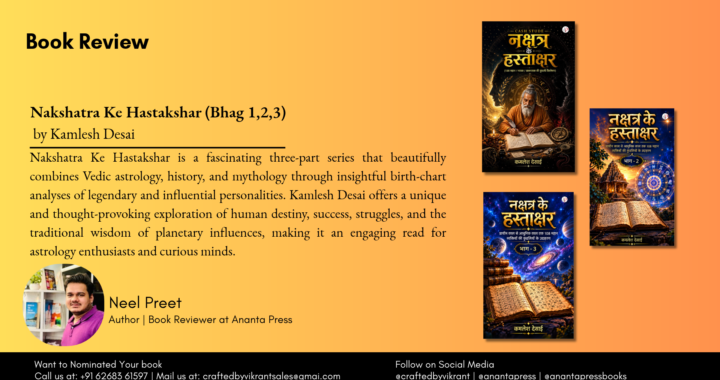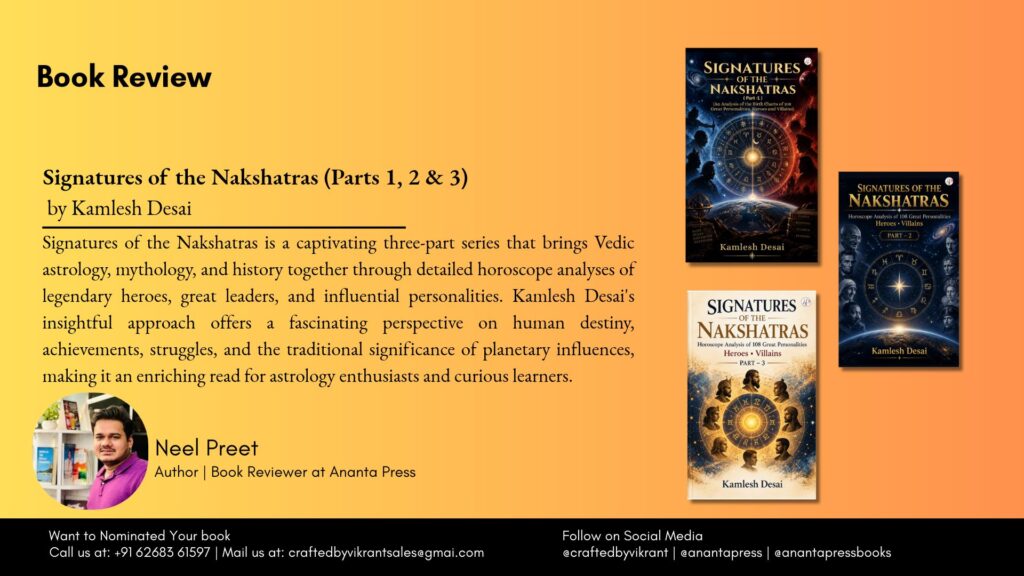
Book Title: Signatures of the Nakshatras
Subtitle: Horoscope Analysis of 108 Great Personalities, Heroes and Villains
Volumes: Part 1, Part 2 & Part 3
Author: Kamlesh Desai
Publisher: Ananta Press
Genre: Vedic Astrology, Historical Analysis, Mythology, Spirituality and Biographical Studies
Introduction: An Extraordinary Journey Through the Stars and Human History
The mysteries of human destiny have fascinated civilization for thousands of years. Why do some individuals achieve extraordinary greatness while others face unexpected failures? What makes certain people influential leaders, courageous warriors, brilliant thinkers, or inspiring social reformers? Can traditional astrological interpretations provide another perspective on the remarkable differences between human lives?
Kamlesh Desai’s Signatures of the Nakshatras, presented in three comprehensive volumes, explores these intriguing questions through the ancient Indian tradition of Vedic astrology.
The series brings together the birth charts and life stories of legendary, historical, and modern personalities, examining their achievements, struggles, personal qualities, and experiences through traditional astrological principles.
What makes this collection particularly appealing is its distinctive combination of mythology, history, biography, and astrological interpretation.
Rather than presenting astrology merely as a system for predicting future events, the author approaches it as a traditional framework for studying personalities and reflecting on human experience.
Across the three volumes, readers travel from the mythological world of the Ramayana and Mahabharata to the kingdoms and empires of history, eventually reaching influential personalities from modern politics, science, business, entertainment, and sports.
This remarkable range gives the collection both educational value and a compelling narrative character.
Part One: Discovering the Foundations of Vedic Astrology
The first volume provides an engaging introduction to the fundamental ideas of Vedic astrology.
It explains traditional concepts involving zodiac signs, planetary positions, astrological houses, conjunctions, yogas, and the interpretation of birth charts.
For beginners, these introductory explanations are particularly helpful because they establish the terminology needed to understand the individual case studies.
The author encourages readers to observe the ascendant, study the planetary placements, examine the relationships among different houses, and consider the horoscope as a complete system.
One of the volume’s most attractive features is its inclusion of legendary personalities from Indian mythology.
Lord Rama, Mata Sita, Lord Krishna, Hanuman, Ravana, Arjuna, Karna, Abhimanyu, and other figures from the great Indian epics form an important part of the opening collection.
Through these personalities, the author connects traditional astrological symbolism with familiar themes of bravery, sacrifice, duty, wisdom, ambition, and moral conflict.
The volume also explores personalities from ancient history, including Lord Mahavira, Confucius, Alexander the Great, Chanakya, Emperor Ashoka, and Julius Caesar.
These figures represent different expressions of leadership, intellectual achievement, spiritual influence, and historical significance.
Their inclusion makes the book appealing not only to students of astrology but also to readers interested in mythology and ancient civilizations.
Part One successfully establishes the foundation for understanding the series’ broader exploration of human experience through traditional astrological perspectives.
Part Two: Leadership, Greatness, Struggle, and Historical Transformation
The second volume develops the series further by exploring influential personalities from medieval history through the early twentieth century.
Its primary attraction lies in the diversity of individuals whose achievements and decisions shaped the course of history.
The volume includes rulers and historical figures such as Raja Bhoj, Prithviraj Chauhan, Genghis Khan, Emperor Akbar, Chhatrapati Shivaji Maharaj, George Washington, Tipu Sultan, Ahilyabai Holkar, and Napoleon Bonaparte.
Their lives provide opportunities to examine traditional astrological associations with political authority, military courage, intellectual ability, personal determination, and adversity.
The discussion of Raja Bhoj is especially interesting.
Remembered for his scholarship, leadership, literary interests, and architectural contributions, Raja Bhoj becomes the subject of an astrological case study examining combinations associated with intelligence, creativity, and authority.
The author acknowledges that his verified birth details are unavailable, making the chart an estimated interpretation.
This distinction is important when considering the historical reliability of such examples.
The volume also explores personalities associated with social reform, intellectual development, political transformation, and scientific discovery.
Figures such as Mahatma Gandhi, Swami Vivekananda, Abraham Lincoln, Albert Einstein, Dr. B. R. Ambedkar, Subhas Chandra Bose, and Dr. C. V. Raman contribute considerable variety to the collection.
Their achievements demonstrate that greatness can emerge through different forms of contribution.
Some individuals influence society through political leadership, while others transform it through education, philosophy, scientific discovery, or personal sacrifice.
By bringing these contrasting personalities together, Desai creates an interesting platform for comparing traditional astrological interpretations.
Part Two also emphasizes that individual decisions, circumstances, values, and personal effort matter when examining the course of a person’s life.
This gives the volume an encouraging philosophical dimension beyond its technical discussions.
Part Three: Astrology Through the Lens of the Modern World
The third volume extends the series into modern history and contemporary society.
This section is particularly engaging because many of the personalities included are widely recognized by today’s readers.
The wider collection features political leaders, social reformers, scientists, entrepreneurs, artists, athletes, and other influential public figures.
Among them are Indira Gandhi, Nelson Mandela, Martin Luther King Jr., Dr. A. P. J. Abdul Kalam, Ratan Tata, Dhirubhai Ambani, Steve Jobs, Kalpana Chawla, Lata Mangeshkar, Sachin Tendulkar, Shah Rukh Khan, Mahendra Singh Dhoni, and Virat Kohli.
These personalities represent remarkable achievements across very different fields.
Their stories involve innovation, perseverance, creativity, courage, leadership, and the pursuit of excellence.
Through traditional astrological interpretations, the author examines possible symbolic connections between planetary placements and the qualities associated with these individuals.
The inclusion of business leaders and innovators adds an interesting modern dimension.
Similarly, the discussions involving artists and athletes bring attention to creativity, dedication, recognition, and personal discipline.
The collection also includes controversial historical personalities, allowing readers to consider traditional astrological interpretations associated with conflict, power, destructive decisions, and downfall.
Part Three demonstrates how the same traditional astrological concepts can be applied to personalities from widely different backgrounds.
It also brings the series closer to contemporary readers by examining people whose achievements remain familiar in public life.
The Beauty of Learning Astrology Through Real-Life Examples
One of the strongest aspects of the entire collection is its practical, example-based approach.
Astrology can be difficult for beginners because it involves numerous technical concepts, including planetary strengths, houses, aspects, conjunctions, yogas, dashas, and transits.
Learning these principles exclusively through theoretical explanations can sometimes feel overwhelming.
Kamlesh Desai attempts to simplify this process by introducing individual birth charts alongside biographical information.
Readers are encouraged to observe planetary positions and understand how traditional astrologers interpret these arrangements.
The Sun is traditionally associated with authority and confidence, the Moon with emotions, Mars with courage, Jupiter with wisdom, Mercury with intelligence, Venus with artistic interests, and Saturn with responsibility and discipline.
The significance of Rahu and Ketu is also considered within the traditional astrological framework.
A particularly useful lesson emphasized in the series is that one planetary position should not be interpreted independently of the entire horoscope.
This encourages a more comprehensive approach to studying traditional astrological methods.
The collection therefore offers an engaging learning experience for readers who prefer practical illustrations rather than memorizing technical definitions.
Beyond Planets: A Deeper Understanding of Human Nature
Although the books focus on astrology, their broader appeal lies in the stories of extraordinary human lives.
Each personality represents a different combination of ambition, determination, talent, responsibility, opportunity, and struggle.
Some individuals achieved recognition through courage and leadership.
Others became influential through intellectual brilliance, humanitarian service, or artistic excellence.
The contrasting life stories encourage readers to reflect on the qualities that contribute to meaningful achievement.
The series also raises questions about the relationship between personal choices and circumstances.
Why do individuals facing similar challenges respond differently? What role do discipline, judgment, values, and perseverance play in shaping a person’s achievements?
These questions add depth to the reading experience.
Importantly, the books repeatedly acknowledge the value of personal effort and thoughtful decisions.
This message encourages readers to consider destiny without neglecting responsibility for their own actions.
The series ultimately becomes an exploration of human character as much as an introduction to traditional astrology.
A Heartfelt Tribute to Compassion and Selfless Service
Another memorable aspect of the collection is its dedication to Padma Shri Kanta Behen Tyagi.
Her life is presented as an inspiring example of compassion, sacrifice, determination, and dedication to society.
The books highlight her contributions to the education and welfare of girls and disadvantaged communities in remote regions.
Her story is accompanied by traditional astrological interpretations associated with discipline, emotional strength, courage, and humanitarian responsibility.
This section introduces an emotional dimension to the collection.
It reminds readers that extraordinary achievement is not always measured through fame, political authority, or financial success.
Sometimes, the greatest contributions come from individuals who dedicate their lives to improving the circumstances of others.
The tribute also reflects the author’s admiration for people whose actions create lasting social change.
Regardless of whether readers accept the astrological explanations, the underlying message of compassion and service remains meaningful.
Kamlesh Desai’s Writing and Educational Approach
Kamlesh Desai approaches the subject with enthusiasm, curiosity, and a strong appreciation for traditional Indian knowledge.
His background in education is reflected in the instructional purpose of the books.
Rather than limiting the material to abstract theories, he organizes the collection around personalities and their life experiences.
This method gives the books an accessible character.
The combination of introductory explanations, biographical details, and horoscope interpretations helps readers follow the author’s perspective.
The writing also conveys a sincere desire to encourage younger generations to explore India’s cultural and intellectual traditions.
Another strength is the breadth of the collection.
By bringing together mythology, history, spirituality, science, politics, entertainment, and sports, the author expands the appeal of the subject beyond a narrowly specialized audience.
However, some discussions involve estimated birth charts and traditional interpretations that cannot be independently verified.
Astrological explanations of personality, historical events, or destiny are also not scientifically established.
For this reason, the books are best approached as studies of traditional astrological thought rather than definitive explanations of human behaviour or historical outcomes.
This perspective allows readers to appreciate the author’s educational intentions while maintaining a thoughtful and critical outlook.
Why This Three-Part Series Deserves Attention
The greatest attraction of Signatures of the Nakshatras is its ambitious scope.
The three volumes create a journey across mythology, ancient history, medieval civilizations, and the modern world.
Part One introduces foundational concepts and legendary personalities.
Part Two explores historical leadership, intellectual achievement, political transformation, and human struggle.
Part Three connects traditional astrological interpretation with influential figures from contemporary society.
Together, they create a broad collection that encourages observation, comparison, and reflection.
The books are particularly suitable for astrology enthusiasts, students of traditional Indian knowledge, readers interested in biographies, and those curious about the cultural history of astrological interpretation.
Their varied subject matter makes them engaging even for readers who are not already familiar with detailed horoscope analysis.
Final Verdict: An Engaging Exploration of the Stars and Human Achievement
Signatures of the Nakshatras (Parts 1, 2 & 3) is an ambitious, informative, and thought-provoking series that brings together Vedic astrology, historical personalities, mythology, and the complexities of human experience.
Kamlesh Desai presents a wide-ranging collection of traditional astrological case studies designed to encourage curiosity, comparison, and deeper learning.
The series’ greatest strength is its ability to make astrological concepts more approachable by connecting them with recognizable personalities and memorable life stories.
From mythological heroes and historical rulers to modern scientists, entrepreneurs, reformers, artists, and athletes, the collection examines different expressions of ambition, courage, creativity, perseverance, and achievement.
The books also offer an important reminder that personal effort, values, and decisions deserve attention when reflecting on the direction of human life.
While their astrological interpretations should be understood as traditional perspectives rather than scientifically demonstrated conclusions, the volumes provide an engaging introduction to the ideas and symbolism associated with Vedic astrology.
Overall, Signatures of the Nakshatras is a fascinating three-volume collection that celebrates curiosity, historical exploration, and India’s rich astrological heritage. It is a rewarding read for anyone interested in discovering how traditional celestial symbolism has been used to interpret the extraordinary stories, struggles, and achievements of influential personalities throughout history.