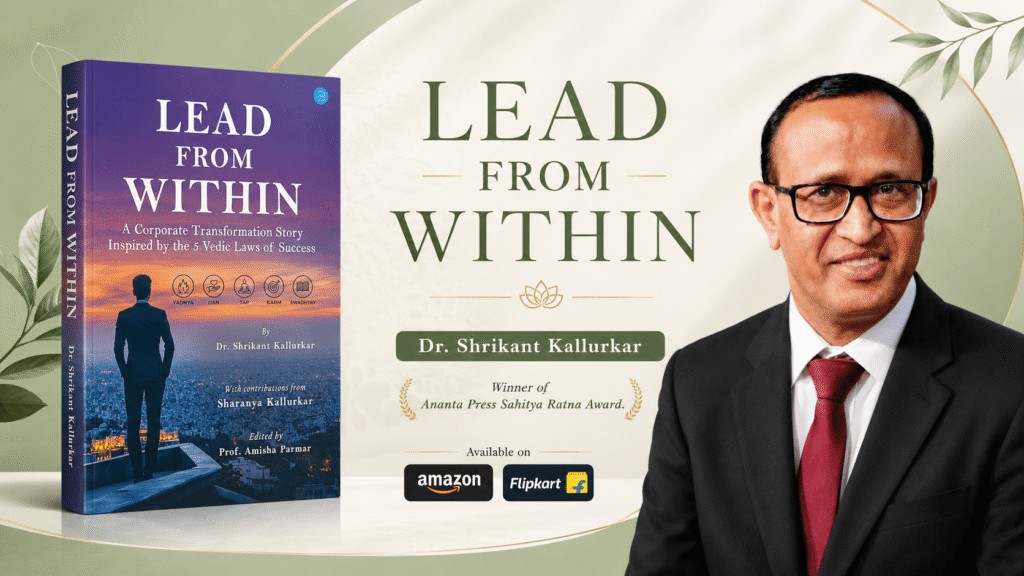
Leadership literature often concentrates on what a leader does to other people: how to communicate a vision, motivate a team, delegate, negotiate, resolve conflict, or drive performance. Lead From Within: A Corporate Transformation Story by 5 Vedic Laws of Success makes a different proposition. Before leadership becomes influence over others, it is the ability to govern one’s own body, energy, mind, judgment, values, actions, and sense of purpose. Dr. Shrikant Kallurkar therefore treats leadership less as a position and more as an internal discipline. This makes the book especially valuable for professionals, educators, managers, mentors, and institutional leaders who recognize that authority alone cannot produce maturity.
The corporate story at the center of the book keeps this idea grounded. Michael Smith, a Cyber Security Engineer, is professionally capable but personally depleted. His technical performance has not protected him from exhaustion, self-doubt, hesitation, and stagnation. He works late, neglects his health, avoids speaking with confidence, and watches others progress. The difficulty becomes impossible to ignore when a colleague receives recognition for work Smith has done. The incident is painful, but it performs an important function in the narrative: it reveals that leadership failure can occur long before someone is formally responsible for a team. Smith is failing to lead himself.
This is a useful challenge to the way organizations often identify “leadership potential.” Visibility, confidence, communication, and decision-making are frequently treated as separate competencies to be trained. Lead From Within suggests that these outward behaviours may be symptoms of deeper conditions. A tired body affects patience and attention. Unregulated energy affects reactions. An anxious or assumption-driven mind affects communication. Weak discernment affects decisions. A loss of purpose affects commitment. If these deeper layers remain unexamined, leadership training can become cosmetic.
The Panchakosha framework provides the holistic model that the book uses to avoid this problem. Annamaya Kosha, the physical layer, reminds leaders and professionals that the body is part of performance. The idea may sound obvious, yet organizational culture routinely contradicts it. Long working hours, poor sleep, irregular routines, and constant digital exposure are often normalized. By including the body in a leadership framework, the book makes sustainability a professional concern.
Pranamaya Kosha, associated with breath, energy, and emotional regulation, is equally relevant for leaders. People do not experience a manager’s intentions directly; they experience tone, pace, reaction, presence, and behaviour. A leader who cannot regulate internal pressure may unintentionally transmit anxiety to an entire team. The ability to pause, breathe, and respond consciously therefore becomes more than a wellness practice. It becomes an interpersonal responsibility.
Manomaya Kosha, the mental and emotional dimension, addresses the interpretations through which leaders see people and situations. Assumptions can be dangerous in positions of influence. A manager may interpret disagreement as disloyalty, silence as incompetence, urgency as importance, or confidence as capability. If these interpretations are never examined, they become organizational consequences. The book’s emphasis on mental awareness is therefore highly relevant to anyone whose private thought patterns affect public decisions.
Vijnanamaya Kosha brings wisdom, discernment, ethics, and clarity into the framework. This may be the most important layer for leadership. Organizations constantly face situations where rules do not provide a complete answer. Leaders must weigh competing priorities, stakeholder interests, long-term consequences, and ethical considerations. Technical knowledge can identify what is possible, but wisdom is needed to decide what should be done. Lead From Within gives this distinction a central place.
Anandamaya Kosha, the dimension of purpose and fulfilment, connects leadership to meaning. A leader who has lost connection with purpose may still achieve targets, but the quality of those achievements can become hollow or unsustainable. Purpose influences the way people interpret responsibility. It can shift the question from “How do I succeed?” to “What is my success serving?” This is especially valuable in education, public institutions, entrepreneurship, and mission-driven organizations where leadership has consequences beyond personal advancement.
The Five Vedic Laws of Success complement the Panchakosha by turning inner awareness into visible conduct. Yadnya, contribution, reframes leadership as service through quality effort. A leader’s value is not only in status but in what he or she contributes to the growth of a team, institution, customer, or community. This principle can be especially powerful in organizations where positional hierarchy encourages entitlement.
Dana, giving and kindness, introduces generosity into professional behaviour. Appreciation, respect, patience, and time are often described as “soft” qualities, yet they strongly influence trust, psychological safety, mentoring, and collaboration. By treating them as disciplined practices rather than personality traits, the book makes relational leadership accessible. One does not need to be naturally charismatic to practise respect or give credit.
Tapa, discipline and stability, addresses the need for consistency. Leaders are watched most carefully in difficult moments. A person who is calm only when everything is going well has not yet demonstrated stability. Tapa asks whether values, routines, and standards remain intact under pressure. This interpretation of discipline is richer than simple productivity because it includes restraint and steadiness.
Karma, right action, moves leadership toward accountability. The book’s framing is particularly important in environments where activity can be mistaken for effectiveness. A leader may attend many meetings, send many messages, and make many decisions without necessarily taking the right action. Right action requires responsibility, integrity, and courage. It asks the person to choose what is appropriate rather than what is merely easy, visible, or politically safe.
Swadhyaya, self-reflection, makes leadership developmental rather than fixed. The strongest leaders are not those who assume they have mastered themselves; they are those who keep observing, learning, and correcting. Self-reflection creates space to ask difficult questions: Why did I react that way? What assumption shaped my judgment? Did I listen? Was I seeking contribution or recognition? Did my decision reflect values or fear? Such questions can transform experience into wisdom.
The book’s formula – Five Koshas leading to inner stability, Five Vedic Laws leading to outer excellence, and the combination producing an extraordinary professional – is memorable because it gives readers a model they can revisit. It is also flexible. A manager may discover that a leadership issue begins in Manomaya, with assumptions about a team member. An educator may realize that exhaustion in Annamaya is reducing patience in the classroom. An entrepreneur may recognize that a loss of Anandamaya, or purpose, is making achievement feel empty. A student may use Swadhyaya to understand recurring patterns before entering professional life.
Dr. Kallurkar’s own career makes this broad relevance understandable. With more than four decades across academia and industry, including senior academic leadership, research, mentoring, entrepreneurship, and institution building, he has worked in environments where technical competence and human development must coexist. His guidance of Ph.D. scholars, publication record, patents, and involvement in institutional and entrepreneurship initiatives demonstrate a long engagement with learning and professional systems. His current emphasis on Vedic Success Systems extends that systems thinking to human development.
What distinguishes the book from many leadership texts is that it does not isolate performance from wellbeing or ethics. Contemporary professionals are often given separate solutions for separate problems: one book for productivity, another for stress, another for confidence, another for leadership, another for purpose. Lead From Within attempts to connect these concerns within one framework. This integrated structure is both its conceptual strength and its cultural contribution.
The book should also be appreciated for its approach to Indian Knowledge Systems. Rather than presenting IKS as heritage to be admired from a distance, it asks how traditional concepts can function in current institutions. This makes the work relevant to educators and academic leaders who are looking for meaningful ways to engage with Indian intellectual traditions without reducing them to slogans. The concepts are interpreted through behavioural and developmental questions that modern readers can examine in their own lives.
Lead From Within ultimately proposes a demanding but constructive definition of leadership. Leadership is not first about commanding attention; it is about cultivating the inner stability from which responsible action can emerge. It is not first about controlling people; it is about understanding oneself well enough to influence others without being controlled by every fear, impulse, or demand for recognition. It is not simply about reaching a position; it is about becoming the kind of person who can hold responsibility with clarity and purpose.
For professionals seeking promotion, managers seeking better leadership, educators shaping future professionals, or senior leaders reflecting on legacy, this is a book with a useful central reminder: sustainable influence begins within. The strength of Lead From Within lies in turning that reminder into a structured model of body, energy, mind, wisdom, purpose, contribution, kindness, discipline, right action, and reflection. It offers leadership not as a performance to imitate but as a system to cultivate.
Amazon link: https://www.amazon.in/Lead-Within-Corporate-Transformation-Inspired/dp/9378256465/ref=tmm_pap_swatch_0