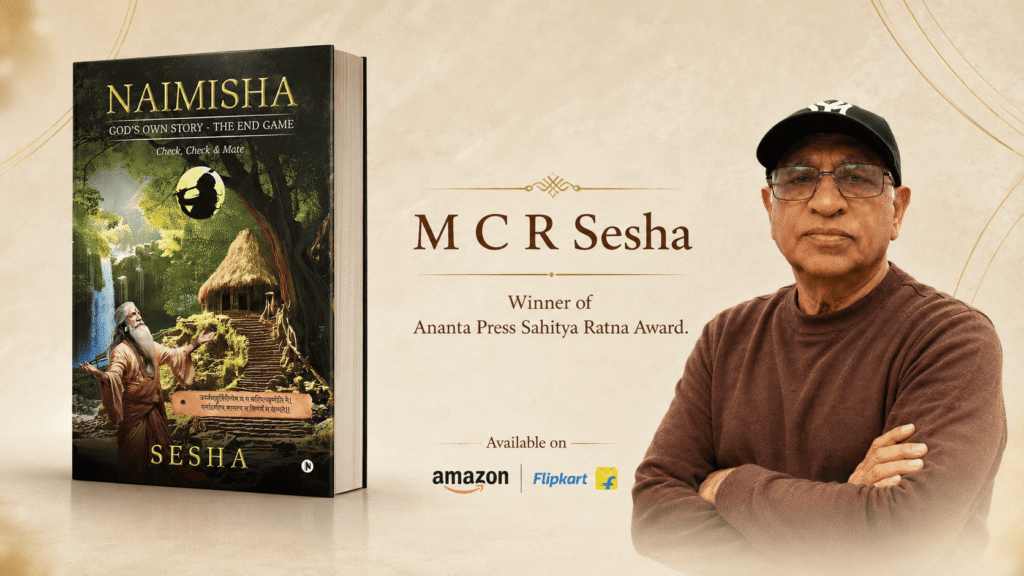
The most familiar image of the Mahabharata is often the battlefield: armies facing one another, conches sounding, warriors bound by vows, and Krishna guiding Arjuna at the edge of a conflict that will reshape an entire civilisation. Yet the deeper power of the epic lies in what surrounds that battlefield – the decades of choices that make war unavoidable and the years of consequence that follow it. Naimisha – God’s Own Story – The End Game – Check, Check & Mate appears to understand this larger arc. As the third and final book in M C R Sesha’s Naimisha Trilogy, it does not stop at the spectacle of Kurukshetra. It follows the story into the wars connected with the Ashwamedha and seeks closure for its major Mahabharata figures as well as for the fictional characters Animish and Asareer. That broader perspective is what makes the book especially interesting as historical fiction.
There is a tendency in epic adaptation to treat the great war as the destination toward which every earlier event points. Once the war is over, the story seems finished. But the Mahabharata itself is far more complicated. Victory does not erase grief. Political success does not restore the dead. A kingdom gained through immense sacrifice carries its own moral burden. Survivors must govern, remember, justify, repent, continue, and eventually face their own endings. A novel that pays attention to those later stages can offer something different from a battle-centred retelling: it can become a study of what human beings do after the event they believed would solve everything.
That is why the words “The End Game” are so effective. End games in chess are often quieter than openings, yet every move is more exposed. There are fewer pieces on the board, less room for disguise, and greater consequences for each error. This is an apt metaphor for the closing phase of an epic. By the time Kurukshetra has done its work, the crowded world of competing heirs, teachers, elders, allies, and rivals has been brutally reduced. Those who remain must live with a clarity they may not have wanted. They can no longer pretend that choices are theoretical. The outcome stands before them.
The additional phrase “Check, Check & Mate” gives the title a sense of inevitability. It suggests successive moments when characters are forced to confront limits. In epic literature, such limits may be political, moral, spiritual, or mortal. A warrior can defeat an enemy and still be defeated by time. A king can gain a throne and still be unable to command peace within himself. A strategist can shape history and still belong to a cosmic cycle larger than any strategy. The title therefore prepares the reader for a conclusion concerned with the boundaries of human agency.
Krishna is central to that question. He is the character who most powerfully complicates the difference between choice and destiny. His guidance influences decisive events, yet he is also associated with a vision of reality in which individual action participates in a larger order. Bringing Krishna’s story toward closure gives the final volume a spiritual dimension that extends beyond political history. The end of his journey is inseparable from the idea that ages themselves pass, that even divine presence can withdraw from a particular historical moment, and that no earthly arrangement is permanent. For a trilogy titled God’s Own Story, this is an especially resonant place to arrive.
At the same time, the novel’s fictional figures help prevent the grand philosophy from becoming remote. Animish and Asareer represent the author’s freedom to create lives not already fixed by epic tradition. Their importance becomes clearest in a final volume because readers can compare their destinations with those of the legendary characters around them. The book description tells us that the two complete their journeys in different ways and that their endings are meant to provoke thought. This is an appealing choice because it gives the conclusion emotional variety. Not every life should resolve according to the same pattern, especially in a story whose source tradition is famous for moral complexity.
The contrast between canonical and invented figures is also one of the key pleasures of historical fiction. A known historical or mythic framework provides scale and recognition, while fictional characters provide intimacy and unpredictability. Through them, readers can inhabit the gaps between famous events. They can experience the emotional climate surrounding decisions that the epic records on a monumental level. They can also encounter perspectives not limited to kings, divine figures, or celebrated warriors. In this sense, Animish and Asareer are not simply additions to the Mahabharata world; they can function as interpretive instruments, helping the reader ask new questions of familiar material.
The Kurukshetra episodes offer the obvious dramatic attraction. Readers interested in military history, strategy, mythological warfare, and heroic conflict are likely to appreciate a narrative that gives these events substantial space. Yet the book’s philosophical undertones suggest that action is never treated as self-sufficient. Every confrontation carries an ethical shadow. The Mahabharata is full of victories that become morally troubling when examined closely, and defeats that reveal unexpected dignity. A thoughtful historical novel can use the energy of war to lead readers toward uncomfortable reflection about means and ends.
The Ashwamedha material may be even more distinctive because it receives less attention in mainstream popular culture. By following events beyond Kurukshetra, Sesha can explore the transition from warfare to sovereignty. The Ashwamedha is both ritual and political statement, a declaration of authority that moves through territory and tests resistance. In narrative terms, it provides a fascinating continuation because it asks whether power secured after catastrophe can ever be uncomplicated. It also ensures that the novel’s “end game” is not compressed into one climactic battle but unfolds through a longer reckoning.
The author’s biography adds a quiet layer of credibility to the project, not because professional success automatically produces literary success, but because the trilogy clearly represents sustained commitment. M C R Sesha was a gold medallist at Andhra University at both graduation and post-graduation levels, entered a nationalised bank as a direct officer, and eventually retired from top management. Only after retirement did he immerse himself more fully in reading and writing. Completing three novels after a long career is an achievement in itself. It reflects intellectual curiosity continuing beyond formal professional life and suggests a writer willing to begin a demanding creative journey at a stage when many people choose only rest.
There is something particularly suitable about such a writer taking on the Mahabharata. The epic is not a young person’s story in the narrow sense. It is deeply concerned with ageing, inheritance, institutional memory, accumulated consequence, the mistakes of one generation passed to another, and the difficulty of judging a life before it is complete. A writer approaching these themes after decades of professional and personal experience may naturally be drawn to endings rather than beginnings, to consequence rather than impulse, and to the question of what remains after ambition has achieved or destroyed its object.
Naimisha – God’s Own Story – The End Game – Check, Check & Mate therefore appears to offer a finale with two kinds of satisfaction. On the surface, it provides the large-scale completion expected from epic historical fiction: famous battles, legendary figures, political transitions, and the culmination of a trilogy. At a deeper level, it invites readers to reflect on the aftermath of action. The battlefield may decide who wins, but it cannot decide what the victory means. That judgment belongs to memory, conscience, time, and the reader.
For readers drawn to Mahabharata retellings but looking for something beyond a familiar sequence of iconic episodes, this book’s attraction lies in its extended horizon. It asks what happens after the trumpets fall silent. It gives attention to closure, consequence, and the different ends available to different lives. It uses both legendary and fictional characters to explore a world in transition. And it treats the final volume not as a place to hurry toward the last page, but as an opportunity to consider the full cost of reaching it. That makes The End Game a meaningful conclusion in concept and a notable addition to contemporary Indian historical fiction inspired by the epic tradition.Amazon Purchase Link: https://amzn.in/d/0giaBcBM