A practical review for parents, caregivers, and early-years educators
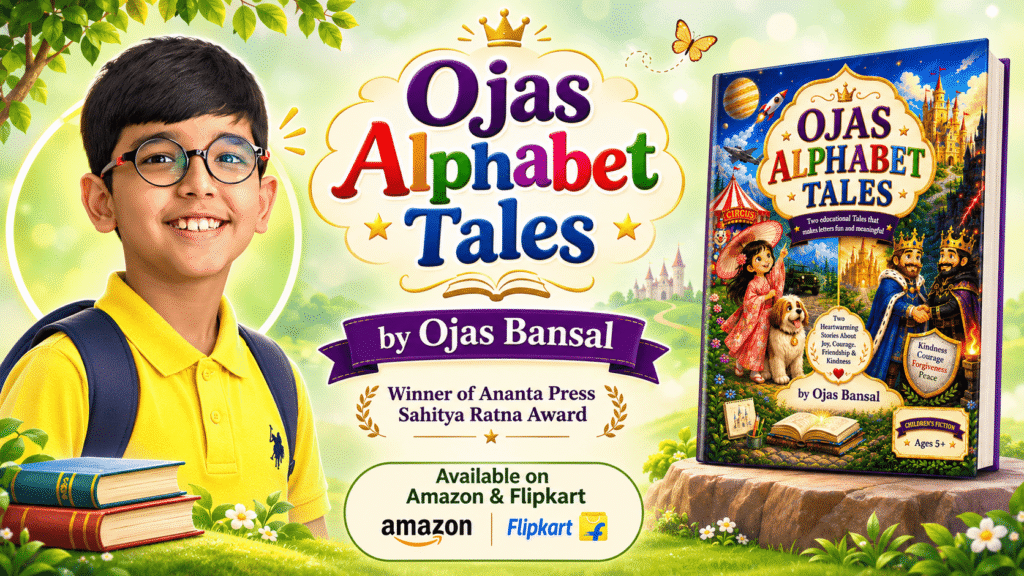
The question most adults ask when choosing an alphabet book is straightforward: will it help a child learn? A better question might be: what kind of learning experience will it create? A five-year-old does not always separate education from play in the way adults do. The same child who resists a repetitive drill may eagerly name objects in a picture, anticipate the next moment of a story, or insist on answering a question aloud. Ojas Alphabet Tales by Ojas Bansal is positioned around that instinct. According to the supplied synopsis, this 34-page illustrated book links letters with storytelling, cheerful characters, vocabulary challenges, and interactive quizzes. That structure makes it interesting not just as a book to give a child, but as a resource to share with one.
Begin with the reading session itself. A parent or caregiver looking for a manageable activity often wants something that can be opened without a lengthy introduction. An illustrated, compact book has that practical advantage. It creates the possibility of reading for a few minutes, stopping to discuss an image, and returning later without making the experience feel unfinished. The precise pacing of Ojas Alphabet Tales cannot be established from the synopsis alone, but its format suggests it is designed for short, approachable encounters. This can be useful for children developing attention, confidence, and familiarity with books. Regular positive experiences often matter more than a single marathon session.
Its second practical strength is the relationship between stories and vocabulary. Children can memorize a label without knowing when to use it. They understand words more deeply when those words are connected to situations. An imaginative tale can provide a context for asking what a word means, how it sounds, whether it describes something familiar, and how it might be used elsewhere. That process does not require an elaborate teaching plan. An adult can pause, ask the child to point to an illustration, and invite a simple explanation. If the child is ready, the conversation can become a sentence-making game. The story provides the motivation; the vocabulary activity gives it direction.
Interactive quizzes add a further opportunity, provided they remain part of a warm exchange. Some children enjoy the thrill of being asked a question and getting it right. Others are more hesitant and need time to think. In either case, the tone of the adult makes a difference. A quiz can become a playful dialogue rather than a test. A caregiver might first ask the printed question, then follow with “What makes you think so?” or “Can you show me in the picture?” These are suggested extensions, not quotations from the book. They demonstrate why an interactive design is potentially helpful: it gives adults a natural reason to listen to the child’s thinking rather than simply read the text aloud and close the cover.
This also makes the book relevant to mixed-ability or mixed-confidence reading situations. One child may be identifying individual letters; another may recognize many words but struggle to explain a story; a third may enjoy oral storytelling while reading independently remains difficult. A format that combines pictures, narratives, words, and questions can offer different ways to participate. It would be premature to label Ojas Alphabet Tales a formally differentiated learning program, since no such pedagogical framework is documented in the supplied materials. Still, the variety of described activities suggests opportunities to adapt a shared reading session to a child’s interests and present abilities.
A particularly productive approach might be to treat each reading session as an invitation rather than a checklist. An adult could ask the child to choose one illustration that catches their eye, talk about a new word, and then invent a tiny extra moment for a character. The next day, the child might draw the word, use it in conversation, or ask to hear part of the story again. Nothing about that routine requires finishing every activity in order. It uses the book’s advertised strengths as a foundation for relaxed repetition. For young readers, repetition need not be boring; familiar stories often become more satisfying because the child can anticipate them and participate with increasing confidence.
The values named in the summary make the resource potentially useful beyond formal literacy teaching. Curiosity, courage, kindness, friendship, and family are themes adults regularly encounter in children’s everyday experiences. A story can give a parent a gentle way to ask about these experiences without beginning with a lecture. A classroom teacher may use a relevant moment to prompt a discussion of helping others or trying something difficult. A grandparent may ask a child to explain what a kind action means to them. The goal is not to make every page carry a moral assignment, but to let a theme emerge naturally when it captures the child’s attention.
The cover reinforces this sense of invitation. It is colorful, busy, and full of recognizable fantasy motifs: a castle, rocket, circus, planet, cheerful figures, and a friendly animal. For an adult, the abundance may initially seem like a lot to take in. For a child, it offers many possible starting points. One reader may notice the dog first; another may ask about the rocket. That is an educational opportunity before the text even begins. Describing and comparing what appears on a cover can build observation and expressive language. It is important to distinguish this cover-based exercise from the actual contents of the stories, which have not been supplied in full.
In a classroom, the described design could support a short read-aloud followed by discussion and a vocabulary game. At home, it could be used as a shared bedtime or weekend activity. In a library, it might help a child discover that letters are connected with the kinds of adventures they already enjoy. These are plausible uses, not established outcomes from a study of the book. The value of such uses would depend on the actual language level, page layout, and questions. Teachers may wish to preview the interior before selecting it for a particular age group, while parents can follow the child’s response and adjust the pace accordingly.
The author’s biography adds a possible creative activity to the experience. Ojas Bansal is introduced as an eight-year-old author who has already published fifteen books. When young readers encounter that fact, it can open a conversation about their own ability to make stories. An adult might invite a child to choose a letter and invent a title, draw a character, or dictate a few sentences. The exercise need not resemble the published book. Its purpose is to show that reading and writing are related forms of imagination. A child who tries making a story may later look at a book with greater interest in how its words and pictures were chosen.
There are sensible limitations to acknowledge. A 34-page book cannot be expected to replace a structured phonics curriculum, reading assessment, or sustained language instruction, and the supplied synopsis does not claim that it does. Nor does the information provided establish that every letter receives equal practice or that the quizzes meet a particular educational standard. Its best apparent role is complementary: to make literacy more inviting, enrich conversations, and offer a playful context for new words. Buyers seeking targeted instruction in a specific skill should inspect sample pages and consider whether the material matches the child’s needs.
The greatest practical merit of Ojas Alphabet Tales may be that it recognizes a simple truth: children often learn with adults, not just from them. Shared reading is a relationship made of listening, laughing, explaining, and returning to things that matter. A book that offers stories, pictures, vocabulary prompts, and questions gives that relationship several ways to grow. Not every family will use it identically, and that flexibility may be a strength. For parents and early-years educators seeking a lively supplement to alphabet practice, this is a promising concept, especially if the goal is to nurture enjoyment and participation alongside recognition and recall.
Ultimately, the right early literacy book is one a child wants to reopen. The available materials for Ojas Alphabet Tales suggest that its appeal rests on more than a list of letters: it proposes imaginative situations, chances to speak, opportunities to notice words, and themes that connect with relationships outside the page. Its effectiveness for any individual learner must be judged in use, but its design points in an encouraging direction. When adults treat books as invitations to talk and wonder together, even a short illustrated reading session can become a lasting part of a child’s relationship with language.
Buy the book on Amazon: https://www.amazon.in/Ojas-Alphabet-Tales-Bansal/dp/B0HLXNHBXV/