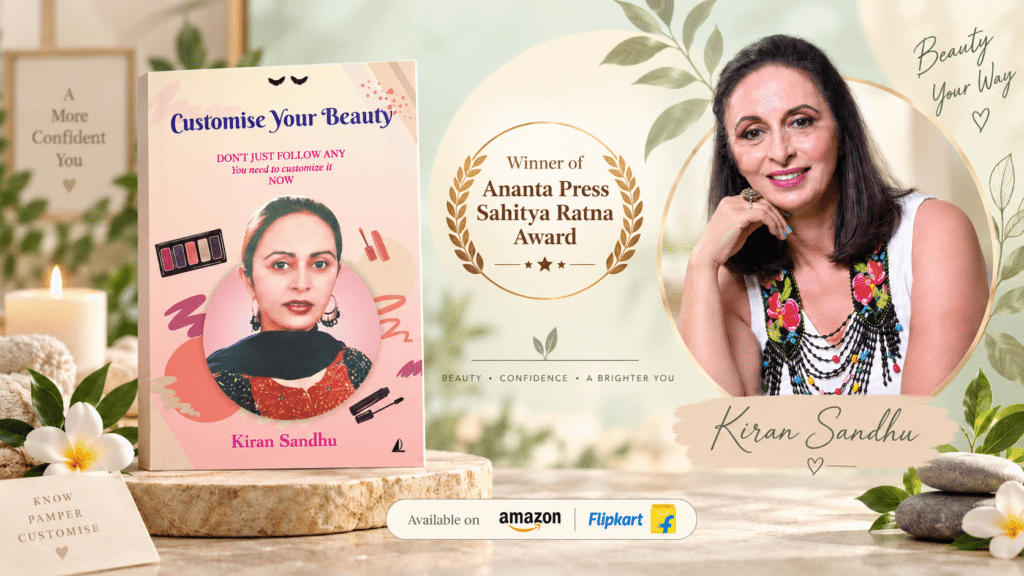
The title Customise Your Beauty immediately suggests resistance to one of the most powerful forces in the beauty industry: standardization. Beauty marketing often depends on the suggestion that a particular product, technique, shade, or routine is the answer everyone has been waiting for. Kiran Sandhu’s book questions that assumption. Her argument is simple but increasingly necessary: the fact that something is popular does not mean it is appropriate for every person. Beauty decisions should be based on individual skin, features, proportions, colouring, and needs. This makes the book particularly relevant in an era when consumers are exposed to an enormous volume of beauty advice every day.
One of the most valuable aspects of the book is its promotion of informed consumption. Sandhu encourages readers to understand their skin type and pay attention to ingredients when purchasing cosmetics. This may be one of the book’s most important lessons because the beauty market is built not only on products but also on language. Terms such as brightening, hydrating, clarifying, lifting, smoothing, repairing, and detoxifying can sound persuasive even when a consumer does not know what a product actually contains or whether it suits her skin. By asking readers to focus on suitability, Sandhu moves the conversation from marketing claims to personal relevance.
This does not make the book anti-product. On the contrary, Sandhu has years of experience with both home remedies and commercially available cosmetics. Her point is not that one category is always superior to another. The point is that choice should be thoughtful. A commercial product may be useful when its ingredients and purpose match the reader’s needs. A home remedy may be attractive when a reader wants a simple, accessible form of care. The strength of the book is that it creates room for both, united by the idea of customization.
That balance reflects the author’s broader professional identity. Sandhu is a naturopathy and wellness professional as well as a beauty enthusiast and entrepreneur. Her interest in beauty began in adolescence and developed over decades of observation and experimentation. As a result, the book approaches beauty from more than one direction. It recognizes the role of cosmetics, but it also connects appearance with self-care, natural living, and practical habits. This prevents the book from feeling like a catalogue of things to buy.
The treatment of skincare is a good example. Rather than presenting a fixed routine that every reader should follow, Sandhu starts with the individual. What is the skin type? What does the skin appear to lack? What concerns are present? Which ingredients correspond to those concerns? This is a far more useful starting point than simply reproducing somebody else’s routine. Skincare is an area in which excessive experimentation can create as many problems as it solves, so the book’s insistence on appropriateness feels especially sensible.
The same anti-copying philosophy appears in the makeup sections. Social media tutorials often show precise techniques that look spectacular on the person demonstrating them, but viewers may be disappointed when the same placement does not produce the same effect on a different face. Sandhu offers an explanation: faces are structurally different. Eye shape, face shape, feature size, and placement all influence the result. By learning these characteristics, readers can adapt techniques rather than repeat them mechanically. This is a more mature way to engage with beauty content because it transforms the reader from imitator to interpreter.
Clothing advice is also approached through structure rather than trend. The book discusses body shape and the way cuts, necklines, waist placement, belts, and fit can affect visual proportion. This can be especially helpful for readers who have accumulated clothing they like in theory but rarely wear because something about the fit feels wrong. Understanding body shape can reveal that the issue is often not the body itself but the relationship between garment construction and proportion. That is a liberating distinction. It allows styling to become a technical and creative process instead of a judgment.
Colour selection deepens this individualized approach. Sandhu introduces the idea of choosing shades in relation to personal colouring and warm or cool undertones. In practical terms, this can help readers build more coherent wardrobes and makeup collections. It also reduces waste. When people know which families of colour tend to suit them, they can avoid repeated purchases that look appealing in isolation but do not work in practice. This is another reason the book can be read as a guide to smarter consumption as much as beauty.
The home-remedy element is equally relevant to the book’s anti-consumerist potential. Beauty culture can easily become expensive, especially when routines expand to include numerous products. By including accessible recipes and home-based options for different skin concerns, Sandhu reminds readers that care does not always have to be complicated. The value of these sections is less about rejecting the modern beauty industry and more about widening the set of possible choices.
Even the book’s inclusion of weight management follows the theme of personalization. Sandhu suggests that readers think about creating plans around their own goals rather than assuming that one formula applies to everyone. Because weight and health can involve complex medical factors, readers should use such material thoughtfully and seek professional advice when needed. Still, the conceptual consistency is clear: whether dealing with skin, makeup, clothing, colour, or wellness, the book asks readers to resist blind imitation.
What makes Customise Your Beauty unique is this consistent intellectual thread. Many beauty books are organized by topic but do not have a unifying philosophy. Sandhu’s guide does. Every section can be traced back to the same idea: difference matters. That gives the book coherence even though it covers a wide range of subjects. The reader can move from skincare to styling without feeling that the book has abandoned its central purpose.
Another notable strength is its usefulness for readers at different levels of experience. A beginner may discover basic concepts such as skin type, face shape, undertone, and body proportion for the first time. A more experienced reader may use the book as a prompt to rethink routines that have become automatic. In both cases, the value comes from learning to ask better questions. Why am I using this? Why does this colour suit me? Why does this cut feel balanced? Why does this technique look different on my face? Those questions are more empowering than simply asking what is currently popular.
Sandhu’s message also has a confidence-building quality. The beauty industry often profits from dissatisfaction, yet Customise Your Beauty suggests that the starting point should be curiosity about the self rather than rejection of the self. To customize something, you first have to observe and understand it. That encourages a more respectful relationship with personal appearance.
For readers who feel exhausted by constant beauty trends, this book offers a calmer alternative. It does not promise freedom from all choices; instead, it provides a method for making choices more intelligently. The result is a guide that can remain relevant because its core lesson is not tied to a particular brand, season, or fashion cycle. Customise Your Beauty is ultimately about discernment. It teaches readers to look past noise, understand their own characteristics, and build routines and styles that belong to them.
Amazon: https://amzn.in/d/01hSkygC