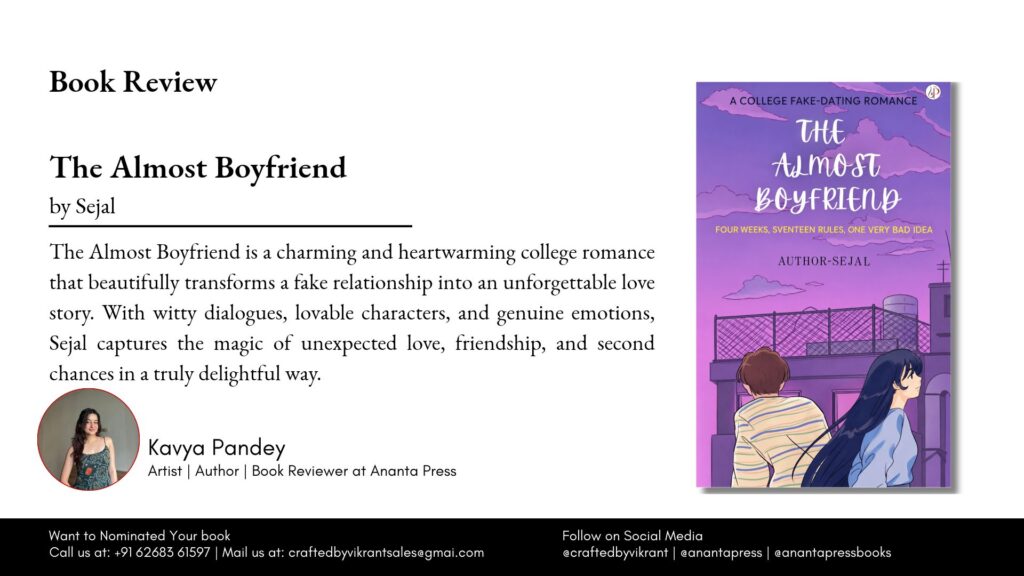
Introduction: When Pretending to Love Becomes the Beginning of Something Real
Love has a mysterious way of entering our lives when we least expect it. Sometimes, it begins with friendship, sometimes with an unexpected meeting, and occasionally, with a completely ridiculous lie. Sejal’s The Almost Boyfriend beautifully explores this last possibility through a charming, humorous, and emotionally engaging college romance.
At the heart of the novel is a simple yet irresistible question: What happens when two people agree to pretend they are in love, only to discover that their feelings are becoming real?
With delightful characters, witty conversations, heartfelt moments, and relatable emotional conflicts, Sejal creates a romantic journey that feels both entertaining and meaningful.
The novel follows Ira Sharma and Aarav Mehta, two academically competitive college students whose carefully organized lives take an unexpected turn when they enter a fake relationship.
What begins as a temporary arrangement gradually develops into something neither of them anticipated.
Beyond its entertaining romantic premise, the story explores friendship, emotional vulnerability, personal ambitions, communication, second chances, and the courage required to build a lasting relationship.
An Unexpected Beginning: One Lie Changes Everything
The story begins with Ira Sharma, a bright, ambitious, and somewhat impulsive college student who finds herself in an embarrassing situation involving her former boyfriend, Kabir.
During an ordinary conversation with her friends, Ira unexpectedly claims that she is dating someone.
Unfortunately, the boyfriend she invents does not exist.
What initially appears to be a harmless attempt to protect her pride quickly becomes complicated when her friends begin asking questions and expect to meet this mysterious person.
Desperate to escape the consequences of her impulsive statement, Ira approaches Aarav Mehta, her intelligent, competitive, and irritatingly composed academic rival.
Aarav initially rejects her unusual proposal. However, his own circumstances make the arrangement unexpectedly appealing.
His grandmother has been encouraging him to meet prospective romantic partners, and pretending to have a girlfriend offers him a convenient escape.
Thus begins an arrangement designed to benefit them both.
Their relationship is supposed to last only four weeks, with seventeen carefully written rules governing their behaviour.
Among these conditions are restrictions on jealousy, unnecessary affection, and developing genuine romantic feelings.
The arrangement seems perfectly logical on paper.
But as the story wonderfully demonstrates, human emotions rarely follow written agreements.
Ira and Aarav: Two Delightfully Imperfect Characters
One of the greatest strengths of The Almost Boyfriend is its central characters.
Ira Sharma is immediately relatable because of her imperfections.
She is intelligent, hardworking, emotionally expressive, and occasionally capable of making spectacularly questionable decisions.
Her tendency to overthink situations and protect herself through sarcasm adds humour and authenticity to her personality.
Beneath her confident exterior, however, she carries emotional insecurities and fears of being hurt again.
Aarav Mehta provides a wonderful contrast.
He is methodical, academically gifted, disciplined, and seemingly comfortable with structure and logic.
His decision to draft a detailed relationship contract perfectly captures his personality.
Yet beneath his composed behaviour lies an individual capable of remarkable tenderness, loyalty, and emotional sensitivity.
The chemistry between these two characters develops naturally through their differences.
Their academic rivalry creates entertaining arguments, while their underlying understanding of each other gradually reveals a deeper emotional connection.
Sejal does not rely entirely on dramatic declarations of love.
Instead, she builds the relationship through small, thoughtful gestures.
Remembering someone’s preferences, noticing their exhaustion, offering support during difficult moments, and quietly making space for another person become powerful expressions of affection.
These understated moments make the romance believable and emotionally satisfying.
The Magic of Fake Dating and Unexpected Feelings
The fake-dating trope is familiar in contemporary romantic fiction, but Sejal gives it charm through humour, character development, and emotional progression.
The relationship contract becomes one of the novel’s most memorable narrative devices.
Initially, its seventeen clauses symbolize the characters’ desire to maintain control.
They believe that establishing clear boundaries will protect them from emotional complications.
However, as their interactions grow more natural, the rules begin to lose their significance.
Jealousy appears unexpectedly. Friendly arguments become affectionate conversations. Ordinary experiences develop into cherished memories.
Even simple moments, such as sharing coffee, working on academic projects, and spending time together during college events, become significant.
The beauty of the story lies in the gradual realization that affection cannot be manufactured through an agreement.
Ira and Aarav begin by performing the roles of a couple, but eventually discover that genuine emotional intimacy requires no performance.
Their relationship becomes increasingly meaningful because their affection develops from familiarity, mutual respect, and genuine understanding.
The transformation from academic rivals to emotional companions is handled with warmth and humour.
A College Setting Full of Life and Nostalgia
Another particularly enjoyable aspect of the novel is its lively college atmosphere.
Sejal captures the familiar experiences of student life through campus conversations, academic competition, friendship groups, festivals, projects, internships, and everyday disagreements.
The canteen, library, hostel, classrooms, and college corridors become meaningful settings in the characters’ developing relationship.
These places are not merely backgrounds.
They create opportunities for the characters to interact, misunderstand one another, discover unexpected qualities, and gradually form lasting emotional bonds.
The college festival sequence is especially engaging.
Amid the excitement of performances, decorations, responsibilities, and late-night preparations, Ira and Aarav experience moments that bring them emotionally closer.
Their growing affection develops alongside the ordinary chaos of college life.
The academic project involving their friends also plays an important role in strengthening their relationship.
Working together reveals qualities that competition had previously hidden.
The characters begin to appreciate one another’s abilities, determination, and willingness to provide support.
These details make the campus environment feel lively and familiar, particularly for readers who enjoy stories about student friendships and first love.
Friendship: The Emotional Foundation of the Story
Although romance occupies the centre of The Almost Boyfriend, friendship is equally important to its emotional appeal.
Characters such as Meera, Rhea, Rohan, and other college companions contribute humour, warmth, and authenticity.
Their presence makes the story feel like more than an isolated romantic relationship.
Meera’s enthusiasm, Rhea’s observations, and Rohan’s entertaining commentary help create a believable circle of friends.
Their conversations and reactions frequently provide comic relief while reinforcing the importance of companionship during young adulthood.
The friendships also highlight how relationships develop within a larger social world.
Ira and Aarav’s romantic journey affects the people around them, while their friends provide encouragement, occasional interference, and emotional support.
These supporting characters help balance the romantic storyline.
They remind readers that college memories are shaped not only by love but also by shared experiences, laughter, teamwork, and friendships that survive beyond graduation.
Beyond Romance: Career Dreams and Personal Growth
What makes Sejal’s storytelling particularly appealing is that the novel does not end its emotional exploration when the protagonists acknowledge their feelings.
Instead, it follows the challenges that emerge when love encounters real-world responsibilities.
Career opportunities, internships, relocation, and the uncertainty of life after graduation introduce difficult decisions.
The Bengaluru internship becomes an important turning point in the characters’ development.
Their professional ambitions require them to consider individual futures alongside their shared relationship.
As circumstances change, misunderstandings and emotional distance test their connection.
The novel explores how fear, silence, and unspoken expectations can gradually create problems between people who genuinely care for each other.
This gives the story emotional substance beyond its lighthearted opening.
Ira and Aarav must learn that loving someone does not automatically mean understanding every feeling or expectation.
Communication becomes essential.
Their journey illustrates the importance of expressing concerns, acknowledging mistakes, and respecting each other’s ambitions.
Rather than presenting romance as an escape from responsibility, Sejal portrays lasting love as something that must grow alongside individual development.
Heartbreak, Second Chances, and Emotional Maturity
As the story progresses, its tone becomes more reflective.
The characters experience disagreements, separation, and the painful realization that affection alone cannot resolve every difficulty.
These developments make their emotional journey more convincing.
Their relationship requires honesty, patience, and a willingness to change.
The second-chance element is particularly meaningful because reconciliation is connected with personal growth.
Ira and Aarav gradually become better at expressing their needs and responding to each other’s concerns.
They learn to address problems instead of allowing misunderstandings to accumulate.
The later sections demonstrate that romantic commitment is not simply about choosing someone during exciting or comfortable moments.
It is also about remaining considerate when circumstances become difficult.
The challenges involving professional opportunities and family responsibilities further reinforce this message.
The novel presents maturity not as the absence of disagreements, but as the ability to navigate them with honesty and mutual respect.
This gives the romance an encouraging and emotionally satisfying direction.
Sejal’s Writing Style: Simple, Witty, and Emotionally Engaging
Sejal’s writing is one of the book’s most appealing features.
The narration is accessible, conversational, and filled with entertaining observations.
The dialogues are especially effective in establishing the distinctive personalities of Ira and Aarav.
Their playful arguments and sarcastic exchanges create humour without overshadowing their emotional connection.
The author also demonstrates an appreciation for small details.
A remembered preference, an unexpected gesture, a borrowed jacket, or an ordinary conversation can communicate affection more effectively than an elaborate romantic declaration.
These moments strengthen the emotional realism of the narrative.
The writing moves comfortably between lighthearted comedy and more serious reflection.
Descriptions of college life contribute atmosphere without overwhelming the story.
The prose remains approachable, making the novel suitable for readers looking for an enjoyable contemporary romance.
At times, the familiar conventions of fake-dating romance make certain developments predictable.
However, the appeal lies less in surprising plot twists and more in the warmth of the characters and the emotional satisfaction of watching them grow together.
The Deeper Meaning Behind the Title
The title The Almost Boyfriend captures the central irony of the story.
Aarav initially becomes Ira’s boyfriend only through an agreement.
Their relationship exists publicly while remaining emotionally undefined.
Yet the temporary arrangement eventually creates a connection far more meaningful than either character imagined.
The word “almost” reflects the uncertainty that accompanies developing feelings.
It represents the distance between pretending and admitting the truth, between emotional hesitation and commitment.
As the story unfolds, the title acquires greater significance.
The novel ultimately suggests that successful relationships are not defined by perfection or certainty.
They are built through shared experiences, difficult conversations, mutual growth, and repeated choices to remain connected.
Final Verdict: A Delightful Romance That Stays with the Reader
The Almost Boyfriend is a charming, emotionally engaging, and entertaining contemporary romance that combines humour with meaningful reflections on love and personal growth.
Sejal creates memorable characters whose relationship develops naturally from academic rivalry and reluctant cooperation into genuine companionship.
The lively college setting, entertaining supporting characters, and amusing relationship contract make the early chapters particularly enjoyable.
As the story progresses, its exploration of career ambitions, misunderstandings, distance, reconciliation, and commitment introduces greater emotional depth.
The novel’s greatest strength is its understanding that lasting love is not created by dramatic promises alone.
It grows through kindness, honesty, patience, friendship, and the willingness to face life’s uncertainties together.
For readers who enjoy college romances, fake-dating stories, slow-burning relationships, witty conversations, and second-chance love, this novel offers a delightful reading experience.
Overall, The Almost Boyfriend is a beautiful reminder that the most meaningful love stories are not always the ones we plan. Sometimes, they begin with an unexpected lie, grow through countless ordinary moments, and become something extraordinary when two imperfect people choose each other, again and again.