A great epic does not necessarily begin with a great hero. Often it begins with someone who has no reason to expect a place in history. That is the narrative promise at the center of Kaalchakra – The Cursed Prophecy, Nikhil Rawal’s debut in mythological fantasy. Vishwa enters the supplied synopsis as an ordinary businessman, not as a recognized champion or a ruler born for war. Profound personal loss unsettles him, and the discovery of an ancient bloodline draws him into a conflict that threatens the balance of creation. This progression has a strong adventure-story appeal. It allows a character who is initially close to the reader’s everyday world to become the guide through increasingly extraordinary revelations. The attraction is the transition: how does a person accustomed to ordinary responsibilities respond when the definition of responsibility suddenly expands beyond anything he can comprehend?
That transition also supplies a natural source of suspense. A protagonist who understands every rule from the beginning may be impressive, but can leave little room for the pleasure of discovery. Vishwa’s initial ordinariness makes ignorance part of the dramatic situation. Who has concealed the story of his lineage? Why does the ancient prophecy concern him? Which parts of his past are still unknown? What must he learn before he can face an adversary connected to the fate of the world? The synopsis does not supply answers, and no reviewer should invent them. Yet these questions arise organically from the ingredients presented. A concealed inheritance is not merely a means of giving a hero greater powers; it is also a mystery capable of changing how every piece of prior information is interpreted.
The plot’s escalation is particularly interesting when viewed as a sequence of changing stakes. First there is grief, which threatens Vishwa’s sense of continuity. Next comes the revelation of a hidden identity, which threatens his sense of self. Then there is an ancient prophecy, which threatens his confidence in free choice. Finally, the emergence of Vritra threatens the wider order that makes all individual lives possible. Each stage enlarges the danger while challenging a different assumption. This is what gives a fantasy quest the capacity to feel cumulative rather than repetitive. A new enemy, new power, or new realm matters most when it requires a new emotional or intellectual response. Rawal’s summary outlines the potential for that form of escalation, even though the details of pacing and scene construction remain unavailable without the novel itself.
Vritra is a crucial part of the design because an adventure’s antagonist defines the meaning of its hero’s resistance. The supplied material identifies Vritra as the embodiment of evil, arriving as Kaliyuga’s shadow deepens. Such an opponent immediately gives the novel a high-stakes epic identity. Readers can anticipate a threat that is larger than political rivalry or private revenge. Yet the strongest use of an overwhelming antagonist is not simply to demonstrate that the hero has found a stronger opponent. It is to ask what the hero must become in order to answer the threat. If Vritra challenges Dharma and existence itself, Vishwa’s task is not just to acquire sufficient force. He must also decide which principles are worth risking himself to defend. That moral requirement can convert a battle of strength into a test of identity.
The companion poem The Wheel of Time makes the opposition even more intriguing without providing a complete map of the novel. It imagines a guardian who comes to see creation as corrupt and seeks to end its flow, describing catastrophe through the language of distorted mercy. It would be inaccurate to declare that this poetic figure is Vritra, because the supplied texts do not explicitly make that identification. Nevertheless, the poem indicates the kind of thematic opposition that interests the author. One will might seek an ending to suffering by ending possibility itself; another might defend existence despite knowing its imperfections. A well-constructed antagonist can make the hero’s convictions visible by attacking them. The poetic material gives readers a reason to expect ideas, and not only force, to be important within the larger conflict.
There is also room here for one of fantasy’s most satisfying narrative experiences: the revision of what heroism means. At first, a newly chosen figure may imagine that being heroic means possessing an exceptional gift. Later, the demands of the journey may expose the insufficiency of power. Information has to be judged, loyalty weighed, and difficult consequences accepted. The synopsis explicitly foregrounds sacrifice, karma, and free will, which suggests that Rawal wants the protagonist’s decisions to matter alongside his abilities. That orientation can make action scenes emotionally significant when readers eventually encounter them. An encounter with danger is most compelling when the risk changes a relationship or forces an irreversible choice. A victory is richer when something important was surrendered to obtain it.
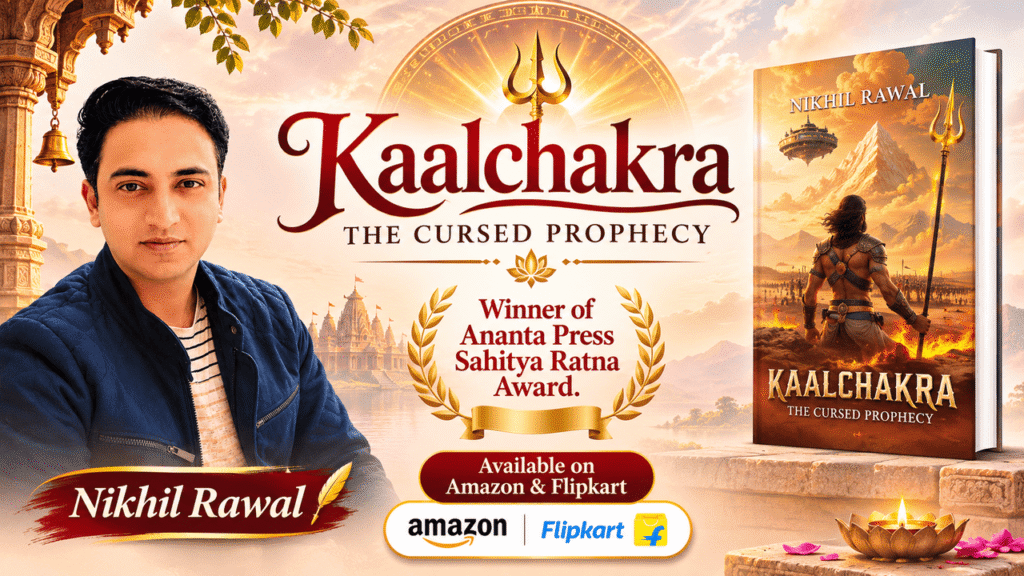
The range of settings promised by the book offers strong visual possibilities as well. The description refers to different realms and ages, opening the door to shifts in atmosphere and scale. The cover reinforces those expectations: an armored figure faces a great mountain beneath a glowing sky, with a trident-like weapon and a hovering structure contributing to an unmistakably epic composition. Distant figures and flames create the impression of a looming struggle. This is effective visual marketing for a genre that often invites readers to imagine cinematic landscapes. But cover art must be kept separate from textual evidence. It advertises a feeling and a genre; it does not establish that any particular pictured confrontation occurs in the narrative. The more substantive promise is that the journey has the conceptual breadth to support such imagery.
For readers of adventure, the book’s blending of mythological fantasy with science-fiction elements may be one of its most distinctive attractions. The ordinary-life opening helps establish a recognizable baseline, while the ancient prophecy pushes the plot into sacred and cosmic territory. The announced speculative elements signal that the author does not wish to confine the imagined universe to one familiar mode. A fantasy quest governed only by inherited magic may offer one type of pleasure; a universe that also invites questions about reality, time, and extraordinary systems can offer another. The synopsis does not identify the science-fiction mechanisms, so the degree of integration cannot be evaluated yet. The hybrid ambition nevertheless creates anticipation about what forms of wonder and danger Vishwa may encounter beyond the known world.
The author’s experience in business analysis is worth noting from the standpoint of narrative design. Long-form speculative stories demand that discoveries, motivations, and consequences remain intelligible across a large canvas. Someone professionally accustomed to tracking relationships between complex systems might bring useful instincts to such a task. That is a possibility, not proof that the novel has flawless plotting. Rawal also describes interests in reading, travel, history, and spirituality, influences that fit the scale and cultural orientation of this project. His debut appears to bring those strands together in an effort to tell an adventurous story with a recognizable philosophical identity. Whether its explanatory passages are economical, whether the transitions between ages feel seamless, and whether each supporting character has adequate depth are questions that can only be answered through close reading of the full text.
An important advantage of the chosen premise is that the hero’s origins can keep the epic conflict emotionally legible. Fantasy sometimes becomes so invested in describing the scale of its world that individual suffering disappears into statistics. Kaalchakra begins in the opposite direction. One damaged life provides the point of entry for imagining a threatened universe. As the narrative grows, the reader has a reason to translate grand language back into small human stakes. Saving creation ultimately means preserving the possibility of ordinary people living ordinary lives, even if they never know what endangered them. Vishwa’s earlier occupation makes him more than a convenient modern protagonist. It embodies the very kind of everyday existence that the conflict aims to defend.
That connection also offers a way to understand the novel’s potential appeal across generations of readers. Those who enjoy heroic fantasy may come for the prophecy, the adversary, and the discovery of extraordinary ability. Those who prefer mysteries may be attracted by questions of lineage and an ancient legacy. Readers interested in spiritual or philosophical literature may attend most closely to Dharma and fate. The story brings these expectations into contact through one protagonist. Its success as reading entertainment will depend on how well those pleasures are balanced, but the premise gives each of them a legitimate place. It does not ask its audience to choose between a human-centered journey and an epic confrontation; it proposes that one should give significance to the other.
The most persuasive way to recommend Kaalchakra – The Cursed Prophecy is therefore to call it an adventure of expanding consequence. Its central figure is not compelling because he is advertised as all-powerful, but because he is presented as a man who must discover what responsibility means when the world he understood no longer holds. Vritra raises the scale of the danger; the prophecy raises the pressure of uncertainty; the ancient inheritance raises questions of identity. Around these elements, Rawal has conceived a quest that promises wonder with moral stakes. The full novel would be needed to assess its action choreography, pacing, and narrative payoff, but the published premise supports a strong initial judgment: this is a story designed for readers who want an epic battle to matter because of the human choices made on the way to it.
AMAZON / BOOKSTORE LINK