AUTHOR FEATURE | BOOKS & LITERATURE | 2026
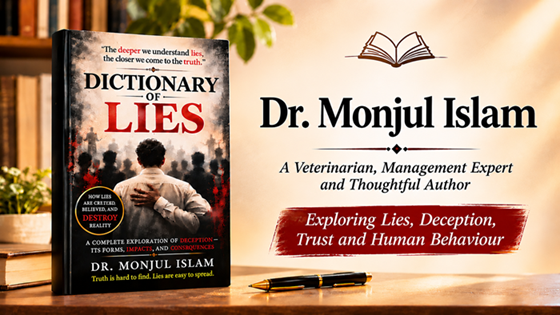
What happens when honesty alone is not enough to protect a person from deception? This thought-provoking question lies at the heart of Dictionary of Lies, a book by Dr. Monjul Islam that examines the complex relationship between truth, trust, dishonesty and human behaviour.
Published by Evincepub Publishing in September 2026, Dictionary of Lies explores how deception influences personal relationships, families, organizations, institutions and society. Moving beyond the conventional understanding of lying as merely making false statements, the book considers the emotional, psychological and social consequences that follow when trust is misused.
For Dr. Monjul Islam, writing this book was more than an intellectual exercise. As he explains in the author’s note, the idea emerged from personal experiences that encouraged him to question the nature of deception and the importance of protecting truthfulness. Rather than presenting a personal account of conflict, he transformed these reflections into a broader examination of a subject that affects people across generations and communities.
A Journey From Personal Reflection to Meaningful Writing
Every author approaches writing with a particular purpose. For Dr. Monjul Islam, the motivation behind Dictionary of Lies developed from an important realization: being truthful and honest does not necessarily prevent someone from becoming vulnerable to dishonesty.
In the book’s preface, he reflects on how painful experiences prompted him to explore why relationships change, how deception develops and why individuals sometimes accept misleading information as truth.His intention is not to encourage suspicion or resentment. Instead, he seeks to understand the circumstances that allow deception to influence human decisions and relationships.
This distinction gives the book its reflective character. It encourages readers to recognize the importance of truth while maintaining empathy, fairness and the ability to trust others.The author’s central message is that protecting truth requires awareness, responsible judgment and a willingness to examine information before accepting it.
Understanding the Many Dimensions of Deception
One of the defining features of Dictionary of Lies is its wide-ranging exploration of dishonesty.Across fifteen chapters, Dr. Islam examines deception through history, religious traditions, anthropology, psychology, philosophy, politics, organizational behaviour and modern technology.The book begins by explaining why recognizing lies is important for maintaining healthy relationships and social trust. It then explores how seemingly minor distortions can gradually develop into larger problems.
An omitted fact, an exaggerated statement or a misleading explanation may initially appear insignificant. However, when such information influences important decisions, its consequences can extend far beyond the original conversation.Dr. Islam also examines the effects of deception on vulnerable individuals, including children, older people, patients and those experiencing unequal relationships.
His discussion emphasizes that recognizing deception should not mean assuming everyone is dishonest. Instead, individuals should learn to distinguish intentional falsehoods from misunderstandings, mistakes and differences of interpretation.This balanced approach makes the book relevant to readers interested in personal development, communication, ethics and human relationships.
An Author Bringing Professional Experience to Human Questions
Dr. Monjul Islam’s background adds another dimension to his writing. A veterinarian by education and a social entrepreneur, he has worked across different organizational environments, including areas associated with management, training and institutional development.His professional interests extend to human behaviour, leadership, organizational relationships and the responsibilities that accompany positions of trust.
These interests are reflected throughout Dictionary of Lies, particularly in its examination of workplace communication, institutional accountability and the consequences of misleading information.The book discusses how dishonesty within organizations can influence decisions, damage professional relationships and weaken confidence in leadership. It also considers the importance of transparent systems, reliable records and ethical communication.
Through these discussions, Dr. Islam connects questions of personal integrity with broader professional responsibilities.His approach suggests that honesty is not simply an individual characteristic but also an essential element of healthy organizational culture.
Addressing Truth in the Digital Age
Another important aspect of Dictionary of Lies is its discussion of misinformation in the modern world.With social media becoming an important source of information, the book examines how misleading claims, manipulated images, fabricated statements and artificial intelligence-generated content can influence public understanding.Dr. Islam explores how repetition and emotional appeal can make unreliable information appear credible.Rather than suggesting that readers should distrust everything they encounter, he encourages responsible verification, critical thinking and careful communication.
The book also discusses conspiracy theories, manufactured fear and the growing sophistication of deception through technology.These subjects give the work contemporary relevance, particularly for students, educators, professionals and readers interested in understanding the relationship between technology and human judgment.
A Personal Dedication and a Wider Message
Behind the book’s intellectual exploration is a personal acknowledgment of the people who shaped the author’s values.Dr. Islam dedicates Dictionary of Lies to his late father, Hasen Ali, and his mother, Jubeda Khatun, whom he describes as his first teachers of morality.
He also acknowledges the encouragement and constructive criticism of his wife, Tahmina Yesmin, and the support of his children, Tahmid Islam and Tanisha Mahreen.These acknowledgments offer a personal dimension to a work concerned with trust, relationships and moral responsibility.Although the book examines difficult experiences and the consequences of dishonesty, its underlying message remains constructive.
Dr. Islam does not claim to provide a complete solution to deception. Instead, he invites readers to question assumptions, examine evidence, acknowledge mistakes and approach others with fairness.
Encouraging a More Truth-Conscious Society
Through Dictionary of Lies, Dr. Monjul Islam presents an invitation to reconsider how truth operates in everyday life.The book is intended for a broad readership, including students, teachers, professionals, managers and individuals interested in personal and social development.Its discussions may also provide material for conversations about ethics, communication and organizational responsibility.
For Dr. Islam, the purpose of understanding deception is not to abandon trust but to protect it through awareness and thoughtful judgment.
His writing encourages readers to recognize that the responsibility for truth does not belong exclusively to institutions or authorities. It begins with individual decisions about what to believe, what to communicate and when to seek clarification.Published by Evincepub Publishing, Dictionary of Lies represents Dr. Monjul Islam’s effort to transform personal reflection into a wider discussion about human behaviour.Ultimately, his message is both simple and meaningful: while a world completely free from dishonesty may remain beyond reach, individuals can contribute to a society in which truth is treated with greater care, responsibility and respect.