A practical and motivational review of choice, anxiety, and personal agency
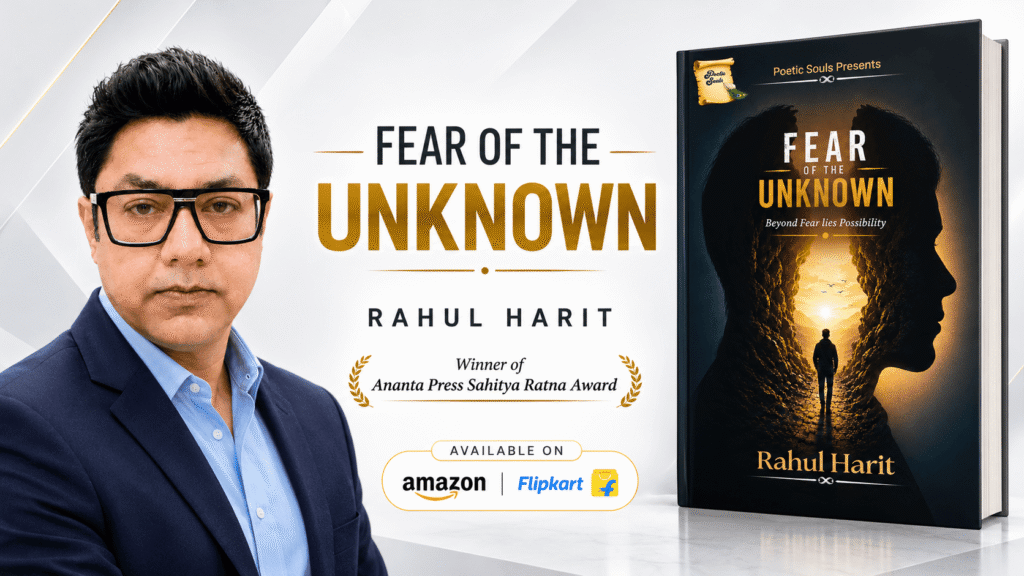
The fears that influence a life are not always dramatic. Sometimes they are small, repetitive negotiations: postponing a conversation, declining an opportunity, avoiding a new place, or assuming the worst before an unfamiliar situation has even begun. Rahul Harit’s Fear of the Unknown has an intriguing message for readers who recognize these patterns. Although its overview discusses ghosts, black magic, spirituality, and supernatural beliefs, the deeper subject is how the mind responds to what it cannot confidently explain. That makes the book relevant far beyond the category of paranormal fear. It speaks to the invisible restrictions that uncertainty can place on ordinary decisions, and to the possibility of becoming more deliberate about those restrictions.
Consider the familiar advice to “be fearless.” As motivation, it sounds inspiring; as a practical instruction, it can be unhelpful. A person cannot always switch off a response that was formed over years of experience, stories, and anticipation. Harit’s questioning approach offers a more credible starting point. Instead of demanding an immediate change in feeling, it asks readers to examine the belief beneath the feeling. Why does this possibility appear dangerous? What evidence supports that prediction? Has the fear been tested, or only repeated? This movement from command to inquiry is one of the book’s most attractive features for a self-help audience. It respects how complicated personal change can be.
Awareness is the first practical theme. We often respond to fear so quickly that we fail to notice the assumption responsible for it. An unfamiliar sound becomes a terrifying presence; a difficult decision becomes a guaranteed disaster. The moment a person recognizes the gap between event and interpretation, another option appears. They can observe the sensation without automatically obeying its explanation. This does not mean that all fears are baseless or that caution is unnecessary. The world contains real hazards. The useful skill is discrimination: learning to distinguish a specific risk supported by evidence from an imagined outcome that has gained authority mainly through repetition.
A second theme is responsibility for thought. Most people did not choose every idea they were taught as children, and they cannot erase that history on command. They can, however, begin to examine its continuing influence. Harit’s discussion of conditioning is important because it prevents self-help from becoming an exercise in blaming individuals for their fears. Beliefs develop in environments. A warning may have been offered with care, or a superstition may have been treated as undeniable truth. Recognizing the source of an idea gives the reader something constructive to do now: reconsider the assumption in the light of present understanding and decide whether it deserves to govern future choices.
This principle also applies to confidence. Confidence is often imagined as a personality trait that some people possess naturally and others lack. A more helpful definition is willingness to move forward while acknowledging uncertainty. Someone need not be certain of success to make a thoughtful decision. They need to assess the available information, accept the possibility of imperfection, and act without allowing imagination to invent endless objections. Fear of the Unknown points toward this form of courage. Its promise is not a magical removal of doubt. It is the possibility of no longer treating doubt as a command to stop. That is an encouraging proposition for students, professionals, and anyone navigating change.
The examination of superstition gives the message an additional dimension. If a person attributes every setback to an invisible force or every coincidence to an omen, they risk neglecting explanations within their reach. They may stop asking questions that could improve a situation. The book’s invitation to reason can therefore be understood as an invitation to agency. It asks readers to identify the factors they can investigate and the responses they can choose. Such thinking is especially valuable when a situation feels overwhelming. It moves attention away from imagined total powerlessness and toward limited but meaningful choices. Even a small distinction between a fact and an assumption can create room for action.
The book’s interest in spirituality and questions about God broadens this practical message. Personal growth does not happen only through productivity techniques. People also seek meaning, belonging, and ways to live with the limits of control. Harit’s framing suggests that reflection on these questions can coexist with rational judgment. A person can hold a sense of wonder or a spiritual commitment while declining to let fear settle every unanswered question. The motivational implication is significant: inner freedom may involve changing not only what we do, but what we believe uncertainty means about us. Not knowing is not automatically a weakness, and asking questions is not automatically a failure of faith.
Readers can also use the book’s central inquiry as a form of everyday self-checking. When anxiety rises around an uncertain situation, they might ask themselves three straightforward questions: What has actually happened? What am I predicting without evidence? What is one sensible step available to me now? These questions are an application of the themes described for the book, not a quoted exercise attributed to Harit. Their usefulness illustrates the practical potential of his approach. They interrupt the tendency to treat an imagined future as a completed fact. They also redirect attention from the overwhelming demand to control everything toward the manageable task of taking the next informed action.
Another noteworthy theme is gratitude. In motivational writing, gratitude is sometimes presented as a shortcut that should instantly replace discomfort. That can seem unrealistic. A more grounded understanding sees gratitude as an additional perspective, not a denial of difficulty. A person can be uncertain about the future and still recognize what is meaningful in the present. Awareness makes that recognition possible by reducing automatic absorption in catastrophic stories. The book’s inclusion of gratitude among its concerns suggests that its concept of freedom is not merely the absence of fear. It also involves the ability to notice life beyond fear: relationships, possibilities, ordinary experiences, and the value of conscious attention.
The accessible breadth of the subject is part of the book’s appeal, but it also defines how it should be approached. A reader seeking a clinical manual for a diagnosed anxiety disorder, a detailed scientific treatise, or specific treatment instructions should not assume that this reflective work fills those roles. The supplied description presents a philosophical and motivational exploration, not a therapeutic intervention. Within that frame, it has a constructive purpose: helping readers think more clearly about emotional reactions and inherited explanations. It can accompany personal reflection without pretending that every form of fear can be resolved through reasoning alone. Responsible motivation leaves room for complexity.
Harit’s unusual professional journey provides an encouraging example of crossing boundaries. From theatre and television to founding Sound Garden Studio in New Delhi, and from filmmaking to authorship, he has worked in different creative forms. A varied career does not automatically make someone an expert on psychology, but it does give context to a book concerned with perception, change, and independent thought. His work in entertainment depends on asking how an experience is shaped and how an audience interprets it. In Fear of the Unknown, the focus moves inward. The reader is encouraged to become more attentive to the stories they tell themselves, especially when those stories limit what seems possible.
The most valuable motivational insight here is that courage can be quiet. It may look like asking for evidence before repeating a frightening claim, telling someone that an old belief no longer feels convincing, or entering an unfamiliar situation with reasonable care rather than automatic dread. These actions are neither spectacular nor effortless, but they can alter the direction of a life. Fear of the Unknown stands out for taking the source of fear seriously instead of offering a superficial instruction to overcome it. The book suggests that freedom grows through a series of honest questions. For readers ready to replace passive fear with attentive choice, that is a meaningful and accessible invitation.
Amazon purchase link: https://amzn.in/d/0aluc36w