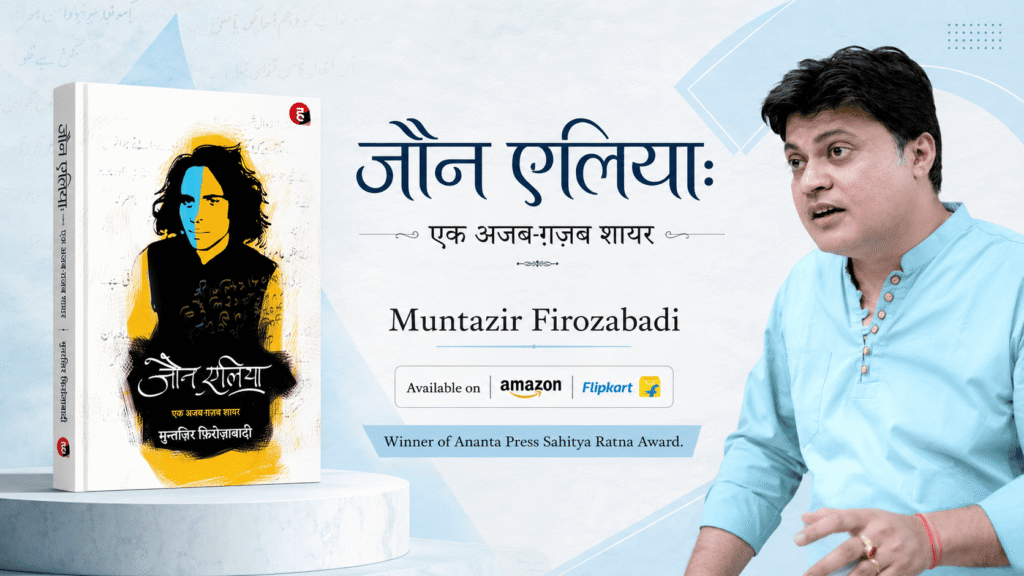
Book: Jaun Elia: Ek Ajab Ghazab Shayar | Author: Muntazir Firozabadi (Anant Bhardwaj) | Category: Poetry
A literary life can belong to more than one geography. Jaun Elia’s story—beginning in Amroha and ending in Karachi—has become one of the most evocative examples of this truth in modern Urdu literature. Muntazir Firozabadi’s Jaun Elia: Ek Ajab Ghazab Shayar is compelling not only as a celebration of an extraordinary poet but also as an act of cultural remembrance across borders. By bringing together poetic forms, biographical traces, personal anecdotes, and the idea of ‘Jauniyat,’ the book invites readers to see Jaun as part of a shared South Asian literary inheritance that resists being neatly divided by political history.
The importance of Amroha in Jaun’s biography is not merely a birthplace detail. The town has a distinguished cultural and intellectual history, and for Jaun it represented an early world of language, learning, family, memory, and identity. Karachi, by contrast, became the landscape of his later life, literary activity, relationships, and eventual burial. Between these two places lies the immense historical fact of Partition and migration. Even without turning every poem into a political document, a reader cannot entirely separate Jaun’s life from the century that moved people, languages, and memories across newly hardened borders.
Firozabadi’s book becomes meaningful in this context because it is itself part of the continuing circulation of Jaun across those borders. Readers in India remain intensely attached to a poet who spent much of his adult life in Pakistan; Pakistani readers engage with a poet whose origins lie in India. His language belongs to both and to neither exclusively. Literature here becomes a shared room that political maps cannot fully partition. The book’s Hindi-facing accessibility further expands that room, allowing readers who may not read the Urdu script fluently to participate in Jaun’s literary world.
This accessibility is crucial to the preservation of Urdu poetry in contemporary India. Many readers love the sounds, idioms, and emotional registers of Urdu without having formal literacy in its script. Transliteration, Hindi presentation, digital platforms, and mixed-language literary culture have therefore become important channels of transmission. A book like Ek Ajab Ghazab Shayar participates in this transmission by making Jaun’s poetry and personality available to a broad readership while retaining the cultural atmosphere around him.
The inclusion of ghazals, nazms, qata’at, and ‘Jauniyat’ enhances this archival function. A poet’s memory survives poorly when it is reduced to a few famous lines. The range of forms reminds readers that Jaun was a working poet with a larger body of thought and technique. The personality-focused material adds another kind of archive: stories, impressions, behavioral traits, and remembered attitudes. Such material can be difficult to preserve because it often circulates orally. Once gathered thoughtfully, it helps future readers understand why certain poems were heard in particular ways.
Of course, literary memory must avoid turning personality into mythology. Jaun’s popularity has generated many stories and exaggerations. The most productive approach is neither to worship the legend nor to dismiss it, but to understand why it formed. Firozabadi’s long-term commitment to Jaun’s life and legacy—extending into public talks, media appearances, and film work—suggests that his interest is not superficial. The book is part of a broader attempt to document and interpret a figure whose cultural presence continues to expand after death.
What makes Jaun particularly suitable for this kind of remembrance is the extraordinary overlap between his private disquiet and public reception. Readers respond to the sense that he was never fully reconciled—to society, to love, to ideology, perhaps even to himself. This restless temperament gives his poetry an emotional mobility. It can move from arrogance to self-accusation, from wit to desolation, from philosophy to intimacy. Such instability mirrors the larger historical experience of displacement in suggestive ways, even when one should resist forcing a biographical explanation onto every line.
The book’s title captures this refusal of neatness. ‘Ajab Ghazab’ is colloquial, affectionate, and slightly astonished. It positions Jaun as someone who cannot be approached with stiff reverence alone. That tonal choice is important. Literary preservation is most effective when it keeps writers alive rather than embalming them. Jaun’s memory thrives precisely because readers continue to argue with him, quote him, imitate him, laugh at his excesses, and find themselves unexpectedly moved by him. Firozabadi’s book joins that living conversation.
The author’s own biography strengthens the book’s cultural role. Muntazir Firozabadi has worked across poetry, literary events, radio, digital media, and platforms such as Rekhta. His 2018 ghazal collection Daur-e-Hazir and participation in mushairas indicate a creative relationship with the tradition he is documenting. His collaboration on the Yaad Shehar radio project likewise shows an interest in memory, storytelling, and oral transmission. These experiences allow him to address readers who may move fluidly between books, recordings, live performances, and online literature.
His planned or ongoing work on Sahir Ludhianvi, Parveen Shakir, and Shiv Kumar Batalvi is equally significant. These poets belong to overlapping but distinct cultural histories, and preserving their stories for accessible audiences helps create a broader map of modern South Asian literature. Seen in that context, Jaun Elia: Ek Ajab Ghazab Shayar is not an isolated fan project. It is one chapter in a sustained effort to bring major poetic personalities into renewed public conversation.
For readers interested in cultural history, the book’s value therefore exceeds the pleasures of quotation. It offers an opportunity to consider how literary fame travels. Jaun’s reputation was substantial during his lifetime, but his posthumous popularity has become extraordinary. Recordings, social media, literary websites, stage recitations, and intergenerational word of mouth have all contributed to this afterlife. The book captures that transition from respected poet to cultural icon and gives readers a more substantial basis for understanding it.
There is also something moving in the fact that a poet associated with displacement now circulates so freely across linguistic and national boundaries. Readers discover him in Devanagari, Urdu script, Roman transliteration, audio, video, and performance. His lines are recontextualized constantly. This can sometimes distort meaning, but it also demonstrates literary vitality. Firozabadi’s volume helps channel that vitality back toward sustained reading, where context and range can recover what isolated quotations lose.
The book is particularly suited to readers who care about the relationship between literature and memory. It asks, implicitly, what we preserve when we preserve a poet. Is it only the poems? The voice? The anecdotes? The historical moment? The contradictions? In Jaun’s case the answer seems to be all of these. ‘Jauniyat’ becomes a name for the residue that remains when text and personality have become inseparable in public imagination.
In the end, Jaun Elia: Ek Ajab Ghazab Shayar is unique because it treats literary remembrance as an active, contemporary process. It brings Amroha and Karachi into the same imaginative frame, allows poetry and personality to illuminate one another, and gives new readers a path into a shared Hindi-Urdu cultural world. Muntazir Firozabadi’s affection for his subject is evident, but the deeper achievement is preservation: he helps ensure that Jaun is encountered not as a border-bound relic or a collection of internet quotes, but as a complex poet whose voice continues to travel.
Amazon purchase link: https://amzn.in/d/09j2BZ3r