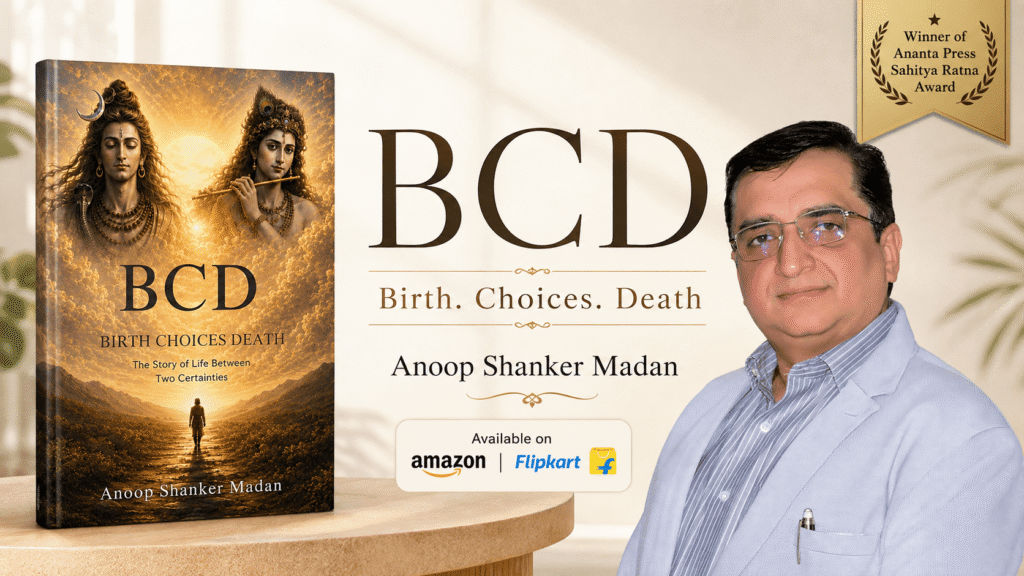
One of the most difficult tasks in nonfiction is to make a large idea simple without making it shallow. B.C.D – Birth, Choices, Death: The Story of Life Between Two Certainties by Anoop Shanker Madan succeeds because its central concept can be explained in a sentence yet expanded into a wide-ranging philosophy of everyday life. Birth is received. Death is inevitable. Choices fill the space between. The structure is almost elementary, but that is precisely its strength. It gives readers a memorable framework for thinking about questions that can otherwise become lost in abstract discussions of destiny, free will, responsibility, consciousness and meaning.
The simplicity of the title is not merely a branding device. It functions as the organizing principle of the book. Each part of the framework creates a different type of question. Birth asks us to confront what was given: our starting point, circumstances and conditions. Death asks us to confront limitation: time is finite and the physical journey ends. Choices ask us to confront participation: within the limits of circumstance and mortality, how do we think, act, respond and grow? This structure allows the book to move across many subjects without losing coherence.
That coherence matters because the book addresses a broad range of everyday themes – body, mind, emotions, relationships, discipline, fear, courage, ego, responsibility, awareness and spirituality. In a less disciplined book, these could feel like separate self-help topics. Here they are linked by one repeated question: what choices are being made, and from what state of awareness are they being made? The framework creates continuity. It helps readers see that physical habits, emotional reactions, relational patterns and spiritual practices are not separate compartments. They are different arenas in which choice becomes visible.
This makes B.C.D especially suited to contemporary readers who are surrounded by information. We live in an age of constant advice. There are endless messages about productivity, wellness, mental strength, relationships, mindfulness and purpose. The problem is no longer simply access to ideas. The problem is integration. A person may know many useful principles and still react automatically under pressure. He may understand the value of discipline and still repeat self-defeating habits. She may value peace and still carry unresolved anger into daily interactions. B.C.D addresses this gap between knowing and living.
The book’s emphasis on reflection is one of its most effective responses to that gap. Reflection asks the reader to look beneath the decision itself and examine its source. Why did I make this choice? Was I acting from fear, ego, habit, responsibility, courage or awareness? What pattern does this decision continue? What consequence is it likely to create? Such questions are simple enough to use in daily life but deep enough to expose contradictions between values and behaviour.
This is where the book’s accessibility becomes more than a matter of easy language. It is accessible because the reader can immediately apply the idea. One does not need a philosophical vocabulary to notice the difference between reacting and responding. One does not need academic psychology to recognize that repeated choices become habits. One does not need religious training to understand that stillness may create awareness and that awareness should influence action. The book meets readers at the level of recognizable experience.
Its use of Shiva and Krishna supports this accessibility. Rather than presenting lengthy theological explanations, the book draws on them symbolically. Shiva represents inner stillness and awareness; Krishna represents conscious action in the midst of responsibility. The pairing creates a clear philosophical tension that many modern readers can understand: the need to balance inward quiet with outward participation. A person who only acts may become restless and reactive. A person who only withdraws may preserve peace by avoiding the very situations in which growth is tested. B.C.D suggests that mature living requires both capacities.
The discussion of meditation and reflection develops this point further. Meditation can create calm, but reflection asks whether that calm has become understanding. If the same anger, fear or blame reappears unchanged the moment stress returns, then the peaceful experience has not yet become an integrated way of living. This is a valuable observation in an age when wellness practices can easily become consumable experiences. B.C.D does not dismiss such practices; it asks more of them. Peace should eventually appear in choices.
The book also benefits from its refusal to exaggerate the extent of personal control. This is a major philosophical strength. Much motivational writing becomes unrealistic when it implies that every outcome reflects mindset or effort. Madan’s framework begins by admitting that life includes uncontrollable conditions. Birth itself symbolizes this fact. Later circumstances, other people’s actions, social realities, accidents and loss can also exceed individual control. A philosophy that ignores this becomes fragile when life becomes difficult.
B.C.D offers a more durable form of agency. We may not control the situation, but there may still be a response available. Sometimes the response changes the situation; sometimes it only changes the way we move through it. Either way, the distinction protects the reader from both helplessness and false omnipotence. This balance is intellectually mature and emotionally realistic.
Mortality gives the framework its final dimension. Death is certain, but the book does not linger on it in a morbid way. Instead, mortality works as a lens for prioritization. What becomes important when time is understood as limited? Which grudges shrink? Which relationships become more valuable? Which postponed actions become urgent? Which ambitions still matter, and which were driven mainly by comparison or ego? Death gives seriousness to choice because it reminds us that repetition is not endless.
The book’s relevance to an age of distraction is particularly strong here. Digital life encourages constant postponement of attention. We can spend hours reacting to notifications, opinions, trends and comparisons without asking whether these activities are aligned with what matters to us. B.C.D turns attention inward without demanding retreat from modern life. It asks the reader to reclaim the small interval in which a choice is still possible.
Anoop Shanker Madan’s authorial background also aligns with this practical approach. His reflections arise from observation, entrepreneurship, decision-making and the responsibility of dealing with uncertainty and people. The resulting philosophy is not detached from consequences. Choices matter because they affect relationships, habits, trust, opportunities and the shape of one’s inner life. This gives the book a pragmatic undercurrent even when it discusses spiritual themes.
Another distinctive quality is that the BCD framework can remain useful after the book is finished. Some books depend heavily on remembering specific exercises or lengthy arguments. This one offers a compact mental model. In a difficult situation, a reader can ask: what here was given to me? What is beyond my control? What part remains open to choice? What pattern will this choice reinforce? Is my response coming from awareness or reaction? That portability is a genuine strength.
The book is likely to appeal to several types of readers. Those interested in personal growth will appreciate its focus on responsibility, discipline and habit. Readers interested in spirituality will find a grounded connection between inner stillness and action. Readers curious about philosophy will find an accessible entry into questions of freedom, mortality and meaning. Professionals and entrepreneurs may connect with its emphasis on decision-making under uncertainty. Younger readers may find the framework useful because it avoids jargon while still respecting the complexity of life.
The uniqueness of B.C.D therefore lies not in claiming to answer every philosophical question, but in giving readers a stable structure through which they can continue asking better ones. Birth, Choices and Death become coordinates. Within them, the reader can examine fear, courage, ego, relationships, discipline, awareness and responsibility without losing sight of the larger human journey.
In a culture that often rewards speed, certainty and instant reaction, this book makes a quieter argument: pause long enough to notice the choice. That pause may be the smallest unit of freedom available to us. We cannot rewrite the fact of our birth or negotiate away the fact of death, but we can become more conscious of the decisions that create the story between them. B.C.D gives that simple truth a memorable form, and its value lies in how often that form can be carried back into ordinary life.
Amazon Purchase Link: https://amzn.in/d/0136zluj