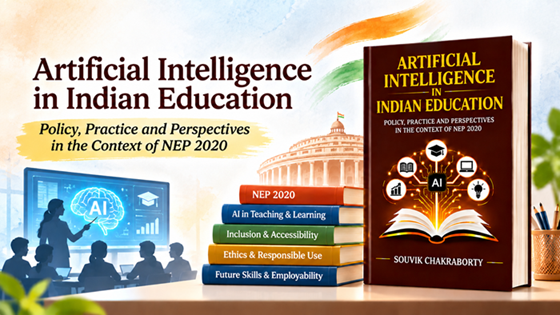
For readers trying to understand what artificial intelligence could mean for Indian classrooms, Souvik Chakraborty’s Artificial Intelligence in Indian Education offers a structured route through a complicated subject. Its full subtitle, Policy, Practice and Perspectives in the Context of NEP 2020, accurately signals the breadth of the journey. The book does not concentrate exclusively on algorithms, nor does it remain at the level of educational policy. Instead, it moves between basic concepts, everyday institutional applications and the larger decisions that educators and governments face.
The reading experience begins with orientation. The first chapter introduces AI and its development, distinguishes related technologies and explains educational uses. Readers without specialist computing backgrounds can follow the basic progression from intelligent tutoring and adaptive systems to learning analytics and content creation. The next chapters introduce the Indian education system and NEP 2020, providing context before the discussion becomes more application-focused. This ordering is a practical strength: it gives readers a vocabulary and a policy framework before asking them to consider implementation.
Teachers may find the middle chapters especially relevant. Discussions of lesson planning, assessment, student engagement, teacher support systems and professional development connect broad technological ideas with familiar educational responsibilities. The book encourages readers to consider what AI can assist with, while still asking where professional judgement remains essential. School leaders can approach the chapters on administration and institutional change with a similar interest. For university readers, sections on research, academic advising, virtual laboratories and employability extend the conversation beyond school education.
One of the most engaging aspects of the book is its willingness to widen the circle of concern. A reader interested primarily in innovative learning platforms is also introduced to rural access, multilingual education, disability inclusion and gender equity. These subjects make the book more than a catalogue of applications. They invite the reader to ask whether a proposed improvement would be available to students with different resources, needs and circumstances. The discussion of the intelligence divide is particularly useful as a way to think about the consequences of unequal access to increasingly sophisticated tools.
The later chapters introduce a more demanding set of questions. Data protection, algorithmic fairness, cybersecurity and governance may feel less immediate than automated feedback or virtual tutoring, but they are necessary to responsible adoption. The international comparison adds another layer by placing Indian discussions alongside selected approaches from five other countries. This gives readers an opportunity to distinguish general ambitions from context-specific decisions. The concluding consideration of infrastructure and future policy brings these threads back together.
Because the book covers thirteen chapters and many interconnected areas, it is better approached as a reference and guided survey than as a quick introduction to a single tool. Some sections contain terminology and policy detail that may require a slower reading pace, particularly for readers new to educational administration. Its breadth also means that not every subject receives the depth of a dedicated specialist volume. These are reasonable trade-offs for a work attempting to connect the whole landscape.
The strongest audience includes educators, teacher educators, students of education, researchers, administrators and policy-interested readers. Its value lies in helping them ask better questions about AI rather than promising effortless answers. By the end, the reader is encouraged to see educational technology as a matter of teaching practice, public responsibility and human opportunity. That makes the book a worthwhile starting point for informed discussion about the future of learning in India.
Amazon Link:https://www.amazon.in/Artificial-Intelligence-Indian-Education-Perspectives/dp/B0HQ3WC8QQ